
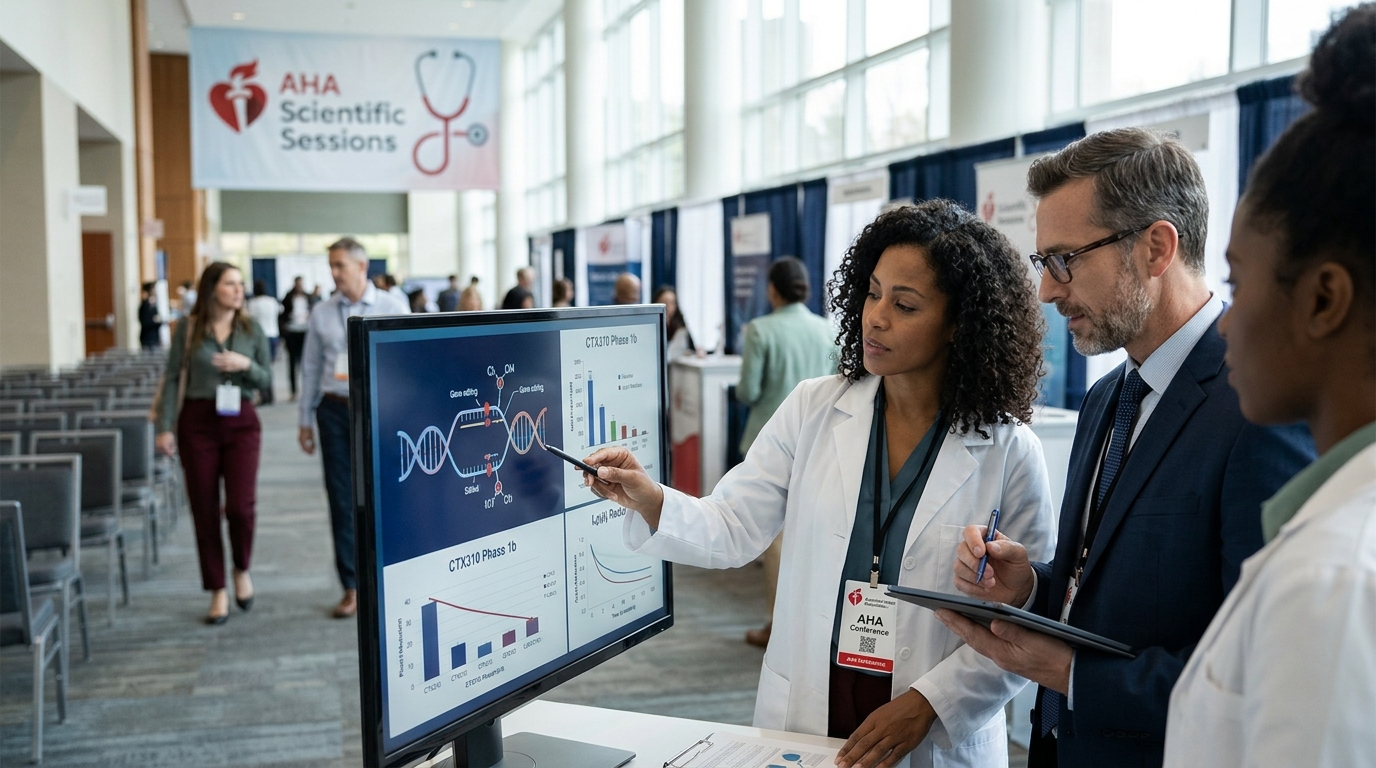
Gene editing has spent most of its commercial life solving problems that affect very few people. CASGEVY, the first approved CRISPR therapy, treats sickle cell disease and transfusion-dependent beta thalassemia, conditions measured in thousands of patients. Monday morning at the American Heart Association Scientific Sessions changes the scale of the conversation entirely.
Phase 1b data for CTX310 in patients with severe hypertriglyceridemia will be presented in a late-breaking oral presentation at AHA Scientific Sessions on November 9, 2026, in a 8:00 a.m. to 9:15 a.m. CT session. The same 75-minute session also includes first results from Eli Lilly’s ATTAIN-OSA trial of orforglipron in sleep apnea, and TYDAL-TIMI 78 on an ANGPTL4 antibody. For investors, the CTX310 readout is the one worth orienting around. Here is why.
What CTX310 Actually Does
CTX310 is a lipid nanoparticle-delivered CRISPR/Cas9 therapy designed to precisely edit the ANGPTL3 gene in hepatocytes following a single-course IV administration. Loss-of-function mutations in ANGPTL3 are associated with significantly reduced levels of LDL and triglycerides, as well as reduced risk of atherosclerotic cardiovascular disease, without known adverse health effects. The therapy is essentially trying to replicate that natural mutation in patients who didn’t inherit it.
A single course of CTX310 produced deep and durable reductions in circulating ANGPTL3, triglycerides, and LDL that were sustained through one year of follow-up. At the highest dose, mean reductions from baseline were 79% in ANGPTL3, 48% in triglycerides, and 53% in LDL-C. Those are Phase 1a results that CRISPR Therapeutics presented at the ESC Congress in August 2026. The Phase 1b data dropping Monday focus specifically on the severe hypertriglyceridemia cohort, a harder patient population with fewer existing options.
The Scale Problem That Editing Has Never Solved
Rare disease works because pricing power compensates for small patient volumes. Cardiovascular disease does not offer that trade-off. In the U.S., tens of millions of adults have elevated cholesterol or elevated triglycerides. Even a fraction of that is a commercially meaningful number, but it also means payers will resist premium pricing and competitors will emerge.
This is where the business question gets interesting. Statins work and cost pennies. PCSK9 inhibitors work better and have struggled commercially for years because of their cost and injection burden. A one-time gene edit, if durable, eliminates the adherence problem entirely. It also creates a different reimbursement debate: a single infusion priced like a gene therapy versus a lifetime of monthly prescriptions. RMAT designation, which CRISPR Therapeutics said the FDA granted CTX310 for both severe hypertriglyceridemia and elevated LDL-C in early November 2026, provides the benefits of Fast Track and Breakthrough Therapy designations, including early FDA interactions and potential eligibility for priority review and accelerated approval. That is regulatory momentum, not a commercial strategy.
Lilly’s Orforglipron Side of the Session
ATTAIN-OSA was developed to evaluate the efficacy and safety of oral orforglipron in adults with moderate-to-severe obstructive sleep apnea, structured as a master protocol with two multicenter, randomized, double-blind, placebo-controlled Phase 3 studies. Prior randomized trial data with GLP-1 medicines have shown that substantial weight loss can improve obstructive sleep apnea severity, and many observers expect ATTAIN-OSA to read out positively. Lilly already has orforglipron approved for obesity under the brand name Foundayo since April 1, 2026, so a sleep apnea win extends the label rather than creates a business from nothing.
The more consequential question on the Lilly side is competitive positioning. The rationale for orforglipron in sleep apnea is that GLP-1-class weight loss can reduce upper-airway collapsibility in many patients, largely through weight loss and reduced upper-airway adiposity. If orforglipron delivers apnea-hypopnea index reductions comparable to tirzepatide in a once-daily pill with no food or water restrictions, that is a convenience argument that could matter to a very large U.S. sleep apnea population.
What Long-Term Investors Should Watch
For CRISPR Therapeutics specifically, Monday is less about a single data readout and more about proof of concept for an entirely different business model in biotech: one-time cardiovascular treatments for common disease. The company has already pivoted from research-stage to commercial-stage with CASGEVY, the world’s first approved CRISPR therapy. CTX310 would be the second chapter, and a far larger addressable market.
The honest risks are significant. Durability beyond one year in sHTG patients remains unproven at scale. Manufacturing LNP-delivered gene editors at commercial volumes is not solved. And payer willingness to cover a five-figure or six-figure one-time treatment for a condition that statins partially address is genuinely uncertain. These are reasons a disciplined investor waits rather than extrapolates from Phase 1b into a price target.
What cannot be ignored is the direction. If Monday morning’s data confirm durable lipid lowering in the specific sHTG cohort, with a clean safety profile, CRISPR editing stops being a specialty medicine and starts being a cardiovascular platform. That is the question the AHA session addresses on Monday, November 9, 2026, starting at 8:00 a.m. CT.