One Asset Gained 2,300%
The Last Time This Setup Happened
Here’s What It Was
Dear Reader,
From 1970 to 1980, one specific asset gained more than 2,300%.
That’s not a typo. A $10,000 investment became $230,000 in a decade.
And here’s why we’re bringing it up right now.
The exact same conditions that produced that gain in the 1970s are forming again today.
Stagflation. The toxic combination of high inflation AND a stalled economy. The 1970s version trapped the U.S. economy in a vise for nearly a decade. Stocks went sideways for 10 years. Bonds got crushed. Cash lost half its value.
Now look at where we are:
Inflation expectations spiked to 4.8%. JP Morgan and Moody’s are warning of recession by 2026. Oil is surging on Middle East tensions. And the Fed is trapped – cut rates and inflation worsens, hike rates and recession arrives faster.
The setup is identical.
Now we know what you’re thinking. “That was 50 years ago. It can’t happen again.”
The smartest money in the world disagrees.
Central banks are loading up on the same asset that gained 2,300% in the 1970s – at the fastest pace in 50 years. JP Morgan is forecasting it could hit $8,000 before this cycle ends.
You’re going to make a decision today whether you realize it or not.
Position before stagflation locks in. Or watch from the sidelines while the same trade plays out again.
Because once the trap closes, getting out gets expensive.
Microchip’s 42% Growth Wasn’t Enough. What to Do Now.
Hey there, bargain hunter. Microchip Technology just handed the market a beautiful quarter and got punished for it. That is exactly the kind of moment worth pulling apart.
Scoreboard
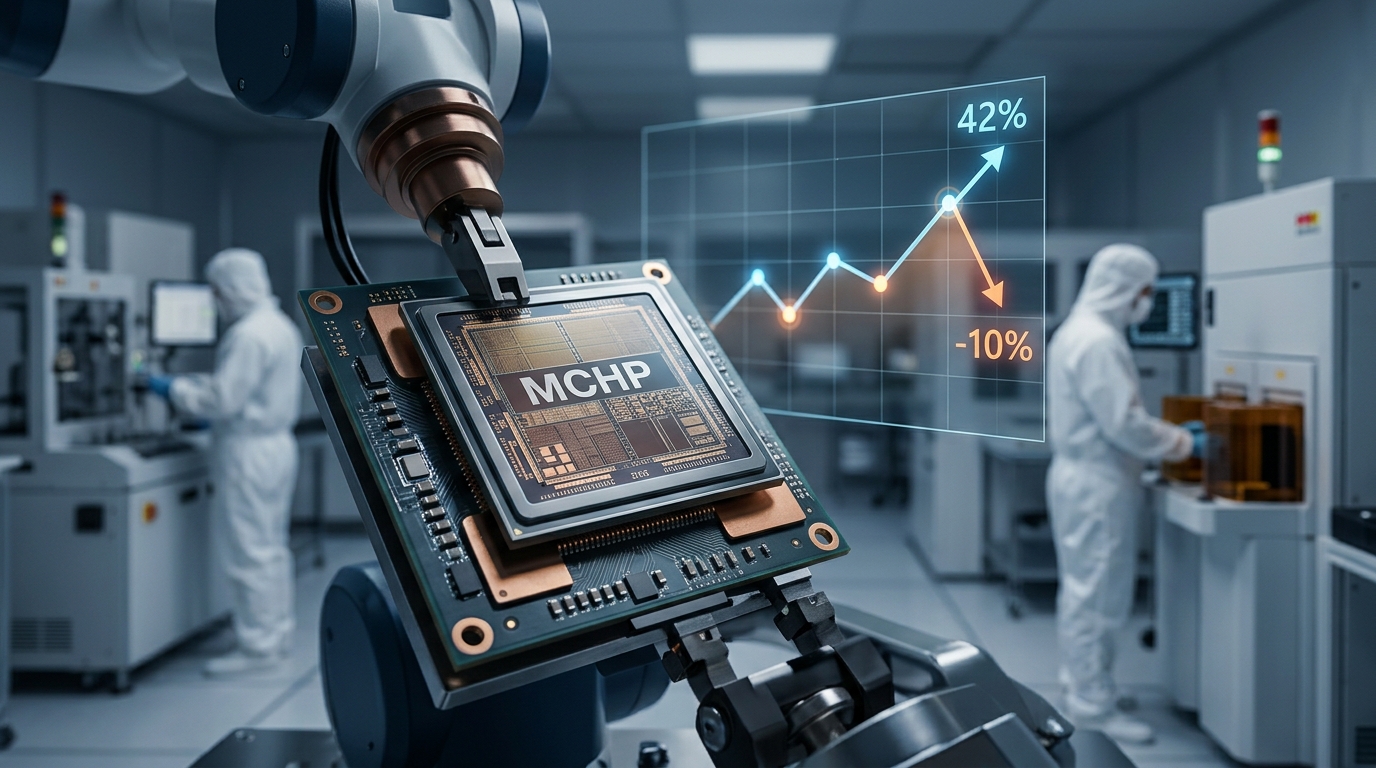
MCHP posted Q2 fiscal 2027 net sales of $1.622 billion, up 9.2% sequentially and 42.2% year over year. Non-GAAP gross margin reached 66.5%, expanding 980 basis points year over year. EPS came in at $0.97, beating the company’s prior non-GAAP EPS guidance range of $0.91 to $0.95. The stock fell 13.9% on Thursday, November 5, 2026, then slid another 10.0% on Friday, November 6, 2026.
What Actually Happened
The headline beat was real, but partially artificial. The company said the quarter included about $53 million in infrequent revenue items: about $21 million from the effect of a pricing change on inventory in the distribution channel, $22 million of patent licensing revenue above what it expects in the December quarter, and a $10 million benefit from a long-term customer contract. Because licensing has no associated cost of sales, those dollars can lift gross margin hard. Strip that out, and the underlying quarter is still strong but not quite as pristine as the 66.5% margin implies.
December quarter guidance calls for net sales down 3% to up 1% sequentially, with non-GAAP gross margin of 64% to 65% and non-GAAP EPS of $0.87 to $0.95. The market read that as a miss and sold first.
The Real Reason
Here is the pivot that changes the entire frame: this is not an inventory problem. Microchip reported a shift in the business environment from broad customer inventory digestion to lengthening lead times and supply constraints across several product lines. That is a fundamentally different animal than the demand hangovers that plagued the analog chip group through 2024 and into 2025.
CEO Steve Sanghi said lead times have stretched to as long as 32 weeks due to foundry, OSAT, and internal capacity constraints. The company said it has substantial unsupported backlog on high-margin products that its supply chain cannot fulfill. Orders are there. The capacity is not. That is a problem with a solution, not a symptom of weakening demand.
Supply constraints punishing strong operators are not unique to microcontrollers. Vertiv posted 61% revenue growth the same week and saw its stock fall 14% on capacity and execution concerns.
Business at a Glance
Microchip makes microcontrollers, analog semiconductors, and connectivity products. It sells into industrial, data center, aerospace and defense, and automotive markets. The model is sticky: deeply embedded chips that customers design around for years. On the earnings call, management said that from the September quarter 2025 to the September quarter 2026, net sales from industrial grew 50.3% and data center grew 55.7%.
Key Numbers
- Non-GAAP operating expenses: 27% of sales; operating income: 39.5% of sales.
- December quarter dividend declared at 45.5 cents per share.
- Management described lead times widening to roughly six to 32 weeks, and said the March quarter backlog is better than December’s was at the same point.
Is It Cheap?
Not on trailing earnings. The TTM multiple is elevated because the cycle trough wiped out near-term profits. On a forward basis, the picture is more interesting. Some widely followed consensus snapshots put Microchip’s average 12-month price target in the low-to-mid $90s. On valuation, forward multiples move daily and depend on which estimate set you use, but Microchip screens closer to the low teens on some data services after the two-day drop. The important question is whether December is the seasonal valley or the start of something worse.
Bull / Base / Bear
Bull: Management said orders exceeded shipments, and that the March quarter backlog is stronger than December’s was at the same point. If supply loosens by spring, revenue and margin both re-accelerate from a higher base, and those $90-plus targets stop looking aspirational.
Base: December is flat to slightly down sequentially, March bounces, and the stock grinds higher as the supply situation normalizes through mid-2027. No fireworks, but steady.
Bear: Lengthening lead times can create a supply-demand mismatch that sometimes ends in order cancellations or customer loss if unmet demand persists. If constrained products slip quarters repeatedly, margin guidance steps down again and the stock revisits the low-50s.
Action Plan
The two-day drop created a real entry point, not a screaming one. If you have no position, consider building a half-sized one at current levels and waiting for the December quarter update in February before adding the other half. The company said it completed acquisitions of Hailo on September 17, 2026 and Vorago Technologies on October 8, 2026, which adds small revenue but meaningful optionality in defense and edge AI.
Cheap Investor Checklist
- Revenue growth sustained above 30% year over year in December quarter?
- Non-GAAP gross margin holds at or above 64% in December?
- March quarter backlog converts to formal upside guidance in February?
- Lead times peak and begin compressing by Q1 2027?
- Analyst consensus target stays above $85 as targets reset?
- No further infrequent revenue items distorting Q3 comparisons?
Bottom Line
If supply constraints ease and the March quarter confirms what the backlog is signaling, MCHP at these levels will look like the obvious buy. If constraints drag into spring and backlog starts canceling, the decline has more room. The business is not broken. The quarter was not a disappointment. The guide was messy, and messy created an opportunity. Watch the February call like a hawk.