
October 26, 2026
Bonus Content: Novartis’s MS Pill Missed the Bar. Is It a Buy?
Editor’s Note: You may recognize Marc Chaikin’s name from his appearances on CNBC, Bloomberg, or Fox Business. His client list has included billionaires such as Paul Tudor Jones, Steve Cohen, and George Soros. His Power Gauge system flashed bullish on Nvidia right before it rose 50,001%. And it just flashed bullish on another off-the-radar AI stock poised to trigger a $248 trillion “White Swan” event as soon as November 16. See below for Marc’s research and free recommendation.
Dear Reader,
The AI game is changing.
New leaders are emerging quickly.
And I can assure you: My research shows Nvidia will NOT be the #1 AI stock of 2027.
I say that with confidence because my Power Gauge system pinpointed Nvidia before it delivered 50,001% gains.
And now it’s pointing to an entirely different AI stock…
One almost no Americans have heard of yet…
But given the data I’m seeing right now…
Given the massive data center crisis facing America…
I can confidently say: This company stands to dominate the AI landscape in 2027.
Why? It’s about to launch an entirely new kind of AI data center…
One that solves every major problem facing data centers today.
This next-gen data center uses 99% less electricity than Elon Musk’s Colossus, for example…
It takes up 99% less space…
Yet this company’s new data center will be over 1,000 times more powerful than the biggest data center on earth right now (Elon Musk’s Colossus, in Tennessee).
Even better, the company supplying the tech just triggered a “bullish” signal in my Power Gauge…
Now, it’s about to bring this device to life with the flip of an “on switch.”
I anticipate a major announcement on or before November 16, when the company unveils its latest technology at the TERATEC Forum in Paris.
The time to get in is right now – before any potential news goes public.
That’s why I’ve created this brand-new presentation, revealing everything you need to know.
Not only do I explain how today’s data centers are in danger of a massive $250 trillion disruption…
Which I’m calling the AI White Swan of 2027…
I reveal the name and ticker symbol of my latest recommendation for FREE, toward the end of the presentation.
If you want the chance to make money on AI going forward, I urge you to check it out now.
Sincerely,
Marc Chaikin
Founder, Chaikin Analytics
Novartis’s MS Pill Missed the Bar. Is It a Buy?
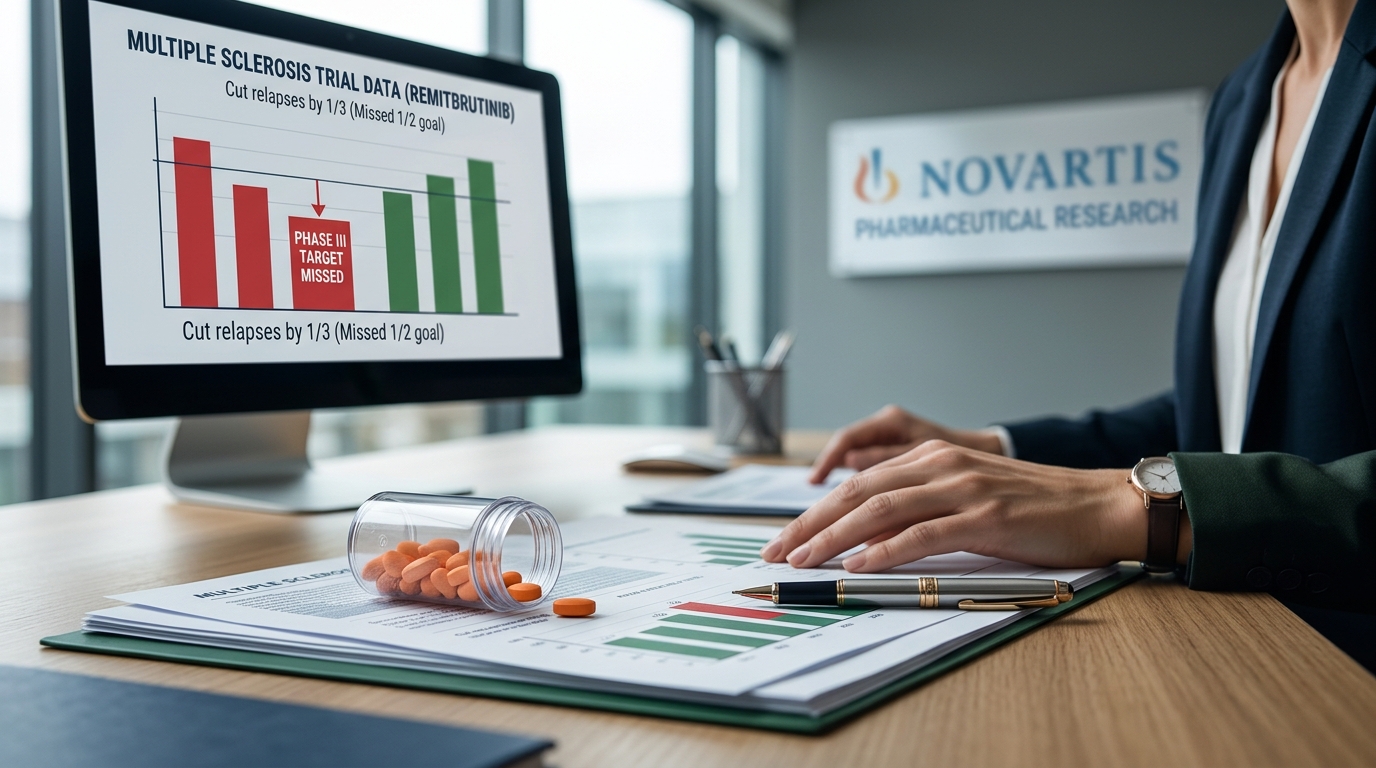
Hey there, bargain hunter. On October 23, Novartis dropped 3.3% in a single session, closing at $151.12. That move erased roughly $10 billion in market value from a roughly $295 billion company. The culprit: detailed Phase III trial data for remibrutinib, the oral multiple sclerosis pill Novartis has been pitching as a future blockbuster.
Scoreboard
NVS: -3.3% on October 23, closing at $151.12. Fifty-two-week range: $121.57 to $170.46. The stock sits roughly 11% below its February high and about 8% off its early-September peak.
What Actually Happened
Remibrutinib met its primary endpoint. Both REMODEL-1 and REMODEL-2 cleared the bar for statistical significance, reducing annualized relapse rates by 35.2% and 31.2% versus teriflunomide, an older oral therapy sold by Sanofi as Aubagio. Novartis says that translates to roughly one relapse every 13 years for treated patients. The safety read was clean: no liver signal, no Hy’s Law cases, and fewer treatment discontinuations than the comparator.
The problem was the number. Analysts had penciled in a 45% to 60% reduction. Remibrutinib came in at 31 to 35. That same week, Roche highlighted a 55% relapse reduction for its rival BTK inhibitor fenebrutinib in pooled Phase III data. The efficacy gap landed badly with the market.
The efficacy gap also sharpens a broader competitive dynamic. Large pharma companies facing patent cliffs have been deploying capital aggressively to acquire clinical-stage assets that can close exactly these kinds of efficacy gaps.
The Real Reason the Shares Fell
This was not a drug failure. It was a relative positioning failure. The BTK inhibitor class needed to prove it belongs above anti-CD20 therapies like Ocrevus and Kesimpta, Novartis’s own existing MS treatment. A 30-plus percent relapse reduction versus an older oral pill does not make that case on its own. Roche’s fenebrutinib, under FDA priority review since September 30, 2026, now holds the efficacy lead. The market is recalibrating how much of that projected $4 billion-plus in peak remibrutinib sales actually materializes if Roche gets there first with stronger relapse numbers.
The safety angle is not nothing. Roche has flagged higher liver enzyme elevations versus comparator in its program, while Novartis has emphasized no liver safety signal for remibrutinib in REMODEL. Some analysts argued before the data that if fenebrutinib required liver monitoring, Novartis’s cleaner profile could ultimately win market share anyway. That thesis is still alive, but it now requires more patience than the initial data suggested.
Is It Cheap?
NVS trades at about 14.7x forward earnings. Johnson & Johnson trades closer to 40x trailing earnings, and GSK, a closer European comp on valuation, sits lower than most US peers. Roche trades below many US peers as well. European pharma carries a structural discount to US peers, often framed in the 20% to 30% range by sell-side and strategy research, driven by fragmented regulatory timelines and lower reimbursement rates. Novartis generated $54.5 billion in 2025 net sales, up 8% in constant currency. The remibrutinib setback is one asset in a broad portfolio that also includes Cosentyx, Kisqali, and Kesimpta.
Bull / Base / Bear
- Bull: Remibrutinib’s clean safety profile wins the label and becomes the prescribers’ choice for patients where liver monitoring is a concern. Novartis files in the US by year-end, and the $4 billion-plus peak sales estimate holds in a two-drug BTK market.
- Base: Fenebrutinib takes the efficacy-first patient segment. Remibrutinib carves out a niche among patients who cannot tolerate hepatic risk, generating $1.5 to $2 billion at peak. NVS trades sideways through approval, with the rest of the portfolio carrying the growth story.
- Bear: Regulators and physicians side with efficacy over safety, fenebrutinib dominates, and remibrutinib launches to a narrow label. Pressure from Entresto post-exclusivity erosion in the US and prior setbacks in pelacarsen and del-desiran pile on. The stock retests its 52-week low near $121.
Action Plan
Do not chase the selloff as a binary remibrutinib bet. The stock’s case rests on the full portfolio, not one pill. A starter position at current levels, with the European pharma discount as your cushion, is defensible. Add on confirmation that the US filing lands by year-end and hold for the regulatory decision. If fenebrutinib’s liver monitoring requirements harden in FDA labeling, remibrutinib’s safety advantage becomes a genuine commercial differentiator. Trim only if the US filing slips into 2027 or if the FDA signals an efficacy-only review standard for the BTK class.
Cheap Investor Checklist
- US regulatory filing by December 31, 2026 (any priority review mechanism clarified)
- Fenebrutinib FDA label: does it carry a liver monitoring requirement?
- Remibrutinib peak sales guidance: does management maintain the $4 billion-plus target at Q3 earnings?
- Entresto post-exclusivity erosion and revenue offset from Cosentyx/Kisqali
- NVS forward P/E vs. JNJ and Roche: does the discount narrow on approval news?
- Disability progression data: whether 3-month confirmed disability progression holds up cleanly across analyses
- Ocrelizumab switch study readout: key to the high-value patient segment
Bottom Line
If fenebrutinib picks up a liver warning and Novartis files on schedule, remibrutinib’s safety story gets its commercial test. If the FDA treats 50-plus percent relapse reduction as the class standard and Roche’s liver signal clears without restriction, remibrutinib is worth considerably less than its $4 billion-plus ceiling. At around 14.7x forward earnings with a 20-plus percent European discount baked in and a diversified portfolio running at 8% constant-currency growth (most recently reported on 2025 sales), NVS is not expensive for the downside scenario. The question is whether you are willing to wait for the label to tell you who wins.