
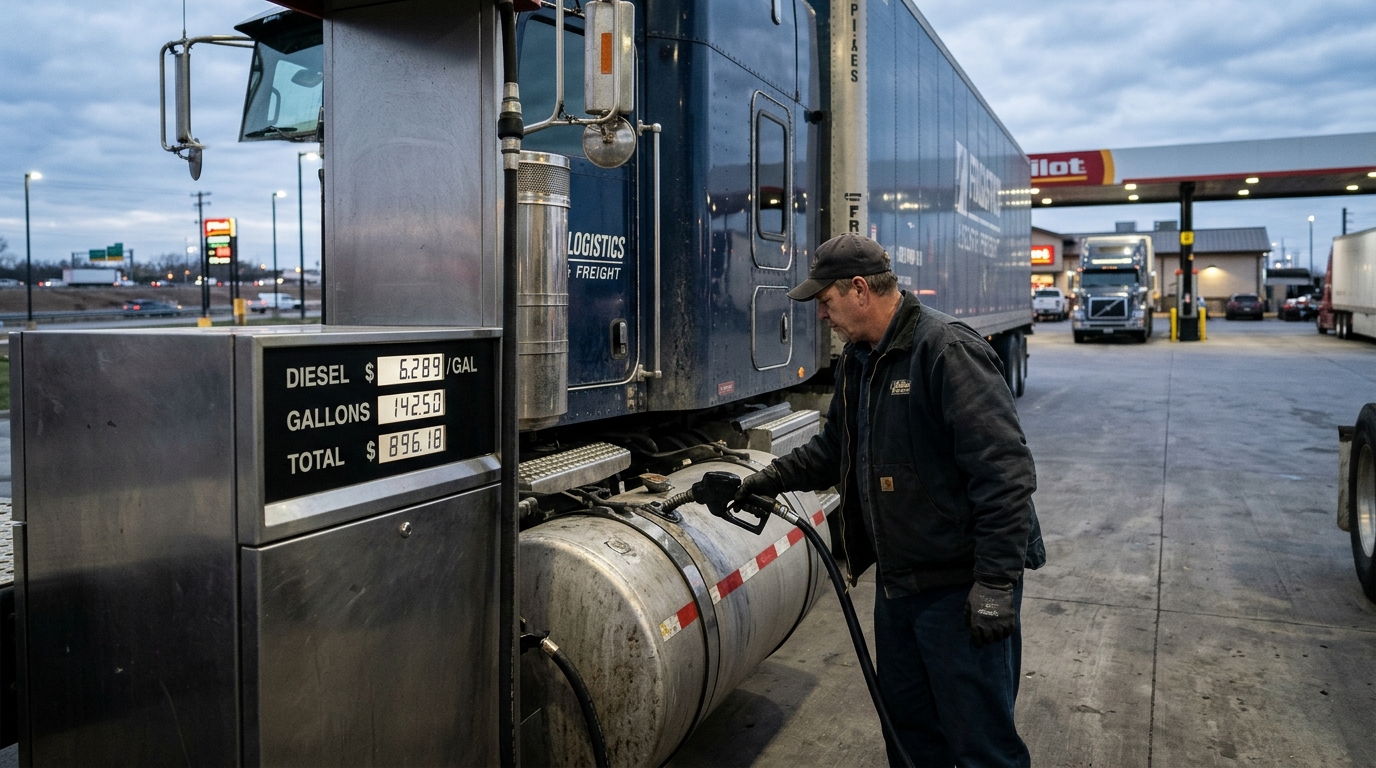
Most investors watch crude. The market’s real pressure point this week is diesel, a fuel that touches every freight bill, every grocery shipment, and every home heating tank in the Northeast, and it is not behaving like a problem that emergency reserves can solve.
What the Numbers Actually Say
The U.S. Energy Information Administration’s October 19 survey put the national average pump price at $6.276 a gallon. Before September 2026, the national average for diesel had never surpassed $5.816. A year ago it was $3.62. That is not drift. That is a structural shift in the fuel that runs American commerce. NYMEX ultra-low-sulfur diesel futures closed October 19 with the diesel crack against WTI at $100.97 a barrel. On October 20, the diesel crack stood at $113.24 against WTI.
East Coast distillate stocks fell to 21.0 million barrels in the week to October 16, their lowest level in the weekly record. New England fell to 2.46 million barrels. The heating season has not begun in earnest. When it does, that regional deficit stops being a trucking cost story and starts being a household emergency.
Why the IEA Release Changes Little
The IEA agreed on October 16 to accelerate the release of around 100 million barrels of emergency oil stocks still pending from its March 2026 collective action tied to the Strait of Hormuz crisis, including over 20 million barrels of diesel as soon as possible. The market’s verdict was blunt. Saxo Bank analyst Ole Hansen said the reaction reflected disappointment over the lack of a firm commitment to release additional barrels immediately. The statement did not specify a 20 million barrel diesel cap, and it did not confirm earlier press speculation about a larger diesel-only release.
The strategic reserve itself offers little comfort. The U.S. Strategic Petroleum Reserve held 282.7 million barrels in the week ending October 16, its lowest level since 1982, down about 132 million barrels from roughly 415 million in late March 2026. Washington is deploying a cushion it cannot easily rebuild.
What the Market May Be Missing
The transmission from diesel to the broader economy is faster and wider than the headlines suggest. Unlike gasoline, diesel plays a central role in transporting goods, operating agricultural equipment, and keeping supply chains running, meaning its rising cost can spread through the economy long after the initial energy shock. Old Dominion Freight Line’s fuel surcharge, keyed to the DOE diesel index, stands at 53.32% for the week running Wednesday, October 28 through Tuesday, November 3. A year ago that surcharge averaged about 27 percent. Every shipper in the country absorbing that increase is either compressing margin or passing costs forward, and the clock is ticking on which choice dominates.
Goldman Sachs has flagged that food prices could increase further if diesel prices prove persistent, because farmers purchase fuel disproportionately in the fall during harvest season and often buy fuel in winter for storage. The Dallas Fed put it plainly in its Beige Book contribution: “The higher price for diesel reigned supreme in terms of the most commonly cited factor driving up costs, impacting freight, agriculture, and airline prices as well as causing widespread margin compression across numerous industries.”
Where It Shows Up
The clearest beneficiaries are the refiners. Valero posted adjusted earnings of $23.90 per diluted share for Q3 2026, with refining margin per barrel rising to $39.24 from $13.14 a year earlier. That crack spread widening powered the refining segment to $8.774 billion in adjusted operating income from $1.665 billion in Q3 2025. Phillips 66 reports October 28 and Marathon Petroleum follows November 3. Both face the same favorable margin environment, though the risk of crude cost increases squeezing spreads is live.
The pressure runs the other direction for freight carriers. Fresh data showed airline fares about 22 percent above their year-ago level, while the index tracking truck freight charges was more than 19 percent higher than a year earlier in September, the steepest increase in over four years. Union Pacific, Old Dominion, and J.B. Hunt each face a customer base scrutinizing fuel surcharges at levels not seen in their operating histories.
Risks and Counterpoints
The IEA has said constrained middle distillate supplies are likely to persist well into 2027. The bull case for diesel prices holding up is straightforward: structural supply destruction from the Hormuz crisis, depleted reserves on both sides of the Atlantic, and a heating season that has barely started. The counterargument is that demand destruction is real. At $6.28 a gallon, discretionary trucking activity slows. Retailers and manufacturers absorbing surcharges above 50 percent begin to consolidate shipments. The EIA expects normalization in global oil markets and wider availability of distillate fuel next year to help lift East Coast inventories into late 2027, but that path assumes demand and trade flows do their part. They might, eventually.
What to Watch Next
The Fed’s October 27 to 28 meeting takes place against a backdrop of unusually conflicting economic signals. Markets were pricing roughly a 37% chance of a rate hike after September CPI came in at 3.7% year over year, far above the Fed’s 2% target. A fuel shock feeding into core services inflation is the mechanism that turns a transitory commodity spike into a policy problem. The EIA weekly petroleum report, due Wednesday, October 28, will show whether East Coast distillate stocks have fallen further below that October 16 low. Phillips 66 earnings on Wednesday and the first cold-weather forecast for the Northeast are the two catalysts most capable of moving this story before the weekend.