
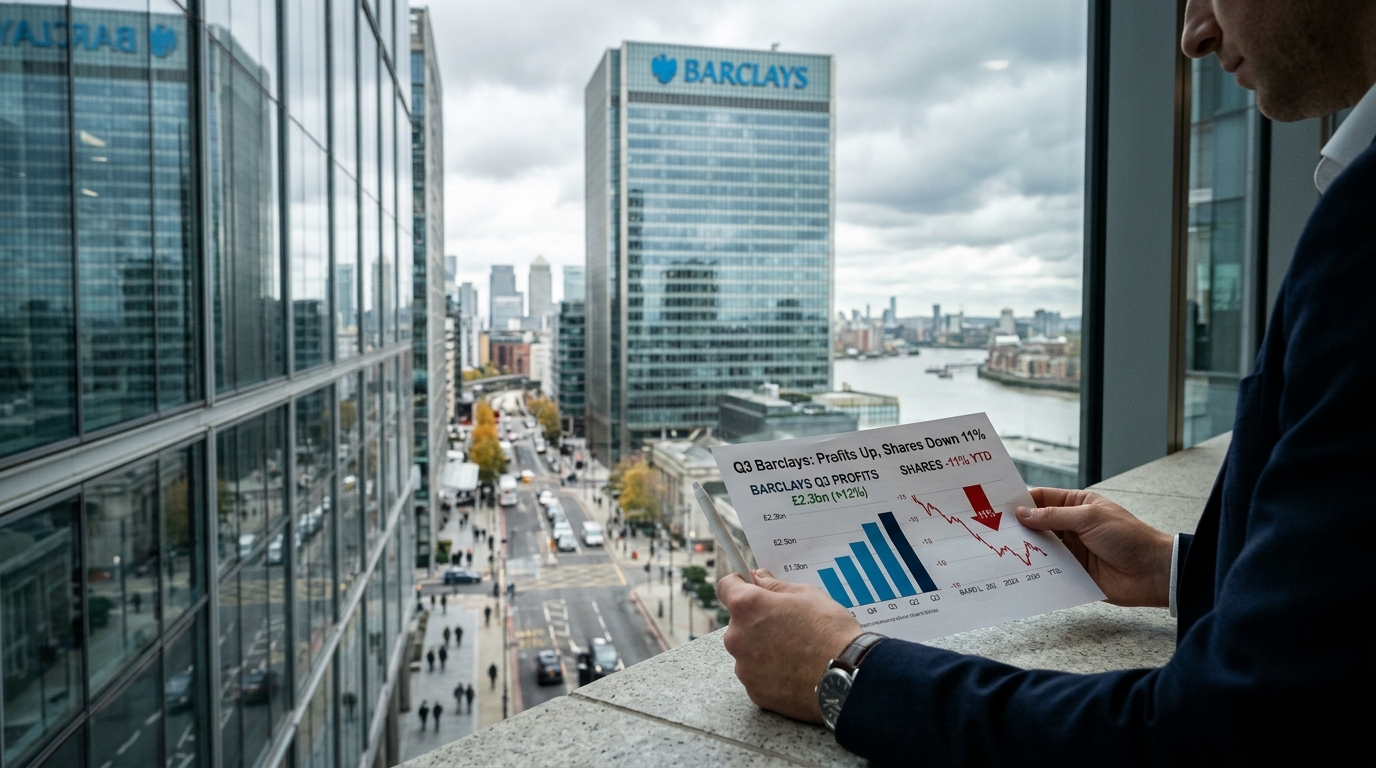
Hey there, bargain hunter. Barclays just reported its best quarterly momentum in years, handed you a fresh £500 million buyback, and the shares are still down 11% on the year. That gap between performance and price is exactly the kind of thing we exist to interrogate.
Scoreboard
Pre-tax profit in Q3 came in at about £2.3 billion, up 12% from about £2.1 billion in the same quarter last year. Income rose 3% to £7.4 billion, helped by net interest income excluding the investment bank and head office, which climbed 7% to £3.5 billion on higher structural hedge income and continued lending growth. Costs rose just 1% to £4.6 billion, pushing the cost-to-income ratio to 62% from 63%, while credit impairment charges fell 20% to £0.5 billion.
What Actually Happened
The roughly £2.3 billion result was in line with the low end of expectations, Reuters reported the number was just in line with the average analyst forecast of about £2.4 billion. So profit landed at the low end of expectations on income that came in below consensus. Equities were the standout, up 47% year-on-year, while FICC fell 19%. The investment bank held its own; it was the revenue miss, not profit quality, that gives bears something to chew on.
What the Market Is Really Saying
The share price discount is not about this quarter. It is about what comes next. Two clouds are parked directly over the stock.
First, the probe. Reuters, citing a Financial Times report, said the Bank of England is examining whether Barclays traders misrepresented illiquid private credit-linked exposures in a way that could understate risk. The complaint centres on Barclays’ allocation of total return swaps referencing illiquid private credit loans to its trading book rather than its banking book, where such exposures would ordinarily attract higher capital requirements. The allegations have not been proven, and no regulatory finding has been announced. But the word “misrepresented” is already in the headlines, and that costs something.
The private credit exposure at the centre of the probe is not a Barclays-specific quirk. Investor anxiety about illiquid private credit structures has been building across the industry’s largest managers.
Second, the Budget. Reuters reported that Chancellor John Healey has kept options open on raising the bank profit surcharge ahead of his October 28 Budget, with analysts flagging a possible return to the previous 8% level from 3%. Some analysts have estimated that an 8% surcharge could shave about 6% off lenders’ earnings.
The surcharge decision does not sit in isolation. Rising gilt yields have already compressed Chancellor Healey’s fiscal headroom ahead of the October 28 Budget, shaping how much room he has to move on bank taxation.
Is It Cheap?
- EPS rose 18% to 12.3 pence; return on tangible equity reached 11.7%, up from 10.6% a year earlier.
- Year-to-date distributions reached £2.8 billion, up 46%.
- The bank is on track to exceed 12% RoTE for 2026 and has reaffirmed its 2028 target of returns above 14% and more than £15 billion of capital returns over 2026 to 2028.
- The CET1 ratio sits at 14.2%, well above minimum requirements, giving it room to keep buying back stock.
The discount is real. The question is whether the Budget and the probe together justify it. A roughly 6% earnings hit from a surcharge reversal would dent but not break the RoTE trajectory. The probe, if it results in forced reclassification, hits capital ratios and future buyback capacity. That is the harder variable to price.
Bull / Base / Bear
Bull: Budget lands as a clearing event, the probe fades without a finding, and the 2028 targets anchor a rerating toward peers.
Base: Surcharge rises to 8%, knocking earnings modestly; probe drags as an overhang but resolves without capital penalties. Shares trade sideways through Q4.
Bear: BoE supervisors force reclassification of some private credit-linked derivatives out of the trading book, capital ratios compress, buyback capacity shrinks, and the Budget hits simultaneously.
Cheap Investor Scorecard
- Pre-tax profit growth: 12% year-on-year. Pass.
- Cost control: ratio improved to 62% from 63%. Pass.
- Credit quality: impairments down 20%. Pass.
- Capital: CET1 at 14.2%. Pass.
- BoE probe: open, unresolved. Watch.
- Budget surcharge: decision due October 28. Watch.
- Buyback capacity: £15bn+ committed over 2026-2028. Pass.
- YTD share performance: down 11%. Potential opportunity or value trap. Verdict pending.
Bottom Line
If the October 28 Budget acts as a clearing event and the BoE review resolves without a capital penalty, Barclays at an 11% discount to its January price looks too cheap against 12% profit growth and a £2.8 billion distribution year. If the surcharge hits and the review turns into a formal capital action, the discount is there for a reason. Hold current positions, watch the Budget on October 28, and scale in only after the regulatory outcome is clearer.