Gold and silver are in a powerful bull market – and one ultra-low-priced small-cap precious metals company has quietly built a unique way to capitalize on this historic uptrend.
The company is already generating record revenue from producing gold and silver mines.
It has attracted some of the biggest names in the resource arena.
And it just announced the largest transaction in its history.
Yet incredibly… shares remain largely undiscovered below $1.
That creates an intriguing opportunity to get in early and low as this fast-emerging company enters its biggest growth phase yet.
What makes this story especially compelling is the business model.
Unlike the typical mining firm, this company doesn’t have to build or operate a single mine.
Instead, it puts its capital to work in carefully selected mining projects in exchange for a share of the gold and silver produced:
✔ Exposure to multiple producing mines without operating them
✔ Exploration upside and mine-life growth funded by mine operators
✔ Diversification across multiple metals and jurisdictions
✔ Growing cash flow to be deployed into new royalties and streams
✔ Powerful leverage to rising gold and silver prices
In other words… put capital to work once… generate cash flow… reinvest that cash flow into the next opportunity… rinse and repeat.
That’s the power of the royalty and streaming model – and this soon-to-be-known sub – $1 company is reaching a critical inflection point as you read this.
And there’s another piece of this story you absolutely need to know.
Behind the company is a longstanding strategic relationship with a major mining-focused investment firm – giving it direct access to a steady pipeline of deals across the global mining landscape.
And we’re already seeing that secret weapon hard at work.
The company has just inked a new gold streaming deal on an established producing gold mine – by far the largest transaction in its history – signaling just how much bigger this story is becoming.
And the smart money is already paying attention.
One of the sector’s best-known financiers has put his own money behind the firm and believes it has a durable competitive advantage in the royalty and streaming space.
Better still, he joins the company’s CEO in our exclusive interview.
We’ve put together a FREE online report revealing the full story – including:
✔ The royalty and streaming advantage
✔ Producing assets already generating cash flow
✔ Largest transaction in company history
✔ The secret weapon driving the deal flow
✔ Our exclusive in-depth interview with the CEO and special guest
And with shares still below $1, the opportunity to get in early is right now.
Click here for instant access… and discover this fast-emerging gold-silver royalty firm before the rest of the market catches on.
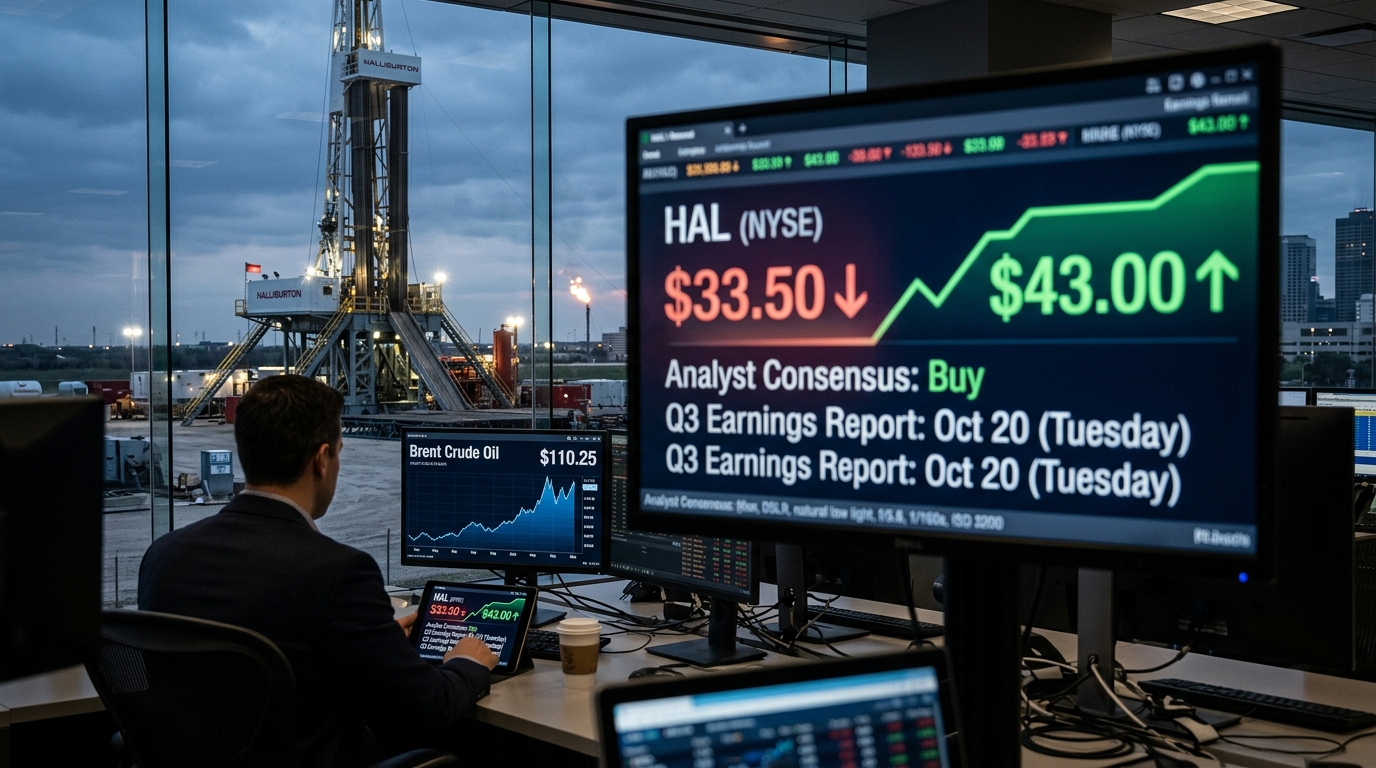
Halliburton Trades at $33.50. Analysts Say $43. Tuesday Will Tell.
Hey there, bargain hunter. Brent crude is sitting near $110 a barrel. The world’s largest fracking company is priced like oil is at $60. Something is wrong with one of those numbers, and Tuesday morning we find out which one.
Scoreboard
Halliburton reports Q3 2026 results before the open on October 20. Consensus: $0.58 per share on about $5.6 billion of revenue. That is roughly flat earnings year over year on roughly flat revenue. The stock closed last week at $33.50. The analyst consensus target sits around $43.24, implying about 29% upside from here. Eighteen analysts rate it Buy, six Hold, one Sell.
The Real Reason for the Discount
Halliburton’s revenue problem is almost entirely a North American problem. Analysts forecast North America revenue at roughly $2.29 billion for Q3, down 3% year over year. The culprit: U.S. completions activity has not kept pace with crude. Shale operators have spent 2026 defending balance sheets rather than chasing production records, which keeps pressure pumping demand softer than a $110 Brent price would imply.
International is the offset. Europe/Africa/CIS is expected up 11.6% year over year. Latin America up 6.8%. The Middle East remains complicated, which has disrupted some activity even as it drove the oil price premium that should, eventually, pull North American drilling higher.
What the Business Actually Does
Halliburton earns money two ways: Completion and Production (C&P) and Drilling and Evaluation (D&E). C&P, which includes hydraulic fracturing, is its largest segment at a projected $3.16 billion this quarter. D&E, which sells software and drilling services, is expected at $2.41 billion and growing faster internationally. The company has been pushing automation technology, including LOGIX drilling automation and Sekal integration, as margin levers that reduce dependence on pure activity volume.
Data Section
- Q3 consensus EPS: $0.58, roughly unchanged year over year
- Q3 consensus revenue: about $5.6 billion, roughly flat year over year
- Q2 2026 actual revenue: $5.7 billion, operating margin 14%
- Q2 free cash flow: $668 million
- Q2 share repurchases: $200 million
- Quarterly dividend: $0.17 per share, yielding about 2.1%
- Debt-to-equity: 0.64; current ratio 2.02
- Market cap: about $28.5 billion
Management guided for C&P revenue to be flat to down 2% sequentially in Q3, and D&E down 3-5% sequentially. Neither is an inspiring start, but Q2 beat on both revenue and EPS, so the bar is manageable.
Is It Cheap?
HAL trades at roughly 11-14x forward earnings depending on the estimate used. The consensus target around $43.24 against a $33.50 share price represents one of the wider discounts in the large-cap services space. For context, SLB’s market cap is much larger than HAL’s, and on revenue that is meaningfully larger as well. HAL is the cheapest of the Big Three by a meaningful margin.
The counterargument: HAL is more exposed to North America than either rival, and North America is the weak link. If U.S. completions activity stays soft into 2027, that discount is earned, not given.
Bull / Base / Bear
Bull: North American producers respond to $110 Brent with a spending reset in Q4. Halliburton’s fleet reactivation and pricing power mean a sharp EPS inflection in 2027. The stock re-rates toward $43-48.
Base: Q3 comes in at or slightly above consensus. Management guides cautiously for Q4. The stock grinds between $33 and $38 as investors wait for activity data to confirm the turn.
Bear: North America completions remain structurally capped by operator capital discipline. International disruptions worsen. Earnings estimates drift lower and the $43 target gets cut. The discount is a trap, not a bargain.
Action Plan
This is a position-sizing story, not an all-in call. If Q3 revenue beats about $5.6 billion and management reaffirms North American activity improvement into Q4, a starter position at current levels with a target near $40 is defensible. Add on confirmation, not anticipation. A miss on C&P revenue or a downbeat guide on North America narrows the margin of safety fast.
Investors already holding SLB or BKR at higher multiples should note that HAL offers the cheapest exposure to the same oil-price tailwind, with more operating leverage if North America turns.
The same oil-price environment pressuring shale operators is reshaping downstream margins. Refiner beneficiaries like Valero and Marathon are capturing the spread that tight fuel markets create when upstream activity stays disciplined.
Cheap Investor Scorecard
- Q3 revenue vs. about $5.6 billion consensus: beat or miss?
- North America revenue: does it stabilize or fall further year over year?
- C&P operating margin: does it expand toward 16%+ on better frac pricing?
- Management Q4 guide: does North America activity inflect or stay flat?
- Free cash flow: does it recover from Q1’s $123 million toward Q2’s $668 million?
- Share repurchase pace: maintained or cut?
- Middle East commentary: deteriorating or stabilizing?
- Forward multiple vs. SLB: does the gap narrow post-release?
Bottom Line
If Tuesday’s report shows North American revenue stabilizing and management signals a Q4 activity recovery, HAL at $33.50 is one of the more straightforward value cases in the energy sector. If the guide disappoints, the gap between $33 and $43 tells you more about a structural earnings ceiling than an opportunity. Watch the North America line above everything else.