If you still haven’t downloaded my “Simple Options Trading For Beginners” book…
…please take a few seconds and download it right now before your new temporary download link expires.
I eventually plan to charge for this book, so do yourself a favor and download it now…
That way, no matter how much it is in the future, you’ll have a copy on your computer already.
Make sense?
FREE: Simple Options Trading For Beginners << Download Now
Good Trading,
Bill Poulos
P.S. Go here to save a copy of my “Simple Options Trading For Beginners” book to your computer before I start charging for it.
The Quiet Patent War Over Zero-Loss City Power
Hey there, bargain hunter. Before anyone flips a switch on a zero-resistance city grid, somebody has to own the wire standard. That race is already underway, and most US investors have no idea it is happening.
Scoreboard
American Superconductor (AMSC) closed October 6 at $31.85, up 6.2% that session, with a 52-week range of $24.87 to $70.49. The stock has shed roughly 48% over the past year despite the underlying business posting record numbers. Full-year fiscal 2025 revenue hit $299.2 million, up 34%, and the 12-month backlog grew nearly 40% to approximately $280 million. By October, that backlog had crossed $300 million after a single quarter pulled in orders exceeding $130 million.
What the Market Is Missing
The stock selloff is not a business story. It is a multiple compression story. AMSC looks optically cheap on trailing earnings, but bargain hunters should remember that fiscal 2025 net income was boosted by a large, non-cash tax benefit tied to deferred tax assets. In other words, the headline trailing P/E can flatter reality unless you normalize it.
High-temperature superconductor cables transmit electricity with near-zero resistive losses, eliminating the 3 to 10 percent of power conventional copper systems bleed as heat. They also do it in a right-of-way up to ten times narrower than copper cable of equivalent capacity. For dense cities trying to feed AI data centers and EV charging networks without tearing up streets, that footprint advantage alone is decisive.
Who Is Filing What
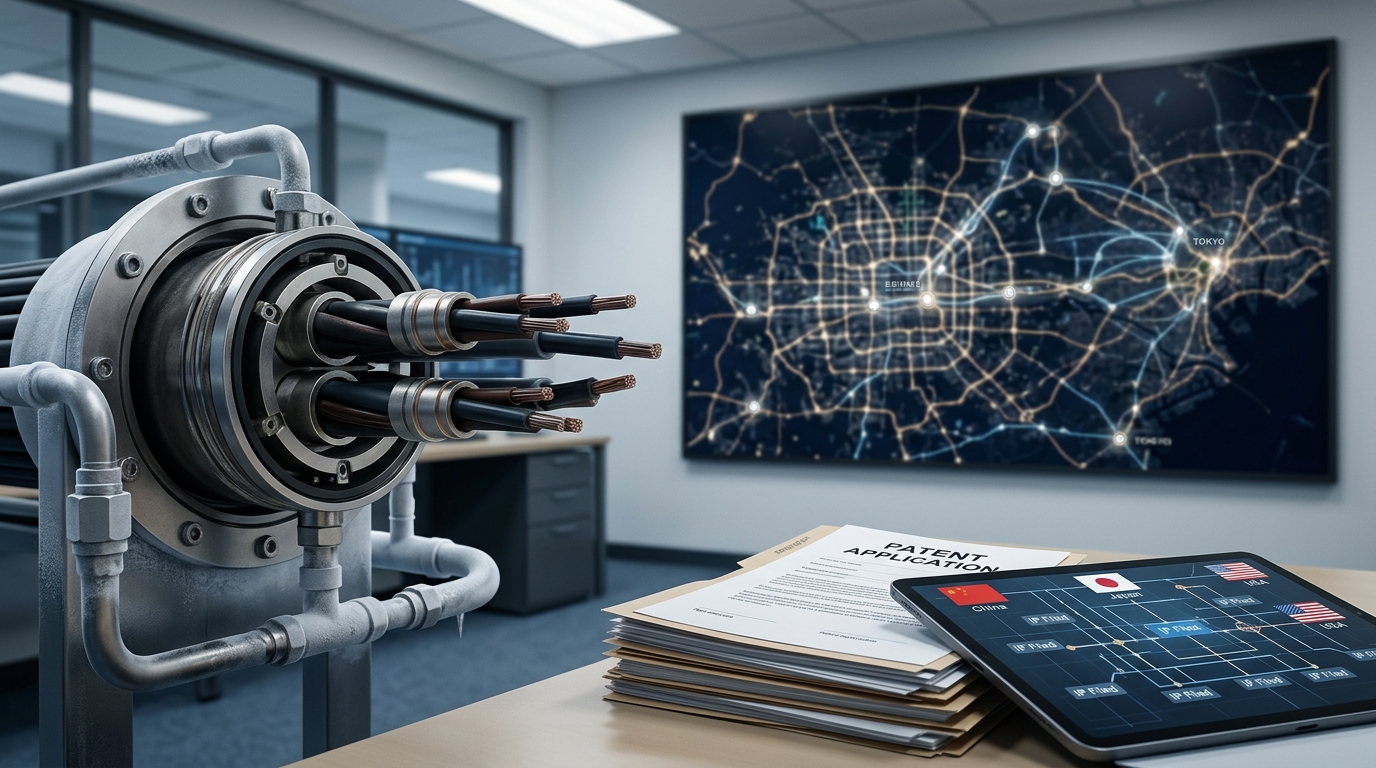
The patent landscape tells the real story, but it is messy. There is significant filing activity globally across superconducting cable components, cryogenics, monitoring, protection, and system integration, with major players spanning state-linked grid entities and multinational cable and industrial groups. The practical investor point is simpler: if superconducting cables move from pilots to mainstream procurement, the winners will not just be the tape makers. They will be the companies holding the system-level know-how and the field-proven designs utilities standardize on.
One example of the ambition level: Nexans says a single 17 cm-diameter high-temperature superconducting cable can transmit up to 3.2 gigawatts in its SCARLET work, a figure meant to illustrate how much power can be pushed through constrained corridors.
The material at the center of this is REBCO tape, rare-earth barium copper oxide. A commonly cited commercialization goal is to drive cost down sharply, with $50 per kiloampere-meter often used as a threshold number in industry discussions. Production scale is the lever. Recent academic industry reviews put the vendor base at about 15 REBCO/HTS tape suppliers globally, with combined annual capacity above 5,000 kilometers on a 12-millimeter-wide basis. Scale will drive the cost curve. The question is who controls the applications IP when it does.
Is AMSC Cheap Here?
At $31.85, a DCF model cited by Simply Wall St points to modest undervaluation versus its estimate of intrinsic value, and the stock screens cheap on five of six valuation lenses in their framework. The forward price-to-earnings is still elevated on many screens, which sounds rich until you note AMSC has guided that revenues will exceed $85 million in the quarter ending September 30, 2026. The operating margin is thin at roughly 5%, and free cash flow has been inconsistent. That is the genuine risk: the business is scaling but not yet generating durable cash at the rate the revenue line implies.
Bull / Base / Bear
- Bull: REBCO tape costs fall to widely discussed commercialization targets by 2028, utility contracts accelerate, and AMSC’s grid segment (about 84% of revenue) re-rates toward higher sector multiples.
- Base: Backlog converts steadily, margins improve as Comtrafo integrates, and the stock drifts toward Street targets, which have recently clustered from the mid-$50s into the $60s.
- Bear: Lumpy contract timing delays revenue recognition, profitability improvements do not stick, and the forward multiple compresses further.
Cheap Investor Scorecard
- 12-month backlog: $300 million-plus. Track quarterly.
- REBCO tape cost per kiloampere-meter: watch for movement toward $50.
- Operating margin: currently about 5%. Target 10% for a cleaner re-rating case.
- Patent filings: monitor WIPO and EPO for state-utility and cable-maker encroachment in jurisdictions AMSC actually sells into.
- Insider activity: limited buying is a caution flag, not a verdict.
Bottom Line
If REBCO tape costs fall and city grid contracts proliferate, AMSC is positioned to be part of the enabling stack that utilities may standardize on. If margins stay thin and the real moat proves narrower than it looks, the stock earns its discount. Scale into weakness, not all at once, and watch the backlog number every quarter.