On August 19, 2026, Moderna added roughly $44 billion in market value in a single session. MRNA surged about 177% after Moderna and Merck announced that their personalized cancer therapy, intismeran autogene, met both the primary and key secondary endpoints of the Phase 3 INTerpath-001 trial in patients with completely resected high-risk melanoma. The stock had spent much of 2025 trading below $30. It closed at $158.07 on September 17.
The clinical result deserves its attention. INTerpath-001 met its primary recurrence-free survival and key secondary distant metastasis-free survival endpoints in resected stage IIB-IV melanoma, representing the first positive Phase 3 signal for individualized mRNA cancer therapy. Investigators randomized 1,137 patients 2:1 to receive the combination or single-agent Keytruda, and people taking the combination lived longer without melanoma returning. The five-year Phase 2b follow-up had already posted a hazard ratio of 0.51 for recurrence or death. Phase 3 confirmed the direction.
But the investment question is not whether intismeran works in melanoma. It does. The question is whether the manufacturing model built around it can generate the economics analysts are projecting. Analysts have tipped intismeran to generate multi-billion dollar peak sales, making it an important asset for Moderna as COVID-19 vaccine revenue has collapsed, and for Merck as Keytruda faces loss of exclusivity beginning in 2028.
The process starts by analyzing a tumor sample to identify neoantigens, proteins unique to that patient’s tumor and no one else’s. Intismeran consists of mRNA designed to code for up to 34 of them. Doing this by hand across hundreds of mutations, for every patient, and repeating it at commercial scale is not practical. Machine learning is what makes per-patient personalization a manufacturing process rather than a research project.
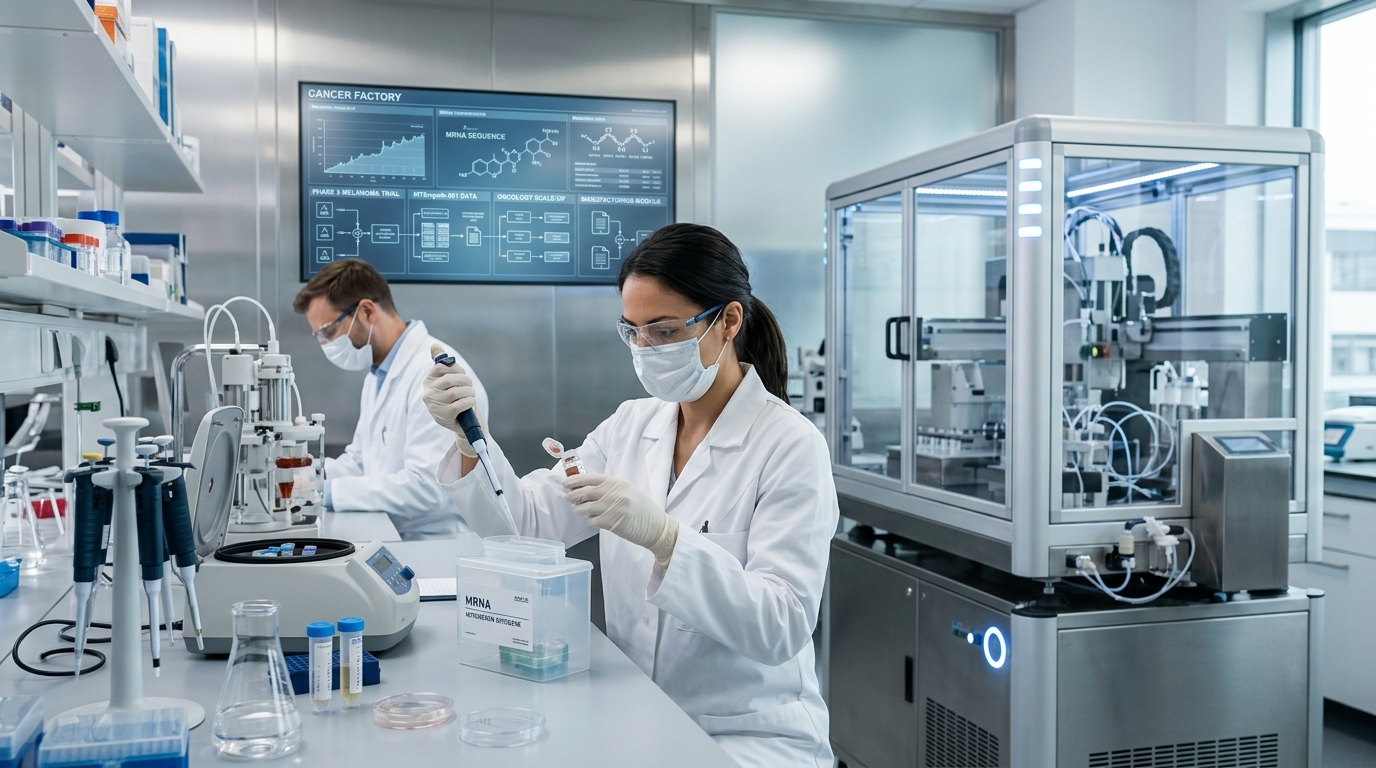
Moderna built its Marlborough, Massachusetts facility specifically for this challenge. The site was purpose-built for intismeran, designed for speed and scalability with advanced automation and robotics, and began clinical batch supply in September 2025. The company is now methodically right-sizing the manufacturing process to improve turnaround time and reduce costs. That last phrase is carrying a lot of weight. Per-patient therapies are expensive to produce, and reimbursement frameworks for individualized oncology treatments remain unsettled.
Meanwhile, the respiratory franchise is also moving. In April 2026, the European Commission granted marketing authorization for mCOMBRIAX, Moderna’s mRNA combination vaccine against both influenza and COVID-19, for individuals 50 years and older, making it the world’s first approved flu-plus-COVID product. Moderna has said the FDA asked for more data before it can approve the product in the U.S., pushing that timeline out.
Exactly how high intismeran sales go will depend on data in other indications. Moderna’s chief development officer has pointed to bladder cancer as a setting where checkpoint inhibitor efficacy provides early confidence. A Phase 3 trial in non-small cell lung cancer, INTerpath-002, is also actively enrolling.
The manufacturing scale problem is the thesis test. A bespoke therapy that takes weeks to produce per patient, across indications with far larger patient populations than melanoma, requires a different kind of factory economics than any mRNA vaccine Moderna has built before. The Phase 3 data answered the biological question. The manufacturing and cost-per-patient question is still open, and that is what the next two years will price.