August 25, 2026
Bonus Content: The Border Is Open. The Warehouse Is Full.
Below is an important message from one of our highly valued sponsors. Please read it carefully as they have some special information to share with you.
Dear reader,
Michael Burry is the famous hedge fund manager who predicted the 2008 meltdown…
And made $100 million during that crash.
He’s now putting his own money on the line…
Betting that this AI company I just exposed in this shocking new interview will collapse.
He said:
“This bubble looks an awful lot like the dot-com bubble.” [This company] is doomed and hemorrhaging cash.”
After correctly predicting the last two major stock market meltdowns…
I have to say… I agree 100%.
I believe this company is about to go bust…
In a meltdown that will be 10 times bigger than Lehman Brothers.
So please click here to get the details because…
While most people are in the dark…
Some of the best investors on the planet…
Are already preparing for this coming AI meltdown.
For example, tech billionaire Peter Thiel recently sold his entire stake in Nvidia, worth about $100 million.
The giant investment firm SoftBank also sold all of its Nvidia holdings for $5.8 billion.
Ray Dalio’s hedge fund has also been dumping shares of some of the biggest AI players.
He recently cut his Nvidia position by 65%, Google by 52% and Meta by 48%.
And over the past few months Warren Buffett sold $177 billion worth of stocks…
And he’s now holding a record position in cash.
I highly recommend you avoid these hyped-up AI stocks…
Regards,
Jim Rickards
Hey there, bargain hunter. Everyone agrees the factory is moving. The argument about where the money lands is the part Wall Street keeps getting wrong.
Scoreboard
Mexico closed 2025 with a record $40.871 billion in foreign direct investment, up 10.8% year over year, according to Mexico’s Secretaría de Economía. U.S. goods trade (exports plus imports) with Mexico totaled an estimated $871.6 billion in 2025, per the Office of the U.S. Trade Representative. The macro reads clean. The micro is where things fracture.
What Actually Happened
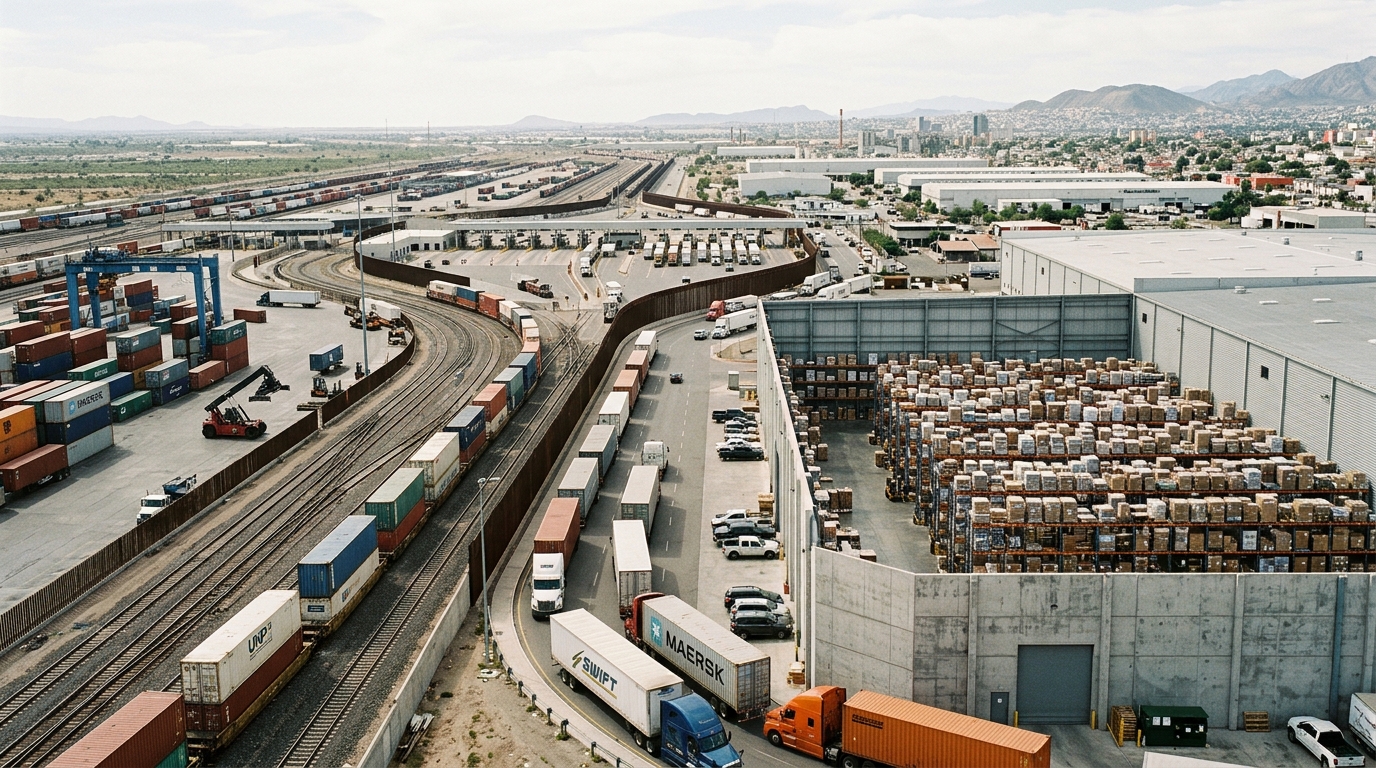
The hype cycle already ran. Vacancy rates in key northern Mexican industrial corridors rose meaningfully by 2025 as speculative builds raced ahead of absorption. Ciudad Juarez shed more than 57,000 maquiladora jobs from mid-2023 to mid-2025, according to the Federal Reserve Bank of Dallas. The first wave of nearshoring was an announcement cycle. The second wave has to be an execution cycle, and execution requires power.
Power is the actual bottleneck. Several nearshoring corridors face electricity supply and water constraints. Mexico’s CFE medium-voltage capacity can determine whether a vacant warehouse is a functional manufacturing option. Many advanced operations need thousands of amps; where CFE must build new lines or substations, timelines can stretch well past a standard build. This is what slows AAPL and concentrates JBL’s advantage.
Where the Three Stocks Stand
Apple (AAPL) is still primarily an Asian manufacturing story. On a 2025 earnings call, Tim Cook said that for that quarter, most iPhones sold in the U.S. would come from India, while nearly all iPads, Macs, Apple Watches, and AirPods in the U.S. would originate from Vietnam. Mexico is a component-supplier geography for Apple, not an iPhone assembly hub. Bargain hunters pricing a near-term Mexico pivot into AAPL are early.
Jabil (JBL) is executing. In 2024 reporting about its Mexico footprint, the company has described its Chihuahua region presence as five facilities with more than one million square feet of regional capacity. In its fiscal Q3 2026 results, Jabil reported net revenue of about $8.8 billion and core diluted EPS of $3.16, and it raised its full-year fiscal 2026 net revenue outlook to $35 billion. The nearshoring dividend is already in the numbers.
Union Pacific (UNP) posted strong Q2 2026 results: net income of $2.0 billion and adjusted EPS of $3.41. In filings tied to rail traffic at Eagle Pass, the Eagle Pass gateway has been described as handling approximately 19 trains per day for Union Pacific and BNSF. Border rail is a throughput story, and throughput is what compounding looks like in the real world.
Cheap Investor Scorecard
- Mexico FDI 2025: $40.871B record, up 10.8% YoY
- JBL fiscal 2026 revenue guidance: $35B (raised in the Q3 FY26 update)
- JBL Q3 core EPS: $3.16
- UNP Q2 adjusted EPS: $3.41; net income $2.0B
- U.S. goods trade with Mexico (exports plus imports), 2025: ~$871.6B
- Eagle Pass rail crossing: ~19 trains per day (UP and BNSF combined, as described in filings)
- AAPL Mexico exposure: component suppliers only, with U.S.-bound sourcing shifting toward India and Vietnam
Bottom Line
If the infrastructure bottleneck is the real constraint, JBL wins now because it already controls the space that works. UNP wins longer because border rail volume compounds regardless of which company’s name is on the lease. AAPL is the laggard: real investment, real intent, but the iPhone assembly math does not close until Indian capacity is fully stretched and tariff pressure removes all other options. Own the manufacturer in place and the railroad moving the goods. Watch the phone maker.