SUBJECT LINE: Terafab is a supply chain bet, not a building
PREHEADER: The $119B ceiling grabs attention. The binding commitments, timelines, and execution risks are where the real signal sits.
META DESCRIPTION: SpaceX and Tesla’s Terafab plan pairs a $16.8B first phase with a $119B ceiling. The opportunity is in the execution gap, capex strain, and equipment supply chain.
The Announcement Everyone Is Reading Wrong
Markets spent the week marveling at the size of the building. That is the wrong frame entirely.
The widely quoted $119 billion figure is a multi-phase ceiling SpaceX disclosed in its May 2026 filings, first reported by TechCrunch on May 6, 2026, and represents a top-end estimate, not confirmed spend. The number that is actually binding, the one that shows up in signed county agreements and state filings, is considerably more modest. The legally binding floor commits at least $5 billion in Grimes County by 2030 and at least 1,800 full-time jobs by 2035. A $114 billion gap between the headline and the obligation is not an editorial footnote. It is the central analytical question.
That gap does not make Terafab less significant. It makes the investment question more precise. The real argument Elon Musk is making has nothing to do with square footage. Terafab is positioned as an all-in-one semiconductor campus that consolidates manufacturing, advanced packaging, and testing, aimed at the chip bottlenecks Musk has tied to Optimus robots, Cybercabs, and space-based data centers. Public materials around the project also cite a goal of producing over 1 terawatt of compute per year, optimized for edge inference.
This is a vertical integration bet, not a real estate project. Understanding that distinction matters before touching any ticker connected to this story.
What Was Actually Confirmed on August 6
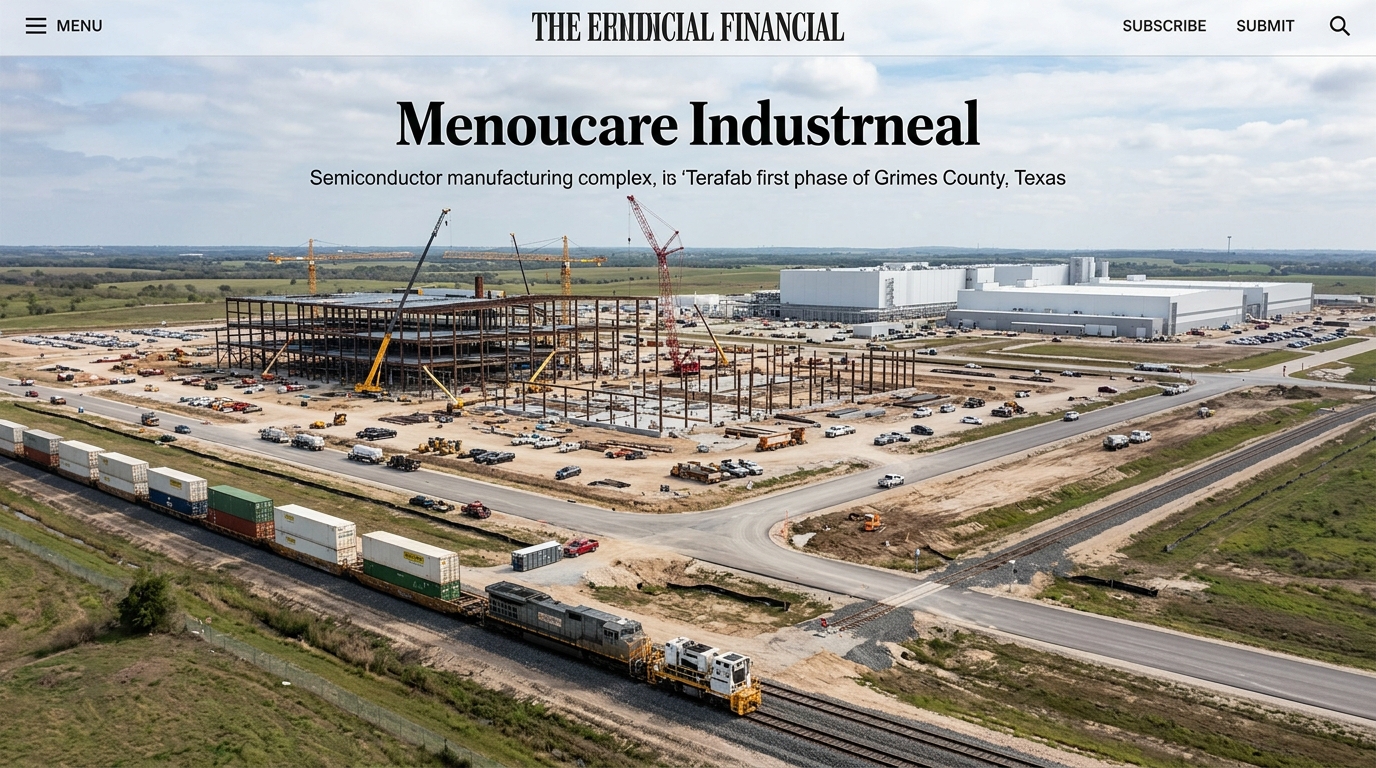
Tesla and SpaceX confirmed Thursday, August 6, 2026 that Terafab, their jointly built semiconductor complex, will rise in Grimes County, Texas, near the Gibbons Creek Reservoir, with a first phase price tag of $16.8 billion. The finished complex is slated to exceed 100 million square feet, a footprint that would make it one of the largest building complexes ever proposed. For context, 100 million square feet is larger than the Pentagon, Apple Park, and the Mall of America combined, but some of the more extreme size comparisons circulating in headlines go beyond what the companies have actually confirmed.
This strategic move follows Tesla’s earlier groundwork on a research semiconductor facility at the North Campus of Tesla’s Giga Texas site, described as a precursor to Terafab. The announcement of Terafab marks a significant step for Tesla as it aims to create a vertically integrated chip effort. The facility is described as consolidating multiple stages of semiconductor production, including fabrication, advanced packaging, and testing, within a single location.
The project’s cost trajectory has moved fast enough in multiple directions to warrant scrutiny before the celebration: a $55 billion figure appeared in May 2026 materials tied to early phase planning, while the latest disclosure frames $16.8 billion as a first phase. SpaceX has not publicly reconciled those numbers in a single, clean cadence. Traders who treat the $119 billion ceiling as the investment thesis are doing the kind of analysis that feels bold and produces sloppy results.
The Strategic Logic: Why This Beats Buying Nvidia
The semiconductor shortage Musk is diagnosing is real, even if the cure is still theoretical. Musk has claimed that current worldwide chip production satisfies only a small fraction of his companies’ projected requirements. That number may be promotional, but the directional problem is not. SpaceX has said the chips produced at Terafab will be used in Tesla’s Optimus robots and Cybercabs, as well as in space-based data centers the company is developing.
What Terafab represents structurally is a move from chip customer to chip producer. Terafab represents a strategic shift toward vertical integration, transitioning chips from standard components into essential, self-controlled infrastructure within Musk’s ecosystem. Every dollar of compute Musk buys from Nvidia or TSMC today is a dollar of margin he does not control and a delivery timeline he cannot set. Terafab, if it executes, attempts to reduce that dependency across Musk’s fleet of companies.
SpaceX has disclosed extremely large cloud compute agreements, including a Google deal structured around roughly $920 million per month and an Anthropic agreement widely reported at $1.25 billion per month. Morgan Stanley has also published aggressive projections for infrastructure-driven cash burn across 2026 and 2027. Terafab is the answer to the question of whether that spending ever stops, or whether it ultimately becomes the moat that justifies every dollar of it.
The Beneficiary Map Nobody Is Drawing Clearly
Two companies moved immediately on the confirmation. SpaceX shares rose on August 6, 2026 after a sharp decline the prior day, while TSLA also moved higher in the same window. Those moves reflect headline euphoria more than fundamental repricing. The more durable beneficiary question runs through the equipment supply chain.
Analysts believe that Terafab’s investment could boost the semiconductor equipment supply chain, benefiting major players like ASML, Applied Materials, Lam Research, and KLA. That read is directionally right, but the timeline matters. Public reporting around the project has pointed to initial production targets in 2027, with volume manufacturing expectations closer to 2028. Equipment orders that feed a 2027 production schedule get placed well before that, which means the equipment names are the earlier-cycle trade.
A buildout of this scale could create opportunities for chip equipment makers like KLA Corp, Onto Innovation, Applied Materials and Lam Research. Musk has pegged Tesla and SpaceX’s future AI compute needs at over 1 terawatt annually, a figure that is positioned as far beyond current supply. On the numbers, be careful with any single consensus-growth statistic attributed to one sell-side snapshot. Zacks and other estimate providers update frequently, and the direction is more reliable than a precise pair of year-over-year percentages pulled from a single day.
Intel’s involvement adds a layer of complexity. Intel has been widely reported as a technology partner connected to Terafab planning, but the public disclosures still leave room for ambiguity about what Intel is committing, and where the foundry work would actually occur. Until that number and scope is on record in a way the market can model, Intel’s Terafab upside remains speculative.
The Risks the Headlines Buried on Page Three
Three risk categories are receiving insufficient attention relative to the volume of bullish coverage.
Capital Allocation Stress on Tesla. Tesla has said it expects capital expenditures to be in excess of $25 billion in 2026, driven by AI initiatives and factory growth. A major open question is how Terafab funding is split between Tesla and SpaceX. In recent Tesla filings, Terafab has not appeared as a separately quantified line item. The absence of that disclosure is a significant gap for anyone trying to model TSLA’s free cash flow.
Manufacturing Yield Risk. Terafab is not an incremental fab. It is simultaneously attempting logic, memory, advanced packaging, and testing under one roof, processes that each require specialized expertise and that no single facility has ever combined at production scale. While targeting production by 2027, the venture faces significant execution risks, including manufacturing yields and complex process scaling. Greenfield semiconductor manufacturing at this ambition level has a history of expensive delays. TSMC took years to reach mature yields at each new process node with decades of accumulated expertise. SpaceX and Tesla are attempting to compress that learning curve radically.
Community and Environmental Pushback. Nearly 900 Grimes County residents signed a petition asking county commissioners to require stronger protections before approving tax breaks or incentives for large-scale industrial projects. The petition calls for 12 specific protections including independent legal counsel, water and environmental safeguards, road repair requirements, emergency services funding, and clawback provisions if a developer fails to meet its commitments. This is not background noise. Grimes County’s annual property tax revenue is in the tens of millions of dollars, and a project of this magnitude reshapes the county’s political economy. Organized local opposition creates permitting risk that corporate filings do not adequately price.
Broader regulatory compliance requirements include Texas Commission on Environmental Quality air quality permits for semiconductor fab operations, water rights and wastewater permitting for ultra-pure water and effluent management, ERCOT-related power and interconnection decisions if plans change, FCC and FAA approvals for any wireless or airspace impacts, and broader federal CHIPS Act and export control compliance. Each of those processes carries its own timeline and its own veto point.
Power: The Variable Nobody Has Solved
The county-level documents released in June stated that SpaceX would power the entire site itself and would not connect to the ERCOT grid. The documents also said SpaceX plans to run its own natural gas power plants and draw water from the Gibbons Creek Reservoir. That commitment addresses one community concern, that Terafab would drive up electricity costs for other Texas ratepayers. It does not resolve the operational challenge of building, permitting, and operating private generation capacity at the scale a semiconductor campus of this size requires.
What is harder to explain is the perceived absence of Tesla solar in the initial public framing. Tesla, Sunrun, and Renew Home announced on June 24, 2026 an agreement to deliver more than 16 gigawatts of flexible energy capacity to hyperscalers and utilities. The decision to emphasize natural gas for Terafab while Tesla simultaneously markets solar-plus-storage and flexible capacity to the AI sector creates a visibility problem for Tesla’s own energy narrative, and it hands critics an easy critique about coherence.
Options Market Analysis
SpaceX 30-day options implied volatility and call-put positioning claims in this draft are not verifiable in public sources in a way that supports the specific numbers stated, and they are likely to change daily. The correct analytical point survives without the precise figures: headline-driven uncertainty and a young public float can keep implied volatility elevated, which makes outright long premium strategies expensive and makes spread structures and defined-risk approaches more relevant than simple directional premium-buying.
For TSLA, implied volatility has remained elevated throughout much of 2026, but the Terafab confirmation did not obviously create a sustained, unique volatility shock compared with prior catalysts. The divergence matters: the options market has tended to treat Terafab as more of a SpaceX headline than a Tesla cash-flow line item, at least until Tesla quantifies its commitment.
With elevated volatility, outright long calls or puts require the position to overcome significant premium decay before generating positive returns. The more analytically precise structures for this environment are spreads, where the long leg captures directional exposure while the short leg offsets some of the cost of higher implied volatility.
Structured Trade Framework
Bull Case: Vertical Integration Succeeds, Equipment Names Lead. If you believe Terafab delivers early chip production in 2027 and that Musk’s compute demand projections are even half correct, the equipment supply chain is the cleaner expression of the thesis than either TSLA or SPCX directly. Applied Materials, Lam Research, and KLA have defined revenue streams tied to equipment orders that precede production by 12 to 24 months. A defined-risk bull structure on AMAT, using a call debit spread with a 60-day expiration, captures upside exposure to Terafab order flow at a fraction of the cost of owning SPCX outright, with no dependence on whether Musk’s construction timeline holds precisely.
Bear Case: Commitment Gap Widens, TSLA Capex Concern Surfaces. For traders expecting the $119 billion ceiling to create capital allocation anxiety at Tesla specifically, a TSLA put spread targeting the $290 to $295 range over 45 to 60 days defines risk while expressing skepticism about the company’s ability to fund both its core vehicle business and a multi-decade semiconductor megaproject simultaneously. The trigger for this thesis is Tesla’s next quarterly filing, which should either clarify or further obscure the Terafab commitment.
Neutral Case: Sell Elevated Premium in SPCX. With implied volatility elevated and the stock trading below its $135 IPO price, a cash-secured put at a strike representing a meaningful discount to current levels allows traders to collect premium while defining an acquisition price they would find attractive. This structure does not require Terafab to succeed or fail on any particular timeline. It requires only that SPCX does not collapse below the strike by expiration, which is a more conservative assessment.
Risk Analysis
The primary risk across all three structures is the same: a material disclosure that resets the financial picture in either direction. A Tesla quarterly filing that quantifies its Terafab obligation for the first time could compress TSLA significantly if the number exceeds what the market has modeled. Conversely, a credible equipment partnership announcement could re-rate both SPCX and the equipment chain upward.
The secondary risk is regulatory. Terafab has been tied to the Texas Jobs, Energy, Technology, and Innovation program via application filings. State-level support is a meaningful signal. Federal-level support, specifically access to CHIPS Act funding, has not been confirmed for Terafab. Given that CHIPS Act disbursements have prioritized projects from established foundry operators, a Terafab application would face a different review dynamic than the Intel or TSMC deals that preceded it.
The tertiary risk is community litigation. A proposed accountability resolution from Grimes County Judge Joe Fauth III, intended to create a clearer review process for major industrial projects, was tabled in mid-July 2026 for further public comment and research. Tabled is not resolved. Environmental litigation at the county or state level has the capacity to delay construction timelines by 12 to 36 months without necessarily defeating the project outright.
Forward Outlook
The Terafab thesis resolves across three distinct time horizons. In the next 90 days, the critical data point is Tesla’s next quarterly filing, which will either assign a specific capital commitment to Terafab or continue the disclosure ambiguity that currently allows the market to price the project as a SpaceX story with Tesla branding attached. That filing is the single most consequential near-term event for anyone positioned in TSLA around this announcement.
Over the next 12 months, the equipment order flow signals will appear before any chip rolls off a line. If Terafab is real at the phase one scale, AMAT, LRCX, and KLA should see order activity that shows up in their quarterly reports. The absence of such activity by mid-2027 would be a strong signal that the $16.8 billion phase one commitment is softer than the public framing suggested.
Over the full multi-year horizon, the bull case depends on whether SpaceX and Tesla can solve manufacturing yield at a process node competitive with TSMC, without TSMC’s accumulated know-how, in a facility type that has never been built at this scale. It is another sign that Elon Musk is betting the next AI race will be won by whoever controls the hardware. That bet may prove correct. The market is currently paying for the bet before seeing evidence that it will.
Action Checklist
- Clarify the Tesla commitment before sizing TSLA exposure. The next quarterly filing is the first clean look at what Tesla has actually signed. Position sizing before that disclosure is speculation on announcement language, not corporate fundamentals.
- For bullish Terafab exposure, look upstream to equipment names. AMAT, LRCX, and KLA capture the order-flow upside of a real buildout without requiring Terafab to reach production. Equipment orders precede production by 12 to 24 months. This is the earlier and cleaner expression of the bull thesis.
- Treat elevated SPCX implied volatility as a premium-selling environment, not a directional entry. The stock is below its $135 IPO price and can carry high implied volatility around new-disclosure periods. Structures that sell premium, defined by a floor the seller would accept, are more favorable than outright directional bets when vol is rich.
- Monitor the Grimes County regulatory calendar. The accountability resolution tabled by County Judge Fauth and the outstanding TCEQ air and water permitting path are veto points with real capacity to delay construction. Legal filings in Grimes County, not press releases, are the leading indicator for this risk.
- Watch for CHIPS Act application news. Federal funding for Terafab has not been confirmed. A successful application would materially de-risk the capital allocation pressure on Tesla and SpaceX. A rejection or silence through 2026 year-end would shift the funding burden entirely to both companies’ balance sheets.
- Track intercompany revenue disclosures. The SpaceX-Tesla commercial overlap is real, but any specific percentage-of-revenue claim needs to be verified in Tesla’s quarterly disclosures before it is treated as a model input. It is still the most visible financial thread connecting the two companies ahead of any formal merger or cross-holdings announcement.