
July 28, 2026
Boeing’s Cash Flip Changes Everything
Deliveries are rising and cash is finally flowing in the right direction.
9,500+ Investors betting on the Future of Work.
The companies that win the next tech shift aren’t the ones improving old tools. They’re the ones building around how people actually work.
Immersed built the virtual workspace that helps 1.5M+ users, including teams at Fortune 500 companies, manage more tasks and projects from anywhere, with access to up to 5 monitors. 9,500+ have invested and 75,000+ are on the waitlist for Visor, the company’s new lightweight headset.
Current Reg A+ offering ends July 30. Invest today.
Disclosure: This is a paid advertisement for Immersed Regulation A+ offering. Please read the offering circular at invest.immersed.com
Hey there, bargain hunter.
Here is a question worth sitting with: when does a battered, debt-laden business with years of headline disasters start to look like an opportunity? When the evidence shifts. Not the mood, not the analyst upgrades. The actual evidence.
This morning, Boeing dropped its Q2 2026 earnings. And for the first time in a long while, the numbers are telling a different story than the headlines have been writing.
What Just Happened
Boeing reported Q2 2026 revenue of $24.6 billion, up 8% year over year and above the $24.26 billion consensus estimate from Bloomberg. That beat matters, but it is not the most important number in the release.
The most important number is cash. Boeing posted positive adjusted free cash flow of $631 million versus the negative $331.4 million that analysts expected and the negative $200 million cash flow burn from a year ago. Operating cash flow came in at $1.4 billion, nearly double the $687.7 million consensus.
That is not a rounding error. That is a structural shift.
The Delivery Engine Is Turning
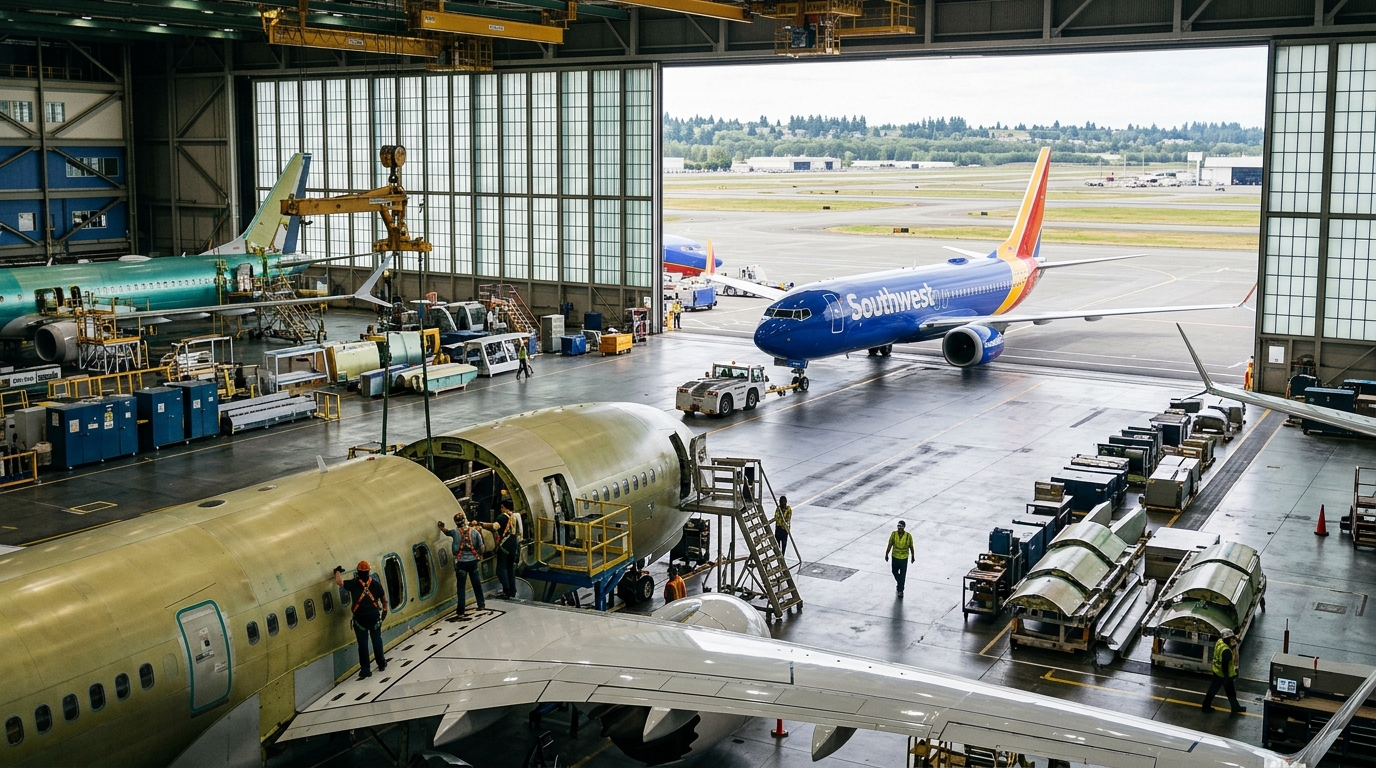
Boeing’s commercial aircraft deliveries in the second quarter rose 14% from a year earlier to 171 planes. To put that in context, a year ago the company was still digging out from a labor strike, a door plug blowout, and FAA-imposed production caps that had choked output to historically low levels.
Boeing reported a net loss of $428 million, or 67 cents a share, compared with a net loss last year of $612 million, or 92 cents a share. Still losing money. That part is real. But the trajectory here is the thing worth watching.
Slight tangent, but it matters: Boeing’s operating cash swing year-over-year is dramatic. Total operating cash flow swung to a positive $227 million in Q2 2025 from a $3.9 billion outflow a year earlier. Now, a year later, it is $1.4 billion. Each quarter, the hole is getting meaningfully smaller.
Prepare now for major midterm election shock
We’re exposing Washington swamp’s secret plan to end Trump’s presidency this November…
And show you how it could unleash the biggest wealth transfer in our nation’s history.
Those who don’t prepare could get wiped out.
You’ll get positioned for what could be the biggest opportunity of the decade.
The Scoreboard
- Q2 2026 Revenue: $24.6B, up 8% YoY, beat consensus
- Commercial deliveries: 171 jets, up 14% YoY
- Free cash flow: +$631M (beat expectations of -$177M)
- Operating cash flow: $1.4B (nearly double the consensus)
- Net loss: $428M, improved from $612M a year ago
- Adjusted loss per share: $0.76 (wider than the $0.28 expected)
- Air Force One charge: $280M one-time hit in the quarter
- Backlog: $619 billion total company
- Cash and marketable securities: $23B
- Debt: still elevated, though down from peak levels
The EPS miss deserves a word. Boeing took a $280 million loss on the program to deliver two 747s that will serve as the next-generation Air Force One aircraft to the U.S. government as it said it ramped up investment for that plane. Strip that out and the underlying operating picture looks better than the headline loss suggests. One-time charges distort quarter-to-quarter comparisons. The pattern beneath them is what counts.
What the Market Has Been Getting Wrong
For three years, the market priced Boeing like the problems were permanent. Production freezes, regulatory scrutiny, a union strike, an Alaska Airlines door plug incident, and two legacy MAX crashes still casting shadows. The perception calcified into a view that Boeing was structurally broken, not temporarily hobbled.
Here is where the evidence diverges from that view.
Boeing and Airbus are the only two major global manufacturers of large commercial aircraft, providing pricing power and barriers to entry. That duopoly does not disappear because the company had a rough three years. And total company backlog at quarter end was $619 billion. That backlog is not a vanity metric. It represents contracted future revenue from airlines that have no alternative supplier at scale. Customers cannot simply walk across the street.
Fitch Ratings recently upgraded Boeing’s credit outlook to Positive from Stable, pointing to the long-term sustainability of the 737 MAX recovery and steady operational performance on the 787 wide-body program. When credit agencies start moving in that direction, it signals that the balance sheet risk, while still real, is beginning to stabilize.
The Production Ramp: Where the Value Unlocks
Boeing’s earnings power is almost entirely a function of how many planes it can deliver per month. More deliveries equals more cash. It is that mechanical.
During Q4 2025, the 737 program increased the production rate to 42 per month and received approval from the Federal Aviation Administration to begin the final phase of 737-10 certification flight testing. The planemaker plans to boost production from 42 to 47 aircraft per month before increasing to 52 monthly jets in early 2027, aided by the launch of a fourth 737 production line at its Everett facility.
On certification, progress is visible. After years of flight testing, analysis and regulatory engagement, Boeing leaders say the path to certification for new 737 MAX models and the 777-9 has become clear, with teams within reach of key milestones including final flight events and certification deliverable closeouts.
Boeing’s 737-7 and -10 programs are in the final stages of achieving certification with CEO Ortberg expecting that to happen this year. And on the 777X, Ortberg expects the certification flight test program to be completed by the end of the year, with first deliveries now targeted for 2027.
The services segment is the part most investors overlook. Boeing Global Services revenue was $5.3 billion in Q2 2025, up 8% year over year, with an operating margin of 19.9%, up 210 basis points. That is a high-margin, recurring business that does not depend on certification timelines.
Is It Cheap? The Honest Answer
This is where we have to be honest with ourselves.
As of July 27, 2026, Boeing is trading at approximately $209 per share. The average 12-month analyst price target is $270.08, with a high estimate of $300 and a low estimate of $230. That implies roughly 29% upside to the consensus target from current levels.
The overall picture remains challenging: EV/EBITDA and EV/EBIT are at very elevated levels, debt remains significant, and interest coverage remains low. This is not a value stock in the traditional sense. You are not buying a cheap business on cash flow multiples today. You are buying a thesis about what the business looks like two to three years from now.
Historically, Boeing’s P/S ratio has ranged from about 0.8x to 2.5x over the past five years. The current trailing P/S is near the higher end of this range, suggesting the market is pricing in optimistic expectations for a turnaround. That is the risk framing that careful investors need to hold onto.
Boeing said it still projects $1 billion to $3 billion in free cash flow this year. If they hit the high end of that range, the valuation starts to look more reasonable. If they miss, the stock has limited cushion.
Bull, Base, and Bear
- Bull case: Production ramps to 47-plus per month by late 2026, 737-7 and 737-10 certifications land on schedule, free cash flow hits $3B or higher, and the $619B backlog begins converting at an accelerating pace. The stock has a credible path toward the $300 analyst target.
- Base case: Ramp-up is slower than management guides, certification timelines slip modestly, free cash flow lands in the $1B range for the year. The stock consolidates near current levels as investors wait for further proof of execution.
- Bear case: A new safety incident, a trade dispute freezing China deliveries, or a supply chain disruption resets the production ramp. The debt burden becomes harder to service. The stock revisits its 52-week low near $177.
The Cheap Investor Scorecard
| Category | Assessment | Score |
|---|---|---|
| Business Quality | Duopoly with irreplaceable global position | 8/10 |
| Financial Strength | Debt still elevated; cash improving | 4/10 |
| Valuation | Rich on trailing metrics; forward thesis dependent | 5/10 |
| Competitive Position | One of two global suppliers; pricing power intact | 9/10 |
| Cash Flow | Turned positive this quarter; trajectory improving | 6/10 |
| Management Execution | Ortberg has delivered on early milestones | 7/10 |
| Catalyst Strength | Certification and production ramp both near-term | 8/10 |
| Margin of Safety | Limited at current price; thesis requires execution | 4/10 |
| Long-Term Potential | $619B backlog, 6,100+ jets on order | 9/10 |
The ONLY AI opportunity you should be looking at
This is the ONLY AI wealth-building opportunity you should be watching right now.
No. It’s not about Nvidia, Tesla, or Meta…
It’s about one overlooked company profiting off AI “digital goldmines” that are poised to experience 100x growth very soon.
This new opportunity will change the market and make investors a lot of money.
That’s why it has received a $500 billion commitment from President Trump himself…
Action Plan
Boeing is not a buy-and-forget position. It is a watch-and-scale situation.
For patient investors who already hold a position: this quarter’s cash flow improvement is meaningful. Hold and monitor the production rate cadence closely. The next two quarters will tell us whether this is a durable trend or a timing-driven beat.
For those on the sideline: the risk-reward here depends on your time horizon. If you are thinking in weeks, the stock has limited cushion on a miss. If you are thinking in years, the combination of a $619 billion backlog, a recovering production line, and a structurally protected competitive position is a more interesting picture. Consider building a position in stages, with the next catalyst being 737-7 and 737-10 certification.
What to watch: free cash flow in Q3, the 737 monthly production rate, any update on the China delivery picture, and whether the 777X certification flight test wraps by year-end as Ortberg has guided.
The bottom line: Boeing is not cheap in the way a textbook value investor would define cheap. The trailing multiples are stretched, the debt load is still enormous, and the EPS miss today shows execution risk has not vanished. But the business underneath the noise is something few competitors could replicate. A $619 billion backlog, a recovering production machine, and a duopoly market position do not come cheap. The question is whether the current price gives you enough of a discount on that future.
Right now, it is closer to a fair price on a great recovery than a bargain price on a great business. That distinction matters. Keep watching.
— The Cheap Investor