July 8, 2026
DaVita Is Down. The Medicaid Clock Is the Reason.
The One Big Beautiful Bill has a dialysis problem nobody is fully modeling.
First a note from InvestorPlace Media
Editor’s Note: Please read the following note from $1 billion money manager Louis Navellier. He called the collapse of Enron, warned about the dotcom crash, and recommended Nvidia all the way back in 2005 (it’s up as high as 70,000%+ today). Now he’s blowing the lid off a startling development involving the SpaceX IPO…
Dear Reader,
Elon Musk just spent $60 billion worth of SpaceX stock…
To close a deal that could fast-track the next evolution of AI and change America forever.
But when I examined the regulatory filing, I saw something that few others had noticed…
The first glimmer of a $7 trillion technological shift that could create extraordinary wealth for savvy investors… and financial turmoil for everyone else.
And you can find its fingerprints on many of the biggest stories of 2026.
From the SpaceX merger with xAI to its subsequent $1.8 trillion IPO…
To the war in Iran, and the boom in orbital data centers…
It all traces back to “Project Apex.”
No wonder Nvidia CEO Jensen Huang recently said:
“What Elon and his team have achieved is singular. It’s never been done before.”
However… if what I’ve discovered about this closely guarded initiative is correct…
In the coming days, it could trigger an explosive sea-change that will make even Elon’s astonishing accomplishments sound trivial in comparison.
This could spark a 70-fold investment boom, solve the world’s greatest scientific mysteries, and enable you to earn $30,000 – $50,000 a year from home – without touching stocks.
According to Elon, it will be easy to set up, cost relatively little upfront, and could generate substantial passive income.
But if you want to be prepared before it takes off, I’ll walk you through the setup – free of charge – here.
U.S. Senator Ted Cruz calls it “a total game-changer.”
The most powerful institutions are lining up to help Elon bring this technology to the masses…
- Google…
- Anthropic…
- Intel…
- Even the Department of Justice!
Right now, you have a chance to leverage this paradigm shift before it reshuffles the global power structure.
Click here for all the details…
Regards,
Louis Navellier
Senior Analyst, InvestorPlace
P.S. In my view, this is the biggest and most important technological shift of 2026.
And I say that not because Elon planned and built this operation in only 19 days (a feat that would take most CEOs years)…
Or because it’s fueled by the most powerful AI supercomputer in the world…
Or even because it played a major role in the biggest IPO of all time…
No, I believe this will continue to send shockwaves through the stock market… and potentially become the crown jewel of Elon Musk’s incredible career.
Because I’ve experienced its technology firsthand – and seen how it absolutely DESTROYS all the other applications in this space.
I recently filmed a brief, 30-second demonstration of this application, so you can see for yourself why Vice President and Fox News’ Sean Hannity call it “the best and also the least woke” and why Bill Ackman says it’s “incredible.”
FEATURED
DaVita Is Down. The Medicaid Clock Is the Reason.
DaVita dropped sharply in premarket trading and has held those losses through the session. One of the worst performers in the market today, with no company-specific earnings or guidance driving it. The selling is purely policy-driven, and it has a specific clock attached to it.
Here is what is actually happening.
The Trump administration’s One Big Beautiful Bill Act, signed into law on July 4, 2025, established mandatory Medicaid work requirements. CMS released the implementing interim final rule on June 1, 2026. The rule takes effect July 31, 2026. States must have requirements in place by January 1, 2027, though several are already moving faster. Nebraska went live May 1. Montana and Arkansas both launched July 1. Under the rule, certain adult Medicaid applicants aged 19 through 64 must meet an 80-hour-per-month community engagement threshold through employment, education, or qualifying service activities to maintain coverage.
The Gold Income Opportunity No One’s Talking About
While investors chase headlines, one overlooked fund is quietly delivering up to $1,152/month.
Click here to see the gold income breakthrough most investors are missing.
The problem for DaVita is structural. In 2025, 89% of DaVita’s patients were covered by government-based health insurance programs. Government payers, including Medicare and Medicaid, accounted for 68% of total revenues. But here is the part that stings: commercial payers, which made up just 32% of 2025 revenues, generate nearly all of the company’s profit because they reimburse at dramatically higher rates than government programs. Anything that pushes patients out of commercial or even stable Medicaid coverage and into uninsured or emergency-only status hits DaVita’s margin structure directly.
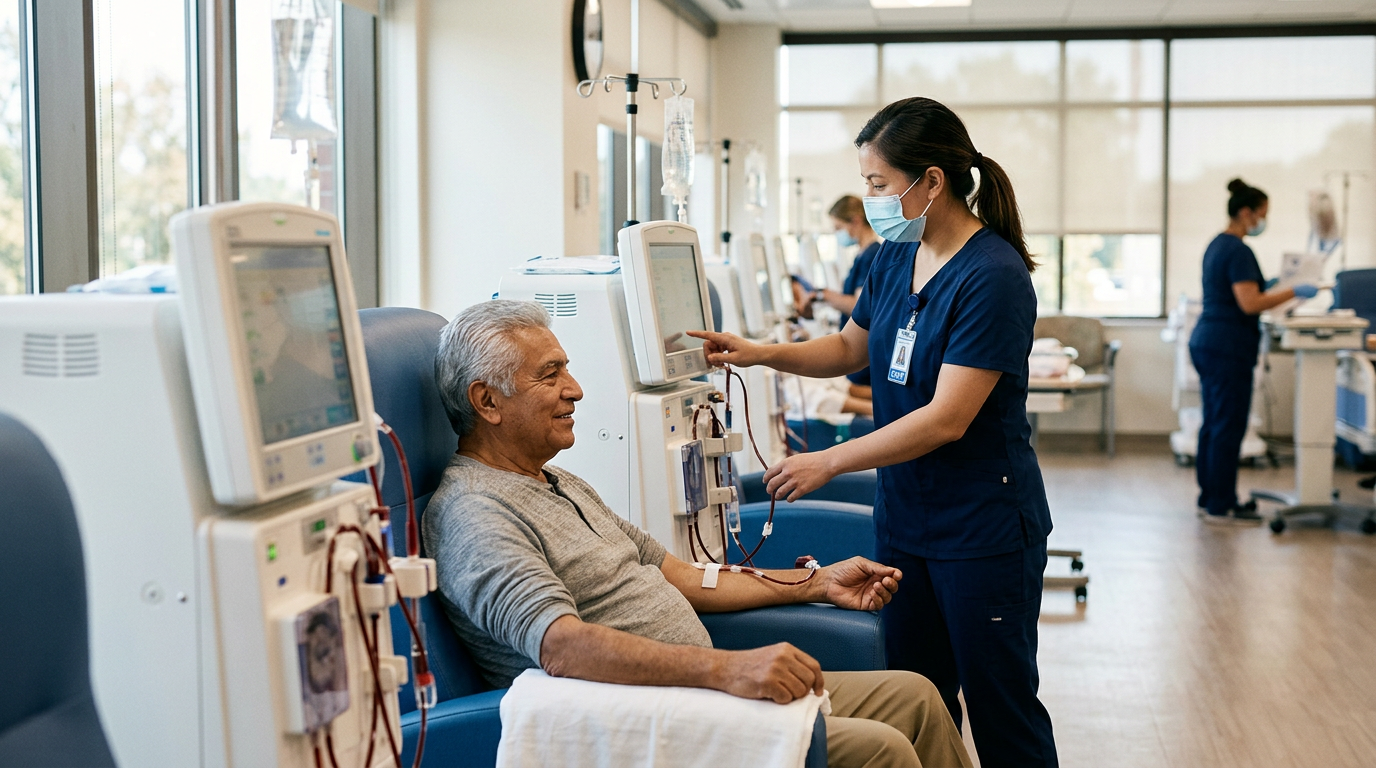
Dialysis is not optional. Patients on in-center hemodialysis attend treatment three times per week. Fatigue and cardiovascular complications limit capacity on treatment days. The National Kidney Foundation has been clear that the 80-hour monthly threshold is not a realistic standard for this patient population. And with the June 2026 rule defining medical frailty more narrowly than many states and stakeholders expected, whether a dialysis patient qualifies for automatic exemption will be decided state by state. That creates a patchwork, and patchwork creates coverage risk.
This is not just a dialysis story. The administrative complexity of implementing these requirements is so significant that even patients who are technically exempt are at risk of losing coverage through paperwork failures and missed notices. States that go live in January 2027 were required to begin sending outreach notices to enrollees by late summer 2026. That clock is already running.
The math runs directly through DaVita’s revenue line. When a patient transitions from commercial coverage to Medicare or Medicaid, DaVita absorbs a reimbursement step-down. If Medicaid coverage disruptions push patients into uninsured or emergency-care status, DaVita absorbs uncompensated care. If patients lose coverage and delay treatment, clinical outcomes deteriorate and the volume picture gets complicated fast.
The business itself is not broken. Q1 2026 revenue came in at $3.42 billion, up 5.9% year over year. Diluted EPS of $2.87 beat consensus by roughly 23%. Full-year 2025 free cash flow was $1.024 billion. DaVita has an active $2 billion share buyback program and repurchased 3.0 million shares in Q1 2026 alone at an average price of $133.70. After Q1, management raised full-year 2026 adjusted EPS guidance to $14.10-$15.20. TD Cowen lifted its price target to $201 from $144 post-earnings.
But the Medicaid policy risk is no longer theoretical. It is arriving on a published, legislated timeline. The interim final rule comment period closes July 31. States begin full implementation January 1. The market is adjusting for that transition today.
Why Musk May Need This Company Next
Musk has a pattern: when his empire needs something critical, he buys it. Batteries. Solar. Data. Now, his AI buildout may depend on one small power-system company moving faster than the giants.
The stock still trades like a forgotten industrial.
What matters next: CMS’s own projections, embedded in the June 2026 interim final rule, estimate that roughly 2.3 million people will be disenrolled from Medicaid in fiscal year 2027 due to the work requirement, growing to between 3.1 and 3.3 million in subsequent years. The CBO’s broader estimate puts total Medicaid coverage losses from the full bill at around 5.2 million over time. Not all of those are dialysis patients. But the share that are, and exactly how DaVita’s payer mix shifts in response, is the question Q2 earnings in early August will need to address head-on.
The underlying dialysis demand is not going away. End-stage renal disease does not respond to policy. What changes is who pays for it, and how much. That is the number worth watching.