July 7, 2026
Tesla Robotaxi Hits Miami
The car company is gone. What is left is harder to value.
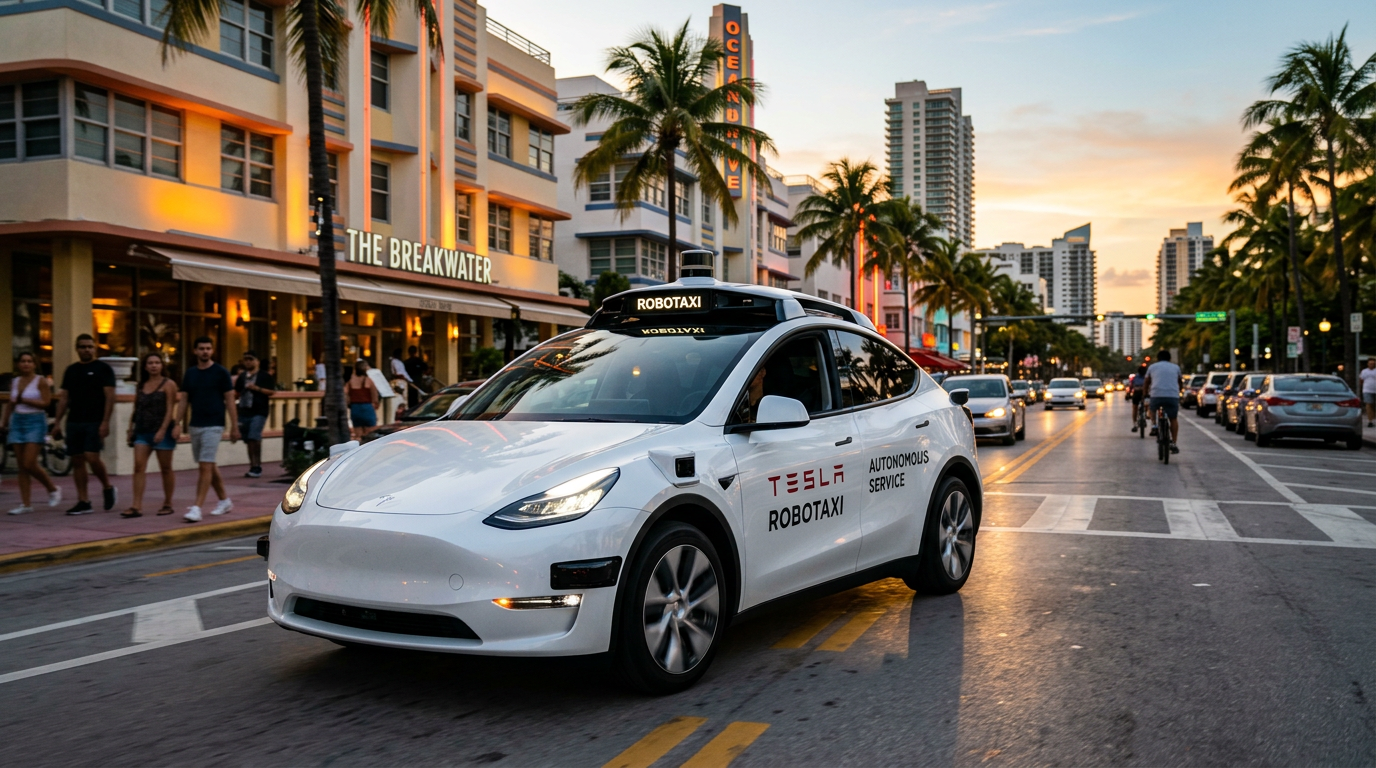
On July 3, 2026, Tesla launched its Robotaxi service in Miami. The stock jumped roughly 5-6% on the news. It is now live in Texas, California, and Florida, expanding beyond its original Austin launch from June 2025. Miami is city number four. Dallas, Houston, and the Bay Area came first.
Worth noting before we go further: the day before the Miami announcement, Tesla reported Q2 2026 deliveries of 480,126 vehicles, the best quarter in company history, up 25% year over year and 18% above Wall Street consensus. The stock still fell 7.5% that day. Then Miami launched, and it bounced back. That sequence tells you something about what this market is actually paying for.
What Tesla Actually Is Now
Tesla stopped being a car company somewhere around 2025. The market figured this out already. The stock trades around 360x trailing earnings. That number makes no sense if you are valuing Model Y deliveries. It makes more sense if you are valuing a robotaxi network, a humanoid robot program, and a fast-growing energy storage business all under the same ticker.
The three legs of the new Tesla: autonomous ride-hailing through the Robotaxi network, the Optimus humanoid robot program now moving toward volume production, and Tesla Energy (Powerwall, Megapack, Solar Roof). Automotive is still the revenue base, with 480,126 vehicles delivered in Q2 2026 alone, but it is no longer the story investors are paying for.
The Robotaxi Numbers
Miami’s launch zone covers roughly 10 to 14 square miles in western Miami-Dade, centered on West Miami, Doral, and Coral Gables, and notably includes Miami International Airport. Downtown and Miami Beach are excluded for now. The entire fleet is Model Y vehicles. Tesla’s purpose-built Cybercab, which entered mass production at Giga Texas in April 2026, is expected to join the fleet as volume ramps later this year.
Missed Tesla? PayPal? SpaceX? You Might Regret Missing This One Too…
Many are calling him The Next Elon Musk…
His first company made investors 6,566% before the age of 25…
Now, he’s building one of the most-anticipated companies in the world… with $26 billion in government contracts already in place.
And one rare 4-letter ticker gives you early access – before the IPO.
Here is the part that does not make it into the headlines: the fleet is small. Austin peaked at around 19 unsupervised vehicles before settling near 14. Dallas and Houston each had roughly 3 active vehicles operating at any given time. Early riders across markets have reported long waits and occasional software issues. The map is growing. The fleet is not keeping pace with it yet.
The competitive context matters too. Waymo already operates in Miami across a 60-square-mile area, roughly four times Tesla’s launch footprint. Waymo is also running more than 500,000 paid rides per week across 11 U.S. cities. Tesla’s Robotaxi is a real, operating service. It is not yet a scaled network.
On the Q1 2026 earnings call, Musk said safety validation is the binding constraint on expansion, not ambition. That is actually a responsible answer. Paid Robotaxi miles nearly doubled sequentially in Q1 2026, which is a real metric, but it is still an early operating data point rather than proof of broad monetization. Material revenue from Robotaxi is not expected until 2027 at the earliest. Tesla has said as much directly.
Next markets in the pipeline per Tesla’s own Q1 update: Orlando, Tampa, Las Vegas, and Phoenix. Tesla also filed for an Autonomous Vehicle Network Company permit in Nevada, targeting up to 5,000 robotaxis in Clark County including Harry Reid International Airport within 12 months of permit approval. Las Vegas is an obvious play: high visitor volume, strong ride-hailing demand, and a massive showcase opportunity.
Optimus: Real Progress, Honest Uncertainty
The Optimus production line has physically arrived at Fremont. Tesla VP Lars Moravy confirmed this publicly, and the line is described as a modular system designed to adapt as the robot’s hardware evolves. Musk confirmed on the Q1 2026 earnings call that Optimus manufacturing at Fremont begins in late July or August 2026, with the Model S and Model X production space being converted for that purpose.
As of July 2026, Optimus is not for sale to the public. The current target for limited external and business-to-business sales is late 2026, industrial customers only. Consumer availability is widely framed as a 2027 target at the optimistic end, with analyst consensus closer to 2028 or 2029 for widespread availability.
Slight tangent, but it matters: Tesla has missed every Optimus production target since 2021. The 2023 production-readiness target slipped. The 2025 deployment target slipped. That history does not mean 2026 targets will also slip, but it is worth tracking execution against announcements rather than treating dates as guarantees. The production line arriving is a real signal. Volume numbers will be the next real signal.
Musk has described Optimus as potentially representing the majority of Tesla’s long-term value. The long-run market size for humanoid robotics is a number analysts float in the trillions. Whether Tesla captures a meaningful share of it is the open question everything else is priced around.
Some investors think Elon’s next move is hiding in plain sight
Most people dismissed the “xPhone” rumors immediately.
That’s probably why this setup caught my attention. According to recent SpaceX documents, Elon may be approaching the mobile market from a completely different angle than the crowd expects.
And fast movers are starting to notice.
The Financial Baseline
- Market cap: approximately $1.48 trillion (as of early July 2026)
- Q1 2026 revenue: $22.4 billion, up 16% year over year
- Q1 2026 gross margin: 21.1%, the strongest in roughly two years
- Q2 2026 deliveries: 480,126 vehicles, best quarter in company history, up 25% YoY
- FSD active subscriptions: 1.28 million, up 51% year over year as of Q1 2026
- Q1 2026 energy storage deployment: 8.8 GWh, down from 14.2 GWh in Q4 2025 (a notable sequential decline worth watching)
- Free cash flow (Q1 2026): $1.44 billion, up 117% year over year
- 2026 AI infrastructure capex guidance: $25 billion or more
- P/E ratio (trailing): approximately 360x
- Stock YTD: still down roughly 7% even after the Miami rally
Bull, Base, Bear
Bull: Robotaxi and Optimus scale faster than the market expects. Tesla’s in-house AI stack, its own silicon, and the factory-floor training data from deployed Optimus units create an advantage competitors cannot replicate at the same cost. Energy storage rebounds from the Q1 dip and becomes a multi-billion dollar earnings floor. At that point, today’s price looks cheap in hindsight.
Base: Robotaxi grows steadily across U.S. cities through 2026 and 2027. Revenue contribution is modest but building. Optimus production starts but external sales do not arrive meaningfully until late 2027 at the earliest. Automotive margins hold around 20%. The stock grinds sideways while the market waits for proof points to show up in actual financials.
Bear: EV sales face ongoing pressure from BYD. An active NHTSA engineering analysis into Tesla’s camera-only FSD system under degraded visibility conditions, escalated in March 2026, creates regulatory friction that could slow the Robotaxi rollout. Optimus misses production timelines again. The $25 billion capex cycle weighs on free cash flow. Investors who paid 360x earnings for a robotics future do not get the robotics revenue on schedule, and the multiple compresses hard.
What to Watch
- July 22 earnings call: Musk’s Optimus production update and first Robotaxi revenue disclosures will be the most watched items
- Fleet size data: when does Tesla start disclosing actual vehicle counts by market?
- NHTSA probe outcome: the March 2026 engineering analysis into FSD performance in low-visibility conditions is an active overhang
- Energy storage recovery: the Q1 2026 drop to 8.8 GWh was sharp; Q2 data will show whether it was a blip or a trend
- FSD subscription growth: the software margin engine sitting inside the car business, and the pipeline for future Robotaxi fleet monetization
- Cybercab ramp at Giga Texas: production began in April 2026; fleet integration timelines are the next milestone
The Gold Income Opportunity No One’s Talking About
While investors chase headlines, one overlooked fund is quietly delivering up to $1,152/month.
Click here to see the gold income breakthrough most investors are missing.
The central tension with Tesla in 2026 is the same as it has always been, just more visible now. The stock is cheap if the optionality is real and execution holds. It is expensive if timelines slip again. What is different is that you can actually watch a Robotaxi operate in Miami, Austin, Dallas, and Houston in real time. The proof points are no longer theoretical.
The stock is still down 7% for the year after all of this. Record deliveries, a new city, a production line landing at Fremont. And still underwater year to date. That is worth sitting with before you decide the market has already figured this one out.