
July 6, 2026
America Forgot How to Make the Most Important Part of Every Chip
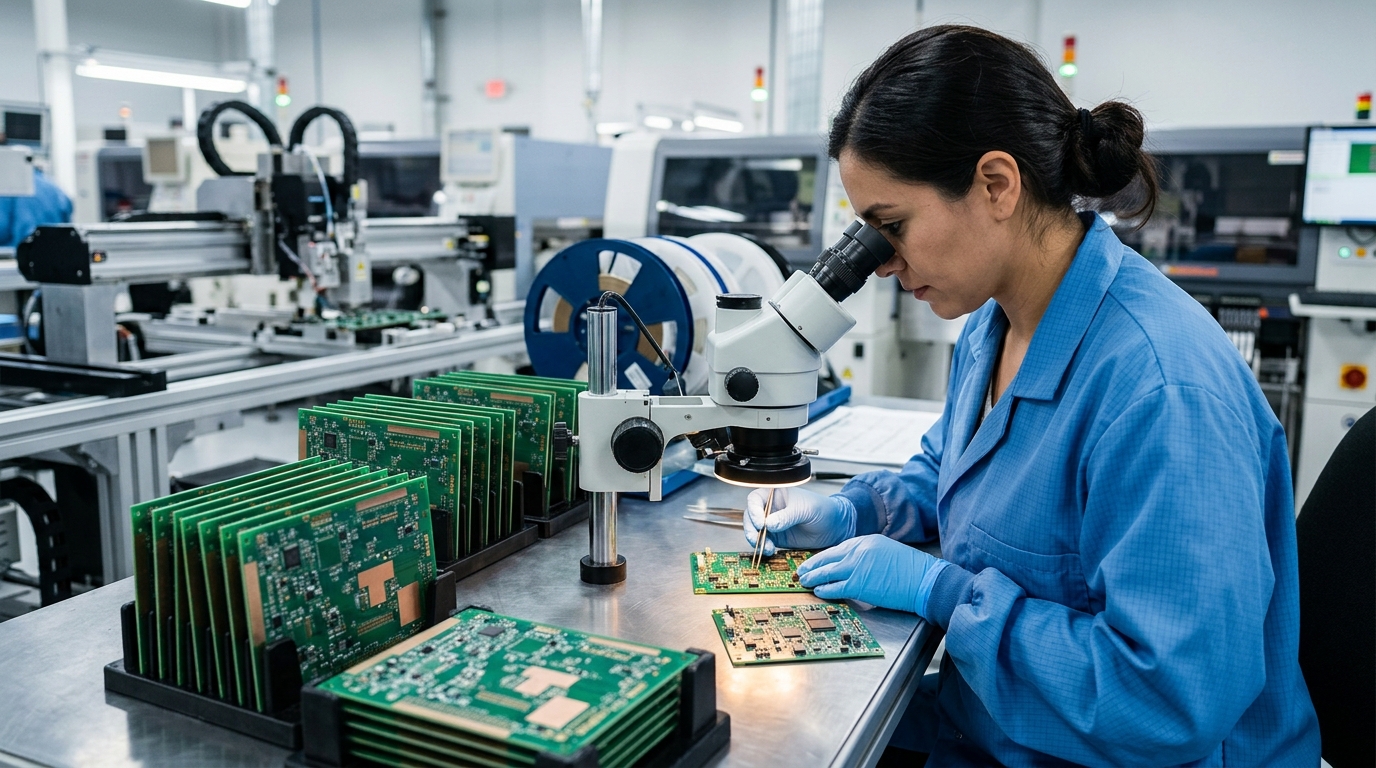
The PCB reshoring race just found its loudest winner.
Article Summary
- America produces just 4% of the world’s printed circuit boards, down from 30% three decades ago. China supplies over half of global output.
- Every chip made in the U.S. — from TSMC Arizona to Nvidia GPUs — must sit on a PCB to function. Most of those boards still come from Asia.
- Three forces are colliding: AI data center buildout, Pentagon electronics modernization, and bipartisan reshoring legislation that mirrors the CHIPS Act playbook.
- TTM Technologies (TTMI) is the largest PCB manufacturer in North America and the largest supplier of circuit boards to the U.S. military.
- Q1 2026: record revenue of $846M, up 30% year over year. Q2 guidance: $930M to $970M. Full-year target: $4 billion.
- The stock is up roughly 169% year to date but has pulled back from its all-time high of $223.83 in late June. Current price near $160, trailing P/E around 85x.
- Analyst consensus is Strong Buy. Average price target around $209. The valuation is stretched — this is not a cheap stock by conventional measures.
- Three major June catalysts: new Ultra-HDI factory in Syracuse, dual European acquisitions, and Russell 1000 index inclusion.
This Building in West Texas Is Generating “AI Royalties”
This is an AI data center. Thousands of them are popping up across America.
But this one in West Texas could pay everyday investors for decades.
Every ChatGPT query… every Alexa answer… every Netflix recommendation…generates a royalty you can collect.
It’s already paid out over $810 million since 2022. And the real buildout hasn’t even started.
Hey there, bargain hunter. Start with a number that almost nobody talks about.
Four percent.
That is the United States share of global printed circuit board production today. Thirty years ago it was 30%. The rest of that capacity migrated to Asia, chasing cheaper labor and subsidized factories, and America let it go. Nobody made a big fuss. PCBs are boring. Green boards with copper traces. Who cares.
Here’s the thing: every single semiconductor that gets made in America — every TSMC wafer in Arizona, every Intel chip in Ohio, every GPU that Nvidia designs — eventually has to sit on a printed circuit board to connect to anything. The chips don’t float. They need a board to function. And right now, most of those boards are made in China. Congress has started quoting that exact line in legislation. That tells you something.
That is not a theoretical risk anymore. It is a structural one, and Washington is finally treating it that way.
The Three-Way Collision
Three things are hitting at once, and their overlap is the interesting part.
AI infrastructure buildout. Hyperscalers are committing staggering sums to data center construction — hundreds of billions annually. Each of those racks, each of those servers, each of those GPU clusters requires advanced high-density interconnect PCBs. Not commodity boards. Complex, precision-engineered boards with layer counts, trace widths, and thermal tolerances that most Asian factories weren’t tooled to build even two years ago.
Defense spending. The Pentagon is in the middle of one of its largest electronics modernization cycles in decades. Radar systems, missile guidance, electronic warfare, satellite communications — all of it runs on RF and microwave printed circuit boards. And the Department of Defense has made it very clear: it does not want those boards coming from Chinese suppliers.
Legislation. This is the one Wall Street hasn’t fully absorbed yet. Senators Gallego and Justice introduced the Protecting Circuit Boards and Substrates Act in May 2026, which would provide a 25% tax credit for the purchase of American-made PCBs. The companion House bill goes further, adding a $3 billion grant program modeled directly on the CHIPS Act framework.
Slight tangent, but it matters: this is structurally identical to what happened with semiconductors before the CHIPS Act. First came the geopolitical alarm. Then the legislative framework. Then the private investment surge. PCBs are on that exact same trajectory, roughly two years behind. The consensus hasn’t caught up yet.
What Wall Street Is Missing
PCBs don’t generate clicks. They don’t have a Jensen Huang keynote. They don’t trend on X. They are the invisible layer beneath every exciting piece of AI hardware, and that invisibility is exactly why the opportunity exists.
The U.S. share of world PCB supply has fallen from 30% to 4% because of offshoring over the past 30 years. The consequence is a supply chain that depends almost entirely on a region where geopolitical risk is rising, lead times are long, and quality control is harder to enforce. Roughly 90% of PCBs used in the U.S. come from Asia — more than half from China alone.
Meanwhile, the demand side just broke open in two directions at once. AI infrastructure is not just a GPU story. It is a board-level story. Advanced high-density interconnect PCBs are what enable the compute density that hyperscalers are demanding. You can’t build a modern AI data center without them.
The Company Three Levels Deep
Most people talking about the AI trade are still looking at Nvidia, TSMC, or the hyperscalers. One level down you get the memory makers and the power management chips. Two levels down you get the cooling infrastructure and the transformers. Three levels down — and this is the layer that almost nobody is watching — you get the printed circuit board manufacturers that physically connect everything together.
TTM Technologies (NASDAQ: TTMI) operates at that third level. It is the largest PCB manufacturer in North America. It is also the largest supplier of circuit boards to the U.S. military. And right now, it is growing at a rate that most investors would associate with a software company, not a board shop.
In Q1 2026, TTM reported net sales of $845.98 million, up 30% year over year, marking an all-time quarterly record. Non-GAAP EPS came in at $0.75, up 50% from the prior year, beating consensus by roughly 14%. That is not a one-quarter spike. The company is guiding for Q2 2026 net sales of $930 million to $970 million, another sequential step-up, and has set a full-year 2026 revenue target of $4 billion — implying roughly 38% growth from 2025’s $2.9 billion.
The revenue mix is shifting the right direction too. Data Center and Networking represented 36% of Q1 sales — up sharply from prior periods — while Aerospace and Defense accounted for 40%. Together, management says roughly 80% of net sales are now tied to AI and defense demand.
The defense side is equally compelling. The company entered 2026 with a $1.6 billion defense backlog providing revenue visibility well into 2027. Orders are coming in faster than they can ship: the overall book-to-bill ratio in Q1 was 1.41. When that number is above 1.0, it means demand is outpacing supply. At 1.41, it means the pipeline is building fast.
AI bubble to POP July 29th
He predicted the 2008 financial crisis…
He predicted Trump’s election in 2016…
He even predicted the rise of COVID-19 writing:
That was three months before the first reported case.
If he’s right again, God Bless America…
Because this crisis will be tectonic in scale…and it’s going to begin with the bubble popping in AI.
Three June Moves the Market Barely Processed
Three things happened in June that deserve more attention than they got.
First, TTM opened an Ultra-HDI manufacturing facility in Syracuse, New York. That is a strategic asset. Ultra-high-density interconnect boards are what the Pentagon needs for next-generation radar, missile guidance, and electronic warfare. You cannot buy them from China anymore. Someone has to make them here. TTM is making them here.
Second, TTM announced the intent to acquire two well-established European companies in separate all-cash deals: Swiss Technology Group AG, headquartered in Zurich, and ILFA GmbH, headquartered in Hannover. STG serves a global customer base in surgical robotics, hearing aids, medical imaging, and implantable solutions. That is a medical device PCB platform being layered on top of an already growing defense and AI business.
Third, TTM joined the Russell 1000 Index on June 26th. Index inclusion means forced buying from passive funds. It means more institutional eyes on the stock. It means TTMI is graduating from mid-cap obscurity into a category that larger funds can now hold without jumping through hoops.
The Numbers
- Q1 2026 Revenue: $846M, up 30% year over year (all-time record)
- Q1 2026 Non-GAAP EPS: $0.75, up 50% year over year
- Q1 Adjusted EBITDA Margin: 15.7%
- Q1 Non-GAAP Gross Margin: 22.3%, up 150 basis points year over year
- Q2 2026 Revenue Guidance: $930M to $970M
- Q2 2026 Non-GAAP EPS Guidance: $0.82 to $0.88
- Full-Year 2026 Revenue Target: $4.0B, up roughly 38% year over year
- Defense Backlog: $1.6B
- Book-to-Bill (Q1 2026): 1.41x
- FY2026 Capital Expenditure Guidance: $300M to $320M
Is It Cheap?
Short answer: no. Not by traditional measures. And that needs to be said plainly before anything else.
TTMI is currently trading around $160 per share, which puts the trailing P/E ratio near 85x. The U.S. electronics industry average trailing P/E sits around 30x. The peer average is closer to 46x. Even on forward estimates, the multiple is elevated relative to the sector. The stock hit an all-time high of $223.83 on June 22nd before pulling back, and it is up roughly 169% year to date.
The analyst community is not backing away though. Four analysts covering the stock have a consensus Strong Buy rating. Price targets from Truist, Needham, B. Riley, and Stifel range from $205 to $215 — all set after the Investor Day in late May. Average analyst target is around $209, which is still above the current price.
So what is the bull case for paying this kind of multiple?
- Management is targeting 2025-to-2027 EPS doubling. If they hit that, the multiple compresses fast on forward earnings.
- The $1.6 billion defense backlog and 1.41 book-to-bill provide meaningful visibility. This is not speculative demand.
- Revenue is forecast to grow roughly 17% annually over the next three years — well above the 11% industry average.
- EBITDA margin guidance for FY2026 is 16% to 18%, up from 15.7% in Q1. Mix shift toward higher-complexity boards is the driver.
- Index inclusion and expanding institutional coverage bring new buyers into the stock over coming months.
Here is where I sit on the valuation question. The stock is not cheap on a trailing basis. It never was. What you are paying for is a structural reshoring story with real revenue visibility, real order momentum, and a legislative tailwind that is still in early innings. Whether that justifies 85x trailing earnings is a judgment call — and a debatable one. But the argument for a premium multiple is stronger here than it is for most names carrying one.
Bull, Base, and Bear
Bull: PCBs Act passes or gets attached to NDAA. AI hyperscaler spending accelerates. New Syracuse facility ramps ahead of schedule. European acquisitions close clean and add margin-accretive medical device revenue. Management doubles EPS by 2027 as guided. Stock re-rates toward analyst targets in the $205 to $215 range.
Base: Growth continues at 20 to 25% annually. Defense backlog converts on schedule. Commercial segment stays strong on AI demand. Margins expand modestly. Stock grinds higher as earnings catch up to valuation over 12 to 18 months.
Bear: This one is real and worth saying plainly. The stock is down roughly 29% from its June 22nd all-time high already. If AI hyperscaler spending slows, defense contract timelines slip, or the European acquisitions create integration headaches, the multiple compresses fast. Free cash flow was negative $85 million in Q1 as capital expenditures ran at $107 million. The company is investing heavily, and execution risk is real when you are opening new facilities and absorbing acquisitions simultaneously.
Action Plan
The pullback from $224 to the $155 to $165 range is worth watching closely. Q2 earnings are expected August 5th. That is the next major catalyst — and the next major risk.
- For aggressive accounts: current levels near $160 represent a 29% discount from the June high. A partial position ahead of Q2 earnings makes sense if you are willing to hold through volatility.
- For conservative accounts: wait for Q2 results on August 5th. If the company hits the high end of its $930M to $970M guidance range and maintains book-to-bill above 1.3, that is confirmation the growth story is intact.
- Trim trigger: if book-to-bill drops below 1.1 or management pulls back the $4B full-year target, the multiple has no support at current levels.
- Watch the PCBs Act: any movement through NDAA or a standalone vote adds a direct catalyst to the domestic reshoring angle.
Cheap Investor Scorecard
- Revenue growth (30% year over year in Q1): Pass
- Order momentum (book-to-bill 1.41): Pass
- Backlog visibility ($1.6B defense): Pass
- Margin expansion (EBITDA at 15.7%, guidance 16% to 18%): Pass
- Insider activity (CFO recently reduced position): Watch
- Free cash flow (negative $85M in Q1 on high capex): Neutral — investing quarter
- Valuation vs. peers (85x trailing P/E vs. 30x industry average): Caution
- Analyst consensus (Strong Buy, avg $209 target): Pass
- Structural tailwinds (reshoring, AI, defense): Pass
- Execution risk (new facility, two acquisitions integrating): Watch
Run This 7-Point Check Before Your Next Trade
Ever been right about a stock’s direction and still lost money on the trade?
It happens to almost every beginner. And it’s almost never bad luck – it’s a checkpoint you skipped before you placed the trade.
I put the 7 that matter most on one page.
It’s called the Smart Trade Options Checklist. Normally $29.97. Free today.
Run it before any options trade. About 30 seconds. You’ll catch the bad ones before they cost you.
Bottom Line
If TTM hits its $4 billion revenue target for 2026 and continues expanding margins, the current pullback from the June high looks like a reasonable entry for patient capital. If AI data center spending decelerates or defense timing slips, the multiple has room to compress significantly from here.
But here is what the bears are underweighting. This is not a cyclical PCB story anymore. The reshoring legislation, the defense mandate, the AI board complexity — these are durable shifts that do not reverse in a quarter. TTM is the largest PCB manufacturer in North America and the largest supplier of circuit boards to the U.S. military. There is no obvious domestic substitute for what they do.
The force acting on this company is not one trend. It is three trends hitting simultaneously, and most of Wall Street is still watching the obvious names two layers above it in the stack.
That gap does not stay open forever. August 5th will tell us a lot.
Worth a closer look.
— The Cheap Investor