July 2, 2026
Korea’s Market Nearly Doubled in Six Months
Featured: Korea’s Market Nearly Doubled in Six Months
Hi Friend,
Just wanted to let you know you can now get a free copy of my new strategy guide here:
How to Master the Retirement Trade [PDF]

What’s the Retirement Trade?
It’s a simple trading opportunity that appears almost every trading day, between 9:30 and 10:45 am EST where traders are making between $300-$1,100+ per contract.
One of my favorite parts about this trade is how predictable it is. It occurs about 3-5 times each week. And once you know what you’re looking for, and how to enter/exit the trade, this could become another nice stream of income for you.
I’m not sure how long I’ll leave this guide up for. So do yourself a favor and take 5 seconds to download it now. At least you’ll have a copy stored for future use!
>> Click Here to Download Your FREE Strategy Guide Now.
To your success,
Dave Aquino
Partner, Head of Options Trading
Base Camp Trading
IMPORTANT NOTICE! No representation is being made that the use of this strategy or any system or trading methodology will generate profits. Past performance is not necessarily indicative of future results. There is substantial risk of loss associated with trading securities and options on equities. Only risk capital should be used to trade. Trading securities is not suitable for everyone. Disclaimer: Futures, Options, and Currency trading all have large potential rewards, but they also have large potential risk. You must be aware of the risks and be willing to accept them in order to invest in these markets. Don’t trade with money you can’t afford to lose. This website is neither a solicitation nor an offer to Buy/Sell futures, options, or currencies. No representation is being made that any account will or is likely to achieve profits or losses similar to those discussed on this web site. The past performance of any trading system or methodology is not necessarily indicative of future results.
CFTC RULE 4.41 – HYPOTHETICAL OR SIMULATED PERFORMANCE RESULTS HAVE CERTAIN LIMITATIONS. UNLIKE AN ACTUAL PERFORMANCE RECORD, SIMULATED RESULTS DO NOT REPRESENT ACTUAL TRADING. ALSO, SINCE THE TRADES HAVE NOT BEEN EXECUTED, THE RESULTS MAY HAVE UNDER-OR-OVER COMPENSATED FOR THE IMPACT, IF ANY, OF CERTAIN MARKET FACTORS, SUCH AS LACK OF LIQUIDITY. SIMULATED TRADING PROGRAMS IN GENERAL ARE ALSO SUBJECT TO THE FACT THAT THEY ARE DESIGNED WITH THE BENEFIT OF HINDSIGHT. NO REPRESENTATION IS BEING MADE THAT ANY ACCOUNT WILL OR IS LIKELY TO ACHIEVE PROFIT OR LOSSES SIMILAR TO THOSE SHOWN.
FEATURED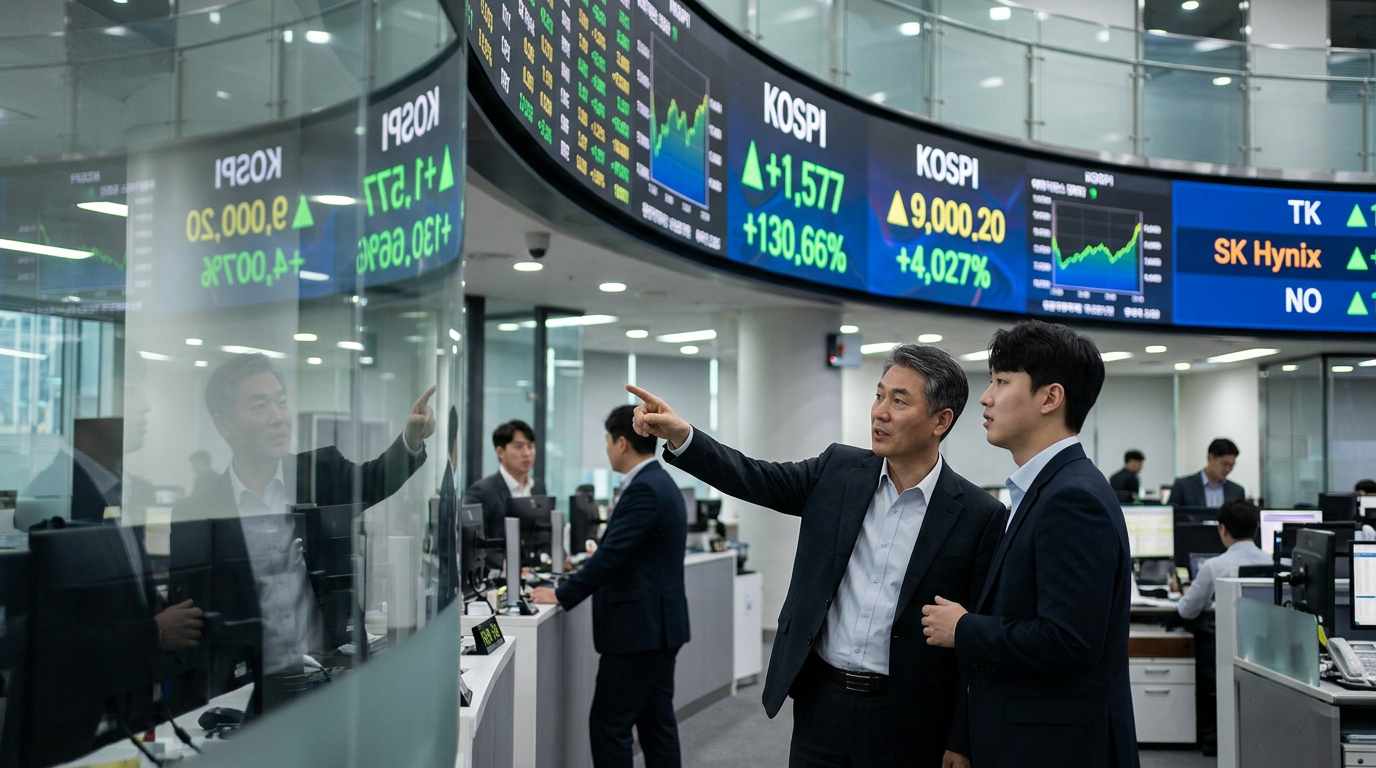
Hey there, bargain hunter.
Most Western investors have a position in South Korea that consists of exactly nothing. That gap is getting harder to justify — and harder to size correctly — by the week.
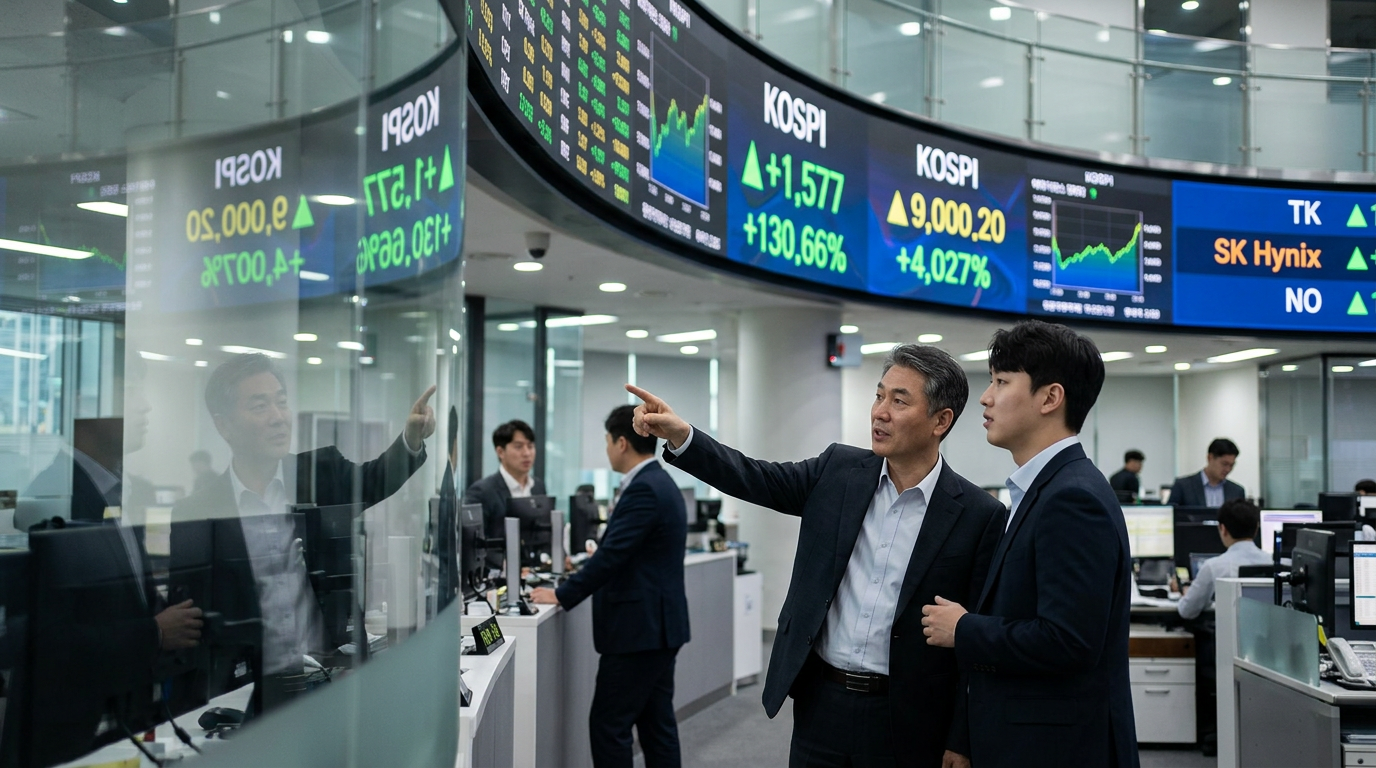
Here is where things stand as of July 2, 2026. The KOSPI surged 96.62% in the first half of the year alone, according to the Korea Exchange, starting from a January 2 close of 4,309. That is not a typo. It is the best first-half performance in the index’s history, surpassing the previous record of 56.99% set during the dot-com bubble in 1999. The index hit an all-time intraday high of 9,385 on June 19 before a wave of volatility pulled it back sharply. As of Wednesday, July 2, it was trading near 7,648 — still up roughly 77% year-to-date.
Here is what makes this different from most runaway rallies. The earnings are real, and they are moving faster than prices.
On June 22, SK Hynix briefly overtook Samsung Electronics in market capitalization, reaching 2,080 trillion won ($1.35 trillion) versus Samsung’s 2,067 trillion won at the close. It was the first time Samsung had relinquished the top spot since it first claimed it in 1999. The crossing lasted one trading day. On June 23, both stocks fell more than 12% in a broad KOSPI selloff that triggered a circuit breaker, and Samsung’s market cap lead was restored by that afternoon’s close.
Mag 7’s relentless assault on Nvidia’s future
Nvidia’s biggest customers are now buying and selling chips to each other. That means, the virtual monopoly that fueled NVDA’s $4 trillion market cap is OVER. If you currently own NVDA, here’s a better alternative. Their competition is scarce, which puts them in a hugely advantageous spot. This supplier’s stock has outperformed Nvidia’s by 50X since July.
Click to get the full details on this urgent “Nvidia alternative” right here.
SK Hynix shares have risen more than 340% year-to-date as of late June, driven by its dominant position in high-bandwidth memory — the specialized stacked-DRAM product that AI accelerators require. Its Q1 2026 operating margin came in at 72%, a new all-time record for semiconductor manufacturing, surpassing even Nvidia’s margin over the same period. Revenue for Q1 reached 5.258 trillion Korean won, a 198% year-over-year increase.
Let that sit for a second. A stock that has more than quadrupled may actually be trading at a lower forward multiple than it did at the start of the year, because earnings estimates moved that much faster.
Now for the concentration problem, because it is the most important thing to understand before you touch this market.
Samsung Electronics and SK Hynix together now account for roughly 57% to 60% of the KOSPI’s total market capitalization, according to data from NH Investment and Securities as of late June. Goldman Sachs has issued a precise warning: if that combined weight rises by just one more percentage point, foreign institutional investors bound by U.S. Investment Company Act diversification rules will be forced to sell approximately $2 billion worth of Korean holdings. That is a structural overhang sitting directly above this market.
The volatility has been extraordinary. The KOSPI triggered a market-wide circuit breaker five times in 2026 alone. Since the mechanism was introduced in 2000, South Korea had experienced only eleven market-wide trading halts in total — and this year accounts for nearly half of them. The June 23 session was the index’s largest point decline on record: down 9.99%, with 859 stocks falling and just 46 rising. Foreign investors sold roughly 5.79 trillion won in a single session.
On July 2 — the day this is being written — the KOSPI dropped another 7.89%, to 7,648, after Meta announced it was entering the cloud leasing business using surplus computing resources. That spooked AI infrastructure investors globally. SK Hynix fell 14.57% in that session. Samsung fell 9.06%. It has now triggered a sidecar or circuit breaker so many times this year that analysts are tracking it like a recurring event.
Wall Street is calling it the “Warsh Shock.” Here’s how to profit from it…
Nearly half of the world’s biggest money allocators are scrambling to reposition for what they expect to be the most volatile market in years.
Larry Benedict isn’t scrambling. He’s seen this before.
He says the Warsh Shock is setting up the most predictable wealth-building window he’s seen in 20 years… and there’s one ticker right at the center of it.
Beyond the two chip giants, something broader is happening that most coverage misses. Investors are also piling into shipbuilding, defense, power equipment, and the K-culture trade, helping make the rally more reflective of Korea’s wider industrial base. The South Korean government announced a 1,500 trillion won (roughly $964 billion) megaproject covering semiconductors, AI data centers, and physical AI infrastructure, which has sent power equipment stocks like LS Electric and HD Hyundai Electric sharply higher. The market is not a pure semiconductor bet. It just looks like one because Samsung and SK Hynix generate all the headlines.
The governance angle is also real. Rising earnings expectations and government commercial law revisions are fueling views that the so-called Korea discount is starting to fade. For years, Korean companies traded at depressed multiples relative to global peers because of weak shareholder protections. Goldman Sachs drew a direct parallel in January 2026 between the current South Korean market and the Japan trade of 2020 — a comparison that will resonate with anyone who caught that run.
JPMorgan raised its bull-case KOSPI target to 15,000. Domestic securities firms are projecting a range of 11,000 to 12,600. Those numbers imply significant upside from current levels, even after the sharp recent pullback.
The relevant tickers for U.S.-based exposure: EWY for South Korea broadly, TSM if you want the Taiwan side of the same semiconductor theme. South Korea’s exports surpassed $100 billion for the first time ever in June, driven by a near-tripling in semiconductor shipments and strong AI-related demand for memory chips and server equipment. The fundamentals are not made up.
What’s interesting is the asymmetry here. The upside is real and earnings-driven. But when U.S. chip sentiment shifts — whether from a Broadcom guidance miss, an MSCI index exclusion, or Meta pivoting into cloud — the KOSPI is the first place the pain shows up, and it shows up fast. Five circuit breakers in six months. The same market that nearly doubled is the same market that can lose 10% in a single afternoon.
Size accordingly.