July 1, 2026
Best Quarter in Six Years. Now Comes the Hard Part.
Q2 is over. The next 30 days set the tone for everything that follows.
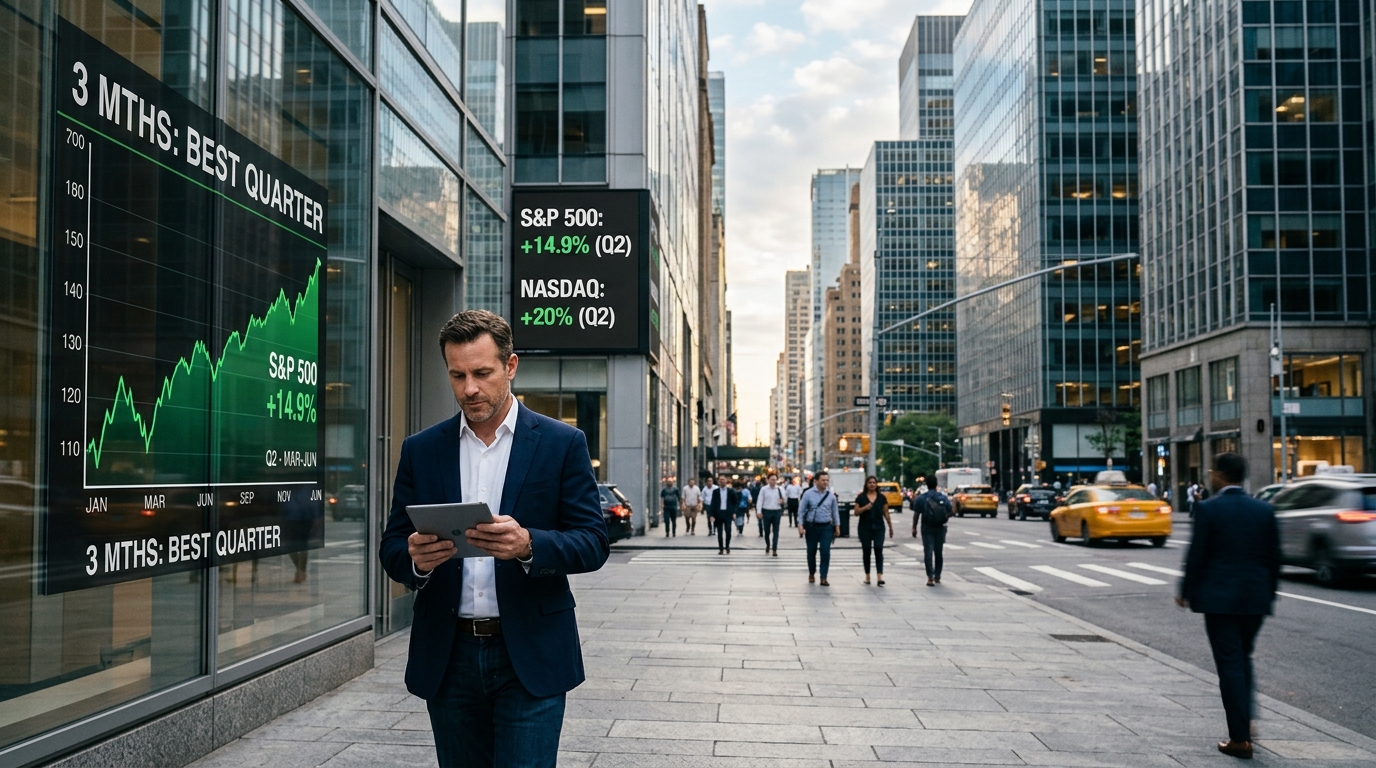
The S&P 500 just posted its best quarter since 2020. Let that sit for a second.
The index rose 14.9% in Q2, its strongest advance in six years, closing at 7,499 on June 30, even as an active conflict in the Middle East threatened oil supply, inflation, and risk appetite. The Nasdaq gained 21.4% over the same stretch. That is not a quiet quarter. That is a historic one.
And yet here is the uncomfortable part. The S&P 500 gained 9.5% in the first half, but 38% of its members declined. Seventeen of the 20 best-performing stocks in the index came from information technology. So this rally was real, but it was not broadly owned. Most people did not get all of it. A lot of people got almost none of it.
What is sitting on the other side of this record quarter is a macro calendar that is genuinely high-stakes.
Forget SpaceX, Elon’s M.A.G.I. Could Be Bigger
While everyone was distracted with the recent SpaceX IPO…
Elon Musk quietly filed a patent with the U.S. Patent and Trademark Office to protect what Jeff Brown believes will be his next breakthrough…
Something he called “the greatest tech invention in history.”
The Week That Frames the Next Six Months
We are in the middle of it right now.
Private sector employment grew by a seasonally adjusted 98,000 in June, down from 122,000 in May and below the Dow Jones consensus forecast for 110,000, ADP reported Wednesday. That is today’s number. Markets shrugged.
ADP chief economist Nela Richardson put it plainly: “The pace of hiring is telling a story of both supply and demand. We know it’s taking people longer to find work, but there also are signs of labor supply constraints in certain industries. For now, the overall effect is a slowdown in job creation.”
Tomorrow is the one that counts. The Bureau of Labor Statistics releases June nonfarm payrolls Thursday, July 2, at 8:30 a.m. ET, a day early because U.S. markets are closed Friday for the Independence Day holiday. Economists surveyed by Dow Jones expect 115,000 new jobs added and an unemployment rate unchanged at 4.3%.
But here is what makes this particular jobs report different from the six before it.
At the Fed’s June 17 meeting, rates held at 3.50% to 3.75% and the updated dot plot shifted decisively. Nine of 18 participating officials projected the federal funds rate would end 2026 above its current level, with the median end-year projection moving to 3.8% from 3.4% in March. That is a meaningful signal, and it was Kevin Warsh’s first meeting as chair. He did not submit his own dot, but the committee’s message was clear: cuts are off the table, and a hike is live.
CME FedWatch data puts the probability of at least one hike by year-end at roughly two-thirds. That number moves Thursday morning.
Slight tangent, but it matters: when May payrolls came in at 172,000 against an expectation of roughly 85,000, the Nasdaq Composite dropped 4.18% in a single session, its worst day since April 2025. The S&P 500 shed 2.6%. So this market has shown it will move fast on a surprise. A holiday-shortened week with thin liquidity makes that dynamic more acute, not less.
His Most Generous Offer Ever. One Dollar. America’s 250th.
Tim Sykes spent 25 years and $1 million proving regular traders deserve real tools. This Fourth of July, access to his patent-pending AI forecasting tool opens for $1.
The Earnings Season Nobody Has Fully Absorbed
The jobs report is actually the warm-up act. The main event starts July 14.
Q2 earnings season gets going in earnest when JPMorgan Chase, and the other major banks, report their quarterly results on July 14. JPMorgan is expected to post EPS of roughly $5.44, up about 9.7% year over year, according to analyst consensus.
And the expectations heading in are extraordinary. The estimated earnings growth rate for the S&P 500 in Q2 2026 is 23.1%, up from 18.8% at the start of the quarter. If 12.3% revenue growth is the actual rate, it will mark the highest revenue growth the index has reported since Q2 2022 and the second consecutive quarter of double-digit revenue growth.
Those are the expectations. That is the bar. And in a market trading at a forward P/E in the low-20s, there is very little room to disappoint on guidance without a real shift in sentiment.
The clean confirmation investors need is firm guidance, stable margins, and AI demand converting into revenue rather than only capital-spending promises. A weaker signal, not even a headline EPS miss, would be the more dangerous outcome. Revenue guidance, AI capex returns, wage pressure, and energy-sensitive margins will show whether this quarter’s 14.9% gain was built on durable earnings or pulled too much optimism forward.
The Risk Nobody Is Discussing Loudly Enough
Here is what is worth flagging on the way into July.
Between the end of 2024 and 2025, the value of household stock portfolios soared 18%, or $10.31 trillion, to $67.77 trillion, according to Federal Reserve data. That stockpile is likely at new records right now given the S&P 500’s first-half rally. The richest 10% of American households own about 87% of that total, which concentrates the wealth effect considerably.
That is not just a portfolio observation. Consumer expenditures account for roughly 69% of U.S. GDP. At that level of stock exposure, any meaningful correction would not stay in portfolios. It would flow through to consumption. The wealth effect, which has been a tailwind for years, could become a transmission risk.
In other words: the higher the market goes, the more dangerous a reversal becomes. That is not a bearish call. That is just the math of where we are.
Louis: The “Strawberry Problem” Is Stalling the AI Revolution
Billion-dollar tech investor Louis Navellier calls it “AI’s darkest secret.”
The good news? One company is about to solve the crisis… unleashing a new $100 trillion opportunity.
What to Watch Next
FOMC minutes from Warsh’s first meeting publish Wednesday, July 8, with detail behind the dot plot’s shift toward a possible 2026 rate hike. June CPI, the last major inflation reading before the July 28-29 FOMC decision, lands Tuesday, July 14. That is the same morning the banks report. It is going to be a loud morning.
The Q2 GDP advance estimate and June PCE both release July 30, the day after the FOMC decision. So within 30 days, the market absorbs NFP, FOMC minutes, CPI, the start of Q2 earnings season, a Fed rate decision, and GDP. There is no escape hatch in this calendar.
The bull case is straightforward: earnings come in above the already-elevated bar, AI capex starts converting into actual revenue lines, and Warsh holds in July with a mild tone that takes a near-term hike off the table. That outcome probably takes this market higher.
The bear case is more subtle. Earnings beat on the headline but guide cautiously. Tomorrow’s jobs number comes in strong enough to push year-end hike odds even higher. And a market where household stock portfolios are near record levels starts to feel the weight of a higher-for-longer rate environment for the first time since Q1. That is not a crash scenario. It is a slow grind lower that nobody is positioned for because the last three months rewarded buying every dip without exception.
The question going into Q3 is not whether this bull market has legs. It does. The question is whether the rally’s next leg gets built on actual earnings delivery or whether Q2’s extraordinary advance already borrowed too much from the future. Thursday gives us the first clue.