June 26, 2026
FCX Is 14% Below Its Peak. The Copper Story Hasn’t Changed.
A growing supply gap and a delayed Grasberg recovery are the two numbers that matter most right now.
Hey there, bargain hunter.
FCX hit a 52-week high of $72.28 earlier this month. As of Thursday’s close it was sitting around $62.20. That’s a roughly 14% pullback while the underlying fundamentals haven’t moved in the wrong direction at all. In fact, Q1 2026 earnings came in with adjusted EPS of $0.57 against a consensus estimate of $0.47, revenue of $6.23 billion that beat forecasts by nearly 5%, and EBITDA of $2.47 billion running 24% above expectations. Net income attributable to common stockholders came in at $881 million, compared to $352 million in Q1 2025.
Elon Musk: Buy Alert
The world’s richest man just launched a new $480 trillion disruption, which could make you massive gains this summer. It has nothing to do with space, robots or AI. It’s much, much bigger.
The fundamentals didn’t move. The price did.
So what’s actually going on?
Start with the commodity itself. On May 13, 2026, COMEX copper hit an all-time high of $6.71 per pound. LME copper had already set its own record back on January 29, briefly touching $14,527.50 per tonne during intraday trading. Copper is currently trading around $6.10 per pound, which is still more than 20% higher than a year ago. The short-term pressure comes from a stronger dollar and some softness in China’s traditional industrial sectors, but that weakness is being only partially offset by resilient demand from renewable energy, grid buildout, and electronics. The longer-term picture is a different conversation entirely.
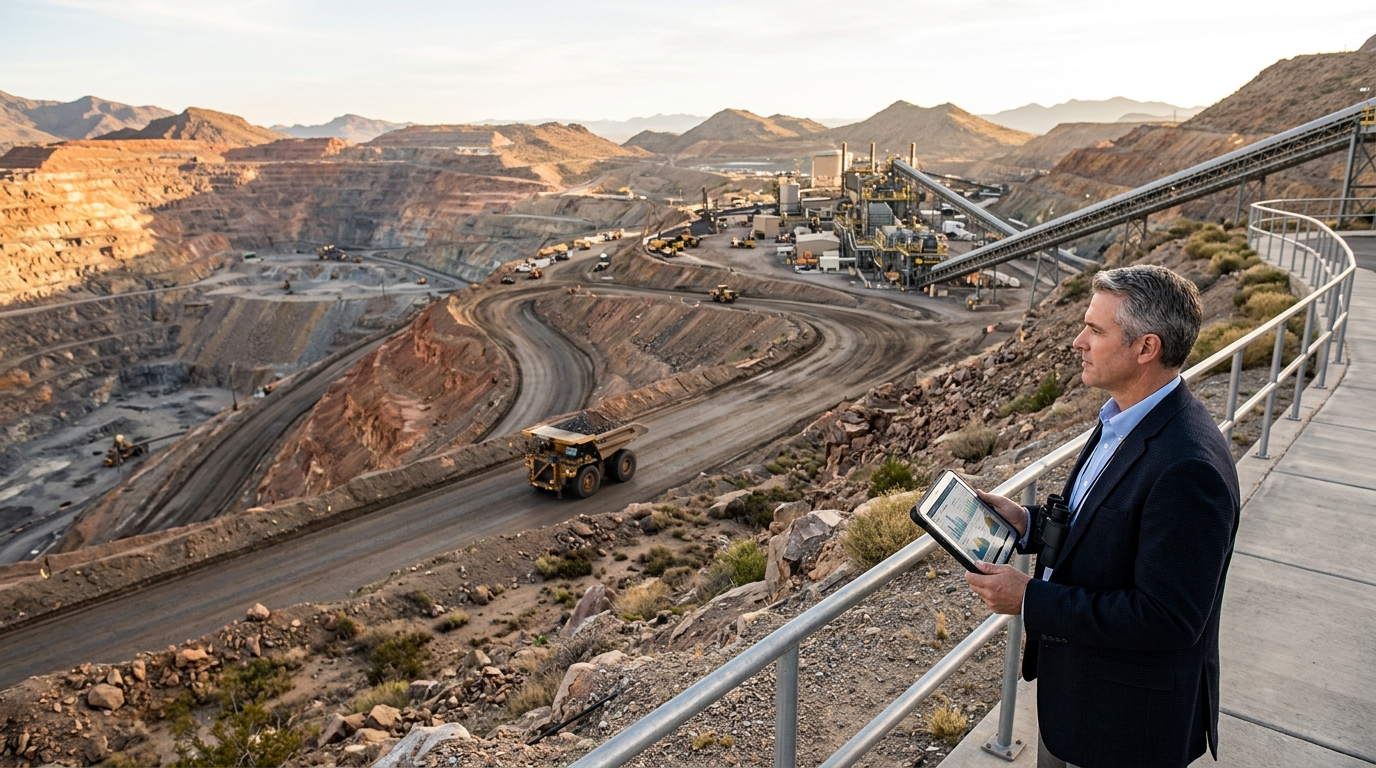
The supply picture is the part most investors are still underweighting. The Grasberg Block Cave mine in Indonesia, one of the world’s most important copper and gold complexes, is currently running at just 40% to 50% of capacity following a September 2025 mudflow incident. As of May 2026, Freeport Indonesia formally pushed back the full recovery timeline to early 2028. The updated plan targets roughly 65% capacity in the second half of 2026, 80% by mid-2027, and sustained full operations only in early 2028. That’s a near-term overhang that the market is clearly pricing into the stock.
Tight supply isn’t just a Grasberg story, though. The Kamoa-Kakula complex in the DRC pushed its 500,000-tonne annual production target back to 2027 after seismic-induced flooding halted mining for weeks in 2025. The copper concentrate market has gotten so stressed that the annual treatment and refining charge benchmark settled at $0 per tonne for 2026, the lowest level ever agreed in annual negotiations, and spot charges have been running negative since 2024. When smelters are effectively paying to process ore rather than getting paid, the concentrate market is very tight.
This IPO Could Make SpaceX Look Small (Read before October 6)
A red-hot AI startup just filed to go public — and it’s already valued at nearly $1 trillion. Wall Street legend Marc Chaikin believes a single announcement on June 16 could send that number far higher. He’s found a backdoor way in before the IPO.
On the demand side, you have three overlapping forces pulling at once: grid modernization, EV buildout, and AI data center infrastructure. Each one is copper-intensive. All three are accelerating simultaneously. The International Copper Study Group projects a 150,000-tonne refined copper deficit for 2026. J.P. Morgan has estimated a 330,000-tonne shortfall. These are institutional forecasts, not fringe numbers.
Slight tangent, but it matters: every $0.10 per pound move in copper equates to approximately $400 million in annual EBITDA at FCX’s 2027 to 2028 production levels, according to CFO Maree Robertson on the Q1 earnings call. That kind of operating leverage cuts both ways. It’s why the stock moves so hard on copper headlines. And it’s why the Grasberg recovery timeline is the single most important variable in FCX’s near-term earnings trajectory.
The analyst community is divided, which is informative on its own. Barclays upgraded FCX to Strong Buy with a $77 price target. UBS raised its target to $75 with a Buy rating. BNP Paribas Exane lifted its target to $82 with an Outperform. On the other side, Morgan Stanley cut to Equal Weight at $66, citing execution risk through 2027. Bernstein sits at $58.50 with a Market Perform. That spread from $58.50 to $82 tells you there is a genuine disagreement about how much of the recovery is already reflected in the stock versus how much upside is still available. The average across 22 analysts is around $70.
Meanwhile, brownfield expansion projects at Bagdad, El Abra, and Lone Star are projected to bring 2.5 billion pounds of new copper supply online over the coming years. These aren’t speculative greenfield bets. They’re on existing permitted land using proven infrastructure.
Trump Admin to Pump $1 Billion into this “Off-the-Radar” AI Stock
The U.S. government pumped more than $1 billion into Intel. The stock popped 128%.
It pumped $400 million into MP Materials. The stock popped 200%.
It bought 10% of Trilogy Metals. The stock popped 500%.
And now, Trump has chosen this AI stock for a $1 billion payday.
Q2 earnings are expected around mid-July. Between now and then, FCX is sitting roughly 14% off its 52-week high while copper remains structurally undersupplied and Q1 results already came in 21% ahead of EPS estimates. The question isn’t whether the gap closes. The question is when, and what the catalyst turns out to be.
Watch the Grasberg capacity update on the earnings call. If the ramp toward 65% is on track for H2, the stock prices that quickly. If management walks it back again, expect another flush. That’s the trade in a single sentence.
Worth a closer look before the call drops.