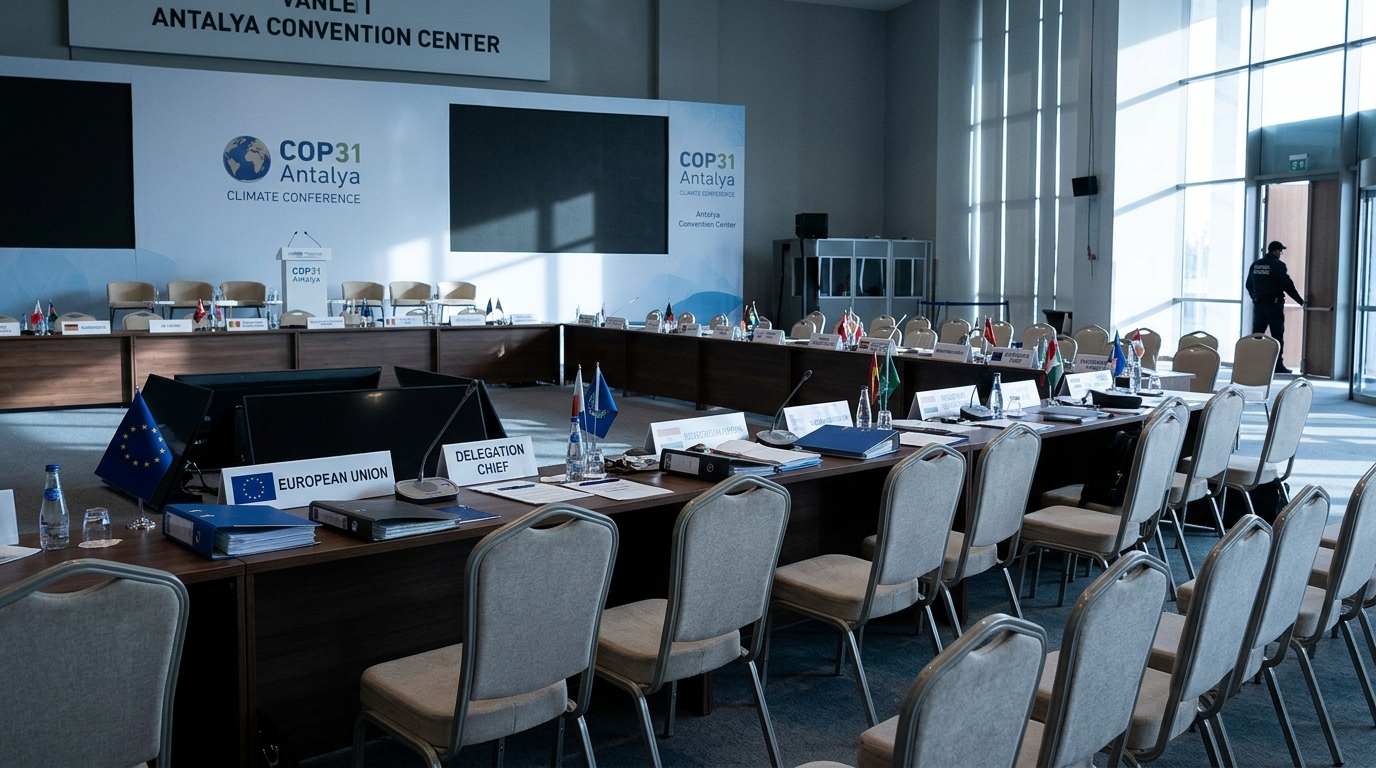
A fight over whether to mention fossil fuels caused the COP31 climate talks in Antalya to fall apart, the first such collapse since 2009. Negotiations unraveled after the conference ran two days past its scheduled close, with 196 countries and the European Union unable to agree on an overarching political outcome. The diplomatic wreckage landed Sunday, November 22, 2026. By Monday morning, every clean-energy fund in a portfolio is a different animal than it was two weeks ago.
What Actually Broke Down
The final draft agreement set out proposed measures for countries to accelerate climate action, but the document drew immediate criticism for dropping explicit language about moving away from fossil fuels. Reports from the talks described Russia and Saudi Arabia as among the countries opposing fossil-fuel transition language. The EU walked out. Ireland’s Climate Minister Darragh O’Brien, speaking for the bloc, said the text went nowhere near the level of action required.
United Nations climate talks in Antalya ended without an overarching deal for the first time since 2009 amid clashes over fossil fuels, carbon capture, and climate finance. Focus now shifts to COP32 in Addis Ababa, Ethiopia, scheduled for November 8 to November 19, 2027. That is at minimum another year away. The gap matters for investors holding funds whose underlying thesis assumed a tightening global framework.
The Investment Case Splits in Two
Funds like ICLN and TAN were built on a world moving in one direction at once. That world did not show up in Antalya. This highlights the immense volatility inherent in thematic investing, especially in geopolitical industries like clean energy and solar.
What remains is a sharper question: which governments are still paying? The EU has an answer. The European Commission released AccelerateEU in April 2026, a policy package designed to accelerate the EU’s shift to clean energy, with EU materials and related analysis putting the annual investment need at about €660 billion for 2026 to 2030. Under that strategy, the European Investment Bank is expected to play a larger role in clean-energy finance, though specific multi-year totals have varied by program and announcement. EU policy did not collapse in Antalya. It walked out in protest of countries that want to slow it down.
That divergence reshapes which part of ICLN’s portfolio earns its keep. ICLN offers broader diversification and a lower expense ratio than TAN. Its global mandate, however, is now a liability in one specific way: exposure to countries where the transition just became substantially less certain. Investors in TAN should understand that meaningful weights in Chinese-linked names mean tariff policy and trade headlines can move that fund harder than a diversified renewable basket.
Building Wealth Around a Fractured Framework
The collapse at Antalya does not kill the energy transition. It localizes it. Investors who understand that distinction can position accordingly rather than dumping the category wholesale.
The EU’s domestic commitment to clean energy is rooted in energy security as much as climate policy, which means it does not require a UN consensus to continue. AccelerateEU was presented in part as a response to energy supply disruptions, treating energy security as a convergence of finance, industrial policy, and climate strategy. That framing survives Antalya regardless of what Russia or Saudi Arabia agreed to sign.
For portfolios already holding ICLN or TAN, the question is not whether to exit but whether the geographic and policy concentration risk is priced correctly. Across 2022 to 2024, ICLN posted steep losses, roughly in the neighborhood of 40% to 45% cumulatively depending on the measurement window. This week’s events are a reminder of why that discount existed.
Risks to Monitor
The most direct risk is policy regression beyond Russia and Saudi Arabia. If the EU faces fiscal pressure and finds domestic reasons to slow spending before 2030, the entire structural argument weakens. Carbon credit markets, which partly underpin the economics of several ICLN holdings, are also exposed to any further erosion of international coordination.
Orsted and other large ICLN components derive most of their revenue from contracted European projects. That insulates them from the UN impasse in the near term. Shell and BP, by contrast, have already trimmed their low-carbon investment commitments significantly, and a world without treaty pressure gives them little reason to reverse course.
Wealth Builder Takeaway
COP31 did not end the clean-energy trade. It ended the version that required the whole world to cooperate. The investors who come out ahead are those who know exactly which governments are still at the table and size their positions to match that reality, not the cleaner story that Antalya was supposed to deliver.