
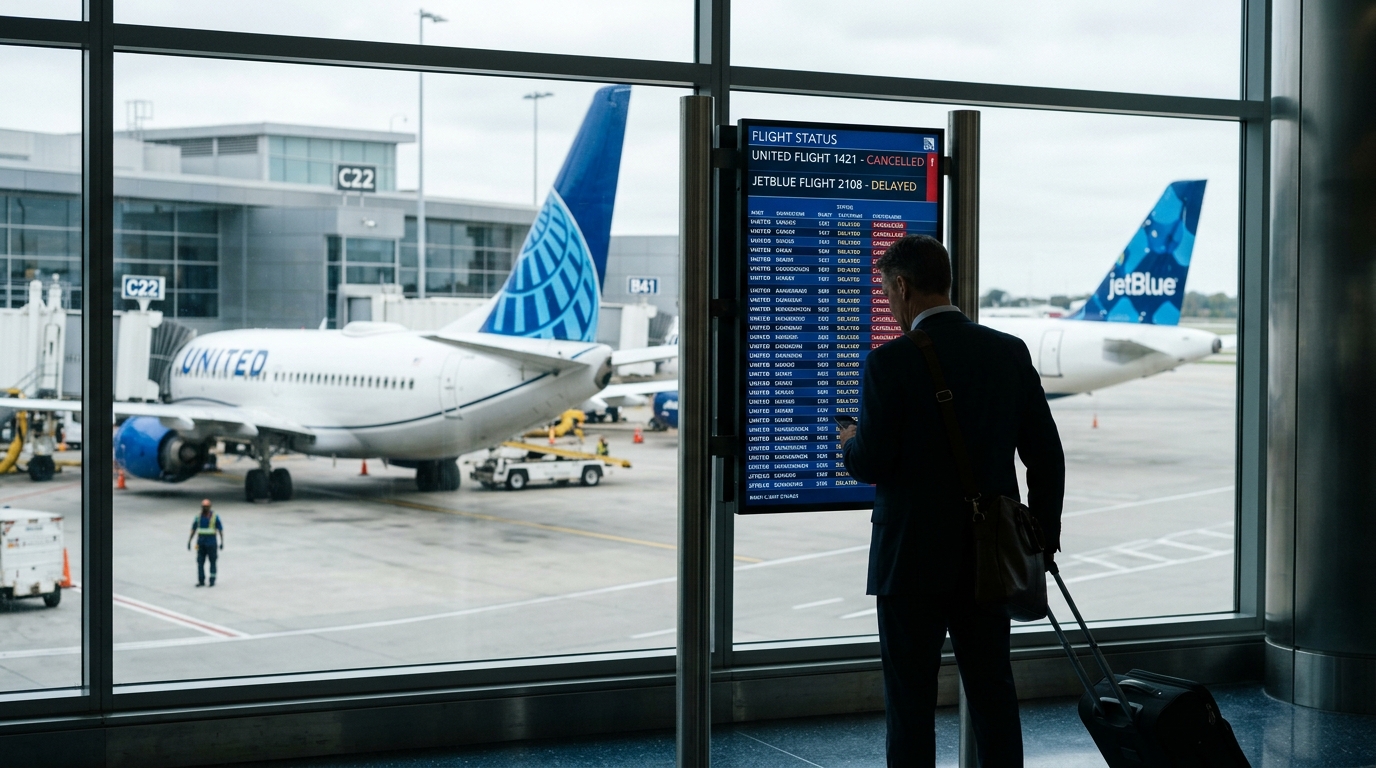
Airlines are on the watchlist this morning for two distinct but compounding reasons: a hard dollar estimate on last week’s FAA ground stop, and a fresh system failure inside United’s own network that the FAA had nothing to do with.
The $345 Million Number
The four largest U.S. airlines face an estimated $345 million earnings hit after the nationwide ground stop on Friday, November 13 disrupted flights through the weekend, according to brokerage Bernstein. Bernstein pegged the cost to American Airlines, Delta Air Lines, United Airlines and Southwest Airlines at roughly $345 million pretax combined, with an 80% range of $270 million to $430 million.
The ground stop was the longest nationwide ground stop in about 25 years, and the first of its kind since January 2023. The financial hit for other carriers such as JetBlue, Alaska Airlines, and Frontier could push the total industry impact to over half a billion dollars. Recovery from the event was uneven: American canceled 22% of its Sunday schedule and JetBlue canceled 28%, while Delta canceled 5%, United 3%, and Southwest 4%, according to BofA analysts.
A preliminary investigation has traced the disruption to excessive data traffic triggered by problems involving recently installed routers at two FAA facilities. Officials have said the aviation chaos may have been tied to a newly installed router put in during work performed by the FAA’s network service provider, L3Harris. That explanation has drawn pushback from Hewlett Packard Enterprise, the parent company of Juniper Networks, which makes the routers involved.
United’s Self-Inflicted Problem
Then came Monday. United Airlines said it resolved a glitch that led to a widespread system outage Monday evening, just days after the technical issue in the FAA’s network triggered the nationwide ground stop. The outage lasted about 90 minutes.
A memo from the union representing United Airlines pilots indicated the issue was with the airline’s weight and balance calculation system, noting the company could not provide outbound flights with final weights. The union said the outage affected multiple pilot-facing applications, including crew communications and messaging systems. United said it has no indication the disruption was related to cybersecurity.
United shares were down about 2.5% in after-hours trading at the time of Reuters’ November 16 coverage. JetBlue had fallen roughly 4% in premarket trade on Monday. The two carriers absorbed the most reputational and operational damage from the extended disruption, and United compounded it with a failure that was entirely its own.
What Traders Should Watch
- UAL: The weight-and-balance outage has been resolved, but the airline confirmed the disruption was unrelated to any broader FAA system issues, meaning investors are now pricing two separate reliability questions into one stock.
- JBLU: Canceled 28% of its Sunday schedule. The premarket weakness reflects the fact that JetBlue had the most ground to recover operationally among the named carriers.
- AAL, DAL, LUV: Covered by the Bernstein estimate but showed relative resilience during the recovery window. Watch for any Q4 guidance revisions.
- L3Harris (LHX): Shares fell after administration officials suggested the contractor may be at fault as the investigation into the router failure continues. Any escalation in the FAA probe is an independent catalyst here.
The Cheat Sheet
Top Theme: U.S. aviation infrastructure risk is now a two-layer problem: government-side ATC fragility and airline-side system reliability, both being priced in the same week.
Stock to Watch: UAL. The ground stop hit and the internal outage are separate events that arrive on the same balance sheet.
Sector to Watch: Airlines. Bernstein’s $345 million estimate is the first quantified earnings anchor for a disruption that the market has been pricing on sentiment alone.
Biggest Risk: FAA investigation findings that implicate a wider technology failure. Any expansion of the L3Harris probe or congressional action on ATC funding could reset the entire group.
One Thing to Remember: JetBlue’s 28% Sunday cancellation rate was the worst among major U.S. carriers cited by BofA. If schedule normalization drags past Tuesday, the premarket weakness may not fully reflect the revenue exposure.