Silver and gold are obliterating all previous profit records with next-level gains now on-deck for well-timed investors.
We’re talking early-stage, small-cap discovery stories that are only just beginning to unfold.
The early-stage opportunity is taking shape across a historic North American silver-gold district that helped build early fortunes but was never explored as a unified system.
For generations, the district produced high-grade metals at surface.
Yet, the deeper story was never told – not because the metals weren’t there but because the land package was highly fragmented and never explored as a single system.
That has now changed.
For the first time ever, this exceptionally well-run small-cap explorer has brought the entire district under one roof – enabling modern geology and drilling to finally test the system properly from surface to depth across kilometers of previously untouched mineralization.
And the timing couldn’t be better.
Phase-2 drilling is accelerating as you read this… setting up a near-term flow of potential needle-moving results as the discovery picture sharpens.
And that’s not all.
Add in a second nearby district-scale silver-gold asset… and the exploration runway expands even further for this emerging small-cap.
We’ve put together a FREE online report with all the details, including:
✔ A newly unified district-scale silver-gold system in North America
✔ What the first drill results are already confirming
✔ Which targets will see drilling next
✔ How a second district-scale asset expands the discovery upside
✔ Key 2026-27 catalysts as drilling intensifies
Inside, you’ll also find our exclusive, in-depth interview with the company’s president & CEO who brings a true firsthand look at where this discovery is headed next and why the timing is so critical.
Click here to access our FREE online report and see why this Sub-US$1 silver-gold stock is setting up to be one of the most compelling early-stage opportunities of 2026-27.
CNH Is Selling Its Excavators to Buy a Better Harvest
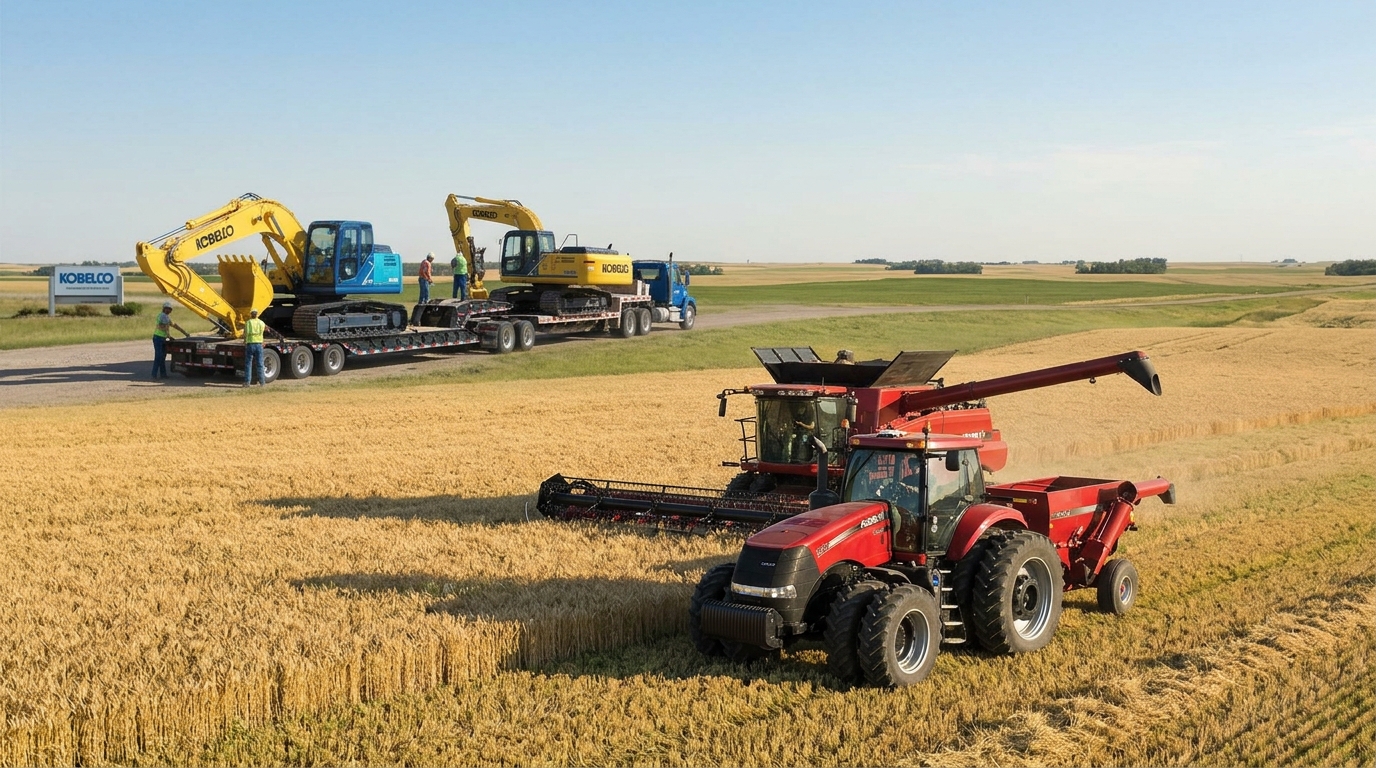
Hey there, bargain hunter. CNH Industrial just handed its bulldozers to someone else and kept the tractors. This morning the company announced a definitive agreement to sell 70% of its construction equipment business to Kobelco Construction Machinery, a wholly owned subsidiary of Kobe Steel, at a $1 billion enterprise valuation. CNH expects to receive $700 million in cash and retains a 30% stake in the resulting joint venture (cash is subject to net debt, working capital, and other customary adjustments).
Scoreboard
- Deal enterprise value: $1 billion
- CNH cash received: $700 million (subject to net debt and working capital adjustments)
- CNH retained stake: 30% in CE JV
- Brands staying in the joint venture: CASE Construction, Eurocomach, New Holland Construction
- Brands staying with CNH: Case IH, New Holland, STEYR
- CNH stock trading near $11.73 ahead of this morning’s Q3 results release, forward P/E varies widely by data source
What Actually Happened
Construction was always the ugly duckling inside CNH. In Q2 2026, the segment posted a gross margin of 11.9%, down sharply from 15.7% a year earlier, with tariff and transportation cost volatility called out as a headwind in company materials. Agriculture, even at its own depressed margins, carried the company. By offloading majority control to Kobelco, CNH removes a capital-hungry, lower-margin division while still keeping a seat at the table: the CE JV is expected to supply construction equipment to CNH’s agriculture dealers, so the channel can stay intact.
The company has said it expects to use the net cash proceeds to reduce debt. That matters because CNH had $25.966 billion of total debt as of June 30, 2026, with much of that tied to Financial Services. The industrial balance sheet still benefits from incremental cash after a year where profitability compressed. First-quarter 2026 adjusted net income was $21 million, an 84% year-over-year decline. Second-quarter came in at $161 million. The cycle has been brutal.
What the Market Is Really Saying
Deere has been telegraphing the same message for months. Its recent outlook and commentary have pointed to a downcycle that could stabilize before demand improves, with used-equipment conditions and order trends watched closely as turning indicators. If Deere is right, CNH just simplified its structure at exactly the right moment, arriving at cycle trough as a focused agricultural company rather than a conglomerate dragging a weak construction segment into the upturn.
The arithmetic is what bargain hunters care about. Construction contributed $866 million in net sales in Q2 2026 alone. At the $1 billion enterprise value Kobelco is paying for the Construction Equipment business, the deal is in the neighborhood of about one times annualized Q2 revenue. CNH got a reasonable exit. The question is what the remaining business is worth.
The construction equipment exit also removes CNH from a segment where a better-capitalized rival is setting the pricing ceiling. Caterpillar’s margin structure at peak cycle shows what a focused construction equipment business can earn when demand is running hot.
Is It Cheap?
At 0.79x trailing sales (as stated in the draft) and a forward P/E that depends heavily on which consensus estimate set you use, CNH can look optically discounted or optically expensive depending on the screen. What is not up for debate: Agriculture adjusted EBIT margin sat at 5.2% in Q2 2026, down from 8.1% a year earlier, and management’s 2026 outlook has centered on agriculture net sales between down 5% and flat year-over-year. Strip out construction, add $700 million of expected cash proceeds (net of adjustments), and the surviving entity looks leaner. But margins need to recover toward mid-cycle targets management has articulated historically before the valuation math becomes genuinely compelling.
AGCO, the closest pure-play peer, is still the right comp set conceptually. But rather than anchoring on a single point estimate for AGCO’s forward multiple, the better takeaway is that CNH’s cheapness here is conditional on an agriculture margin and volume recovery showing up in the numbers, not just the story.
The reshoring wave adds a second variable to the equipment demand picture. Domestic manufacturing capital spending is flowing into automation and factory equipment at a pace not seen in decades.
Bull / Base / Bear
Bull: Agriculture cycle turns in 2027, margins recover toward 8-9%, debt falls on $700 million proceeds, and the pure-play story attracts re-rating.
Base: Recovery is slow and uneven. South America stays a swing factor, and margins recover modestly. The stock drifts higher as the market waits for proof.
Bear: Farm income stays pressured, tariff and logistics costs remain a headwind, and the construction divestiture proceeds mostly go to debt service. The thin earnings base makes valuation look stretched on depressed earnings.
Action Plan
This is a scale-in situation, not a one-shot bet. The Kobelco deal removes a structural headache and surfaces cash. But buying the full position today means buying into cycle trough with margin recovery as faith, not fact.
- First tranche now: Small position to establish exposure on the catalyst. The deal confirms strategic direction and strengthens the balance sheet.
- Second tranche on Q3 results: If agriculture margins are tracking toward the high end of the 4.5-5.5% full-year guidance band, add.
- Full position in 2027: When mid-cycle margin recovery becomes visible in reported numbers, not just guidance.
- Trim trigger: If South America deterioration spreads to North America, or if cost headwinds intensify instead of easing.
Cheap Investor Checklist
- Deal closes on schedule with no material working capital adjustments that erode the $700 million
- Agriculture adjusted EBIT margin exits 2026 at or above 5.5%
- Industrial free cash flow lands in the $150-350 million guidance band for full-year 2026
- South American agriculture sales stabilize in H2 2026
- Debt reduction from proceeds is confirmed in a post-close balance sheet update
- CE JV dealer channel agreement does not disrupt Case IH and New Holland retail performance
- Precision Tech progress is measurable and disclosed clearly by mid-2027
Bottom Line
If the agriculture cycle has genuinely troughed and CNH uses the expected $700 million cash proceeds to clean up its balance sheet, today’s buyer is purchasing a focused Case IH and New Holland franchise at a reasonable multiple with recovery optionality. If the cycle drags, the thin earnings base makes patience expensive. Buy in stages. Watch the margins, not the headlines.