
June 11, 2026
The Factory Is Coming Home. These Two Stocks Supply the Equipment.
Cognex (CGNX) and Parker-Hannifin (PH) at the center of hyper-scale automation and domestic manufacturing
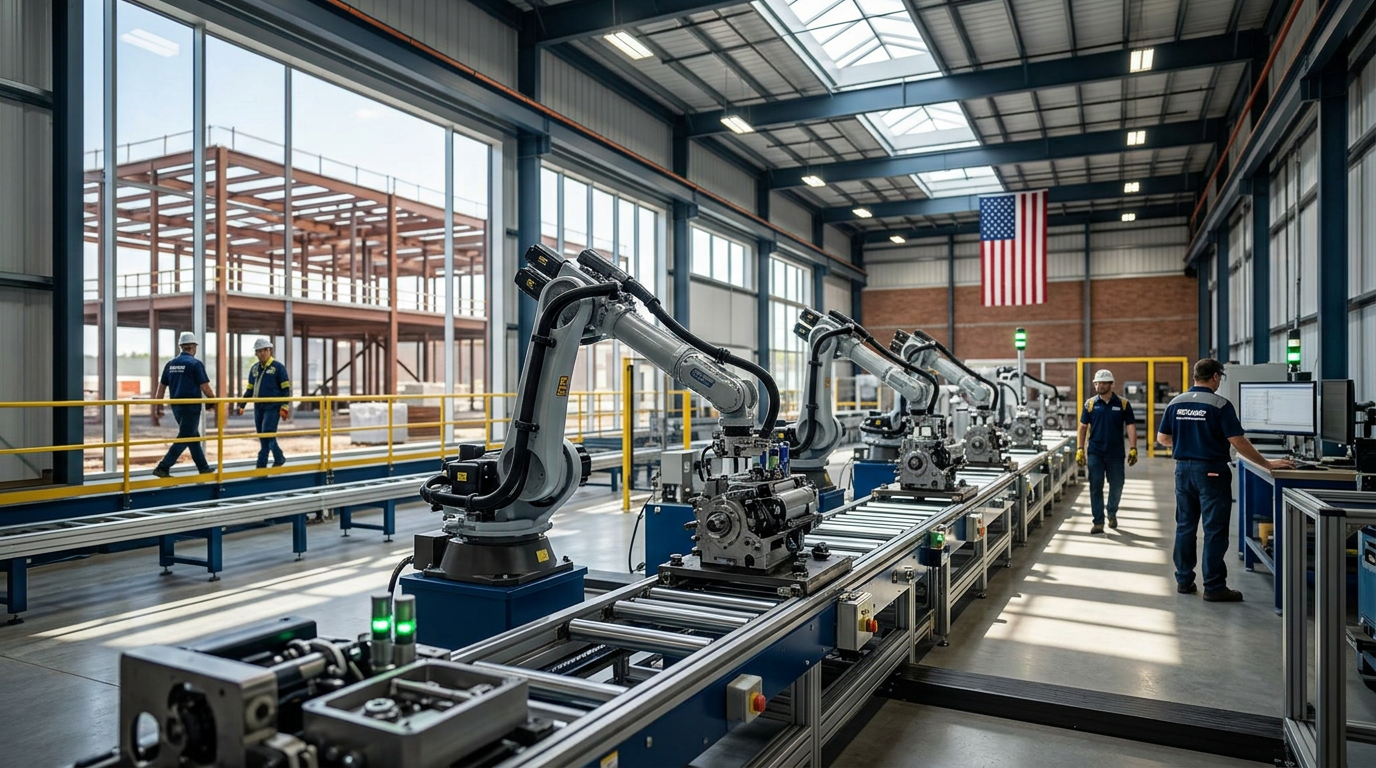
Something structural is happening in American manufacturing. It is not a story. It is not a talking point. It is capital flowing into concrete, steel, and factory equipment at a pace that has not been seen in decades.
In 2024, companies announced more than 244,000 reshoring and foreign direct investment jobs, pushing cumulative totals past two million positions since 2010. U.S. labor costs average $25 to $30 per hour compared to roughly $6 to $7 in China. That gap does not close on its own. It closes through automation – and that is exactly where today’s two names live.
What Is Actually Driving This
A McKinsey survey of global supply chain leaders found that 82 percent reported their supply chains were affected by new tariffs in 2025, with 20 to 40 percent of their supply chain activity impacted. Among those affected, 33 percent developed supplier nearshoring or onshoring plans. These are not small companies hedging. These are serious capital allocation decisions that require physical infrastructure – conveyors, hydraulics, pneumatics, cameras, sensors, quality-control systems.
Here is the uncomfortable arithmetic: without significant automation, most reshoring projects struggle to make financial sense once startup subsidies and tax incentives run out. That is not a bearish take on reshoring. It is the reason the two companies below matter right now.
Don’t Let Uncle Sam Beat You to the Next Big Winner
The U.S. Government is no longer just making rules for the stock market.
It is now buying stocks itself.
And every time it buys, the stock price has gone up quickly.
Michael Robinson has spent months studying this new pattern.
He believes he has found the next company they are likely to buy.
You still have time to get in before the news hits.
Cognex Corporation (CGNX) – The Eyes on the Line
Cognex provides machine vision products that capture and analyze visual information to automate manufacturing and distribution tasks. Think of it as giving factory robots the ability to see – locating, identifying, inspecting, and measuring discrete items like mobile phones, automotive components, EV batteries, and e-commerce packages. Human vision cannot meet the size, accuracy, or speed requirements of modern high-volume production. Cognex fills that gap at scale.
The numbers coming out of this company right now are worth paying attention to.
- Q1 2026 revenue: $268.4 million – 24% year-over-year growth, beating analyst estimates of $245.6 million by 9.3%
- Q1 2026 adjusted EPS: $0.34, up 113% year over year – seventh consecutive quarter of EPS growth
- Q1 2026 adjusted EBITDA margin: 26.9%, expanding 1,010 basis points year over year
- Full-year 2025 revenue: $994 million, up 9% year over year
- Balance sheet: $642 million in cash and investments, zero debt
- Free cash flow conversion: above 100% – management targeting that again in 2026
Logistics, which represents 26% of 2025 revenue, delivered double-digit growth for the ninth consecutive quarter. Semiconductor posted double-digit Q1 growth, with management raising its 2026 outlook. Consumer electronics and packaging followed the same pattern. The company also launched two new embedded AI vision systems – the In-Sight 6900 and 3900 – and its OneVision cloud platform has already been adopted by more than 100 customers globally since its mid-2025 beta launch.
One tangent worth noting: management’s goal is to double the customer base within five years. In 2025, they added approximately 9,000 new accounts – three times the 2024 level. That is not a metric you see every quarter in this space.
On valuation, CGNX trades at a trailing P/E around 77x and a forward P/E near 34x, below its five-year average forward P/E of 48x. That forward multiple discount is the part people tend to skip. If the margin expansion toward a 25% adjusted EBITDA run-rate exiting 2026 materializes – backed by $35 to $40 million in identified cost reductions – the earnings picture looks meaningfully different in 12 months. Expensive on trailing earnings, less so on where the business is actually heading.
The risks are real. Automotive remains weak. Short-cycle demand is hard to forecast. The stock has run hard and any macro stumble could push the multiple back down fast. Watch semiconductor capex acceleration as the single most important variable for the next four quarters.
Parker-Hannifin Corp. (PH) – The Muscle Behind the Machine
If Cognex gives factories their eyes, Parker-Hannifin gives them their arms, legs, and circulatory system. The company designs and manufactures motion and control technologies – hydraulic systems, pneumatic components, valves, pumps, and electromechanical systems – that control the movement of liquids, gases, and mechanical force across heavy industrial and aerospace equipment.
Parker is a Fortune 250 company with more than a century of operating history, and the recent numbers reflect a business running at peak efficiency.
- Fiscal Q3 2026 revenue: $5.49 billion, beating estimates by 1.67%; EPS of $8.17, beating by 4.21%
- Fiscal 2025 full-year free cash flow: $3.3 billion, or 16.8% of sales, at a 109% conversion rate
- Aerospace segment fiscal 2025: $6.2 billion in sales, 13% organic growth; $7.4 billion backlog – a record
- Total company backlog at end of fiscal 2025: $11 billion
- Industrial segment adjusted operating margin: 25.1%, up 90 basis points year over year
- Fiscal 2026 updated guidance: reported sales growth of 5.5% to 7.5%, organic growth of approximately 5% at the midpoint
The aerospace business is carrying significant weight here. Aftermarket demand has been the driver, and the backlog of $7.4 billion gives visibility that most industrial companies would envy. The industrial segment, by contrast, has been grinding through a soft patch – negative organic growth last fiscal year despite hitting a record adjusted margin of 25.1%. That is disciplined execution. They held the line on profitability while top-line recovery lagged.
Parker also recently announced the acquisition of Curtis Instruments, expanding its electrification offerings – positioning the company into zero-emission equipment markets as another long-cycle growth driver alongside reshoring demand. The acquisition is expected to be EPS-accretive in the first year.
Valuation: PH trades at a trailing P/E of roughly 33x, above the broader U.S. machinery industry average of around 26.8x. Analysts see the stock as approximately 18% undervalued relative to a fair value near $1,033. The 38 Wall Street analysts covering PH carry a Strong Buy consensus with a median price target of $1,050. Longer-term holders have seen a 5-year total return of more than 227%. The risk here is that the industrial short-cycle recovery keeps stalling – transportation, agricultural equipment, and off-highway markets remain soft. That is not a small part of the business.
“Is My Money Safe?”
While most folks stress about what to do with their money during one of America’s most confusing markets…
Thousands of regular Americans are following the research of one “blue collar millionaire.”
His reliable “Fast Cash” trade strategy pinpoints opportunities that target “fast cash” every single week, no matter what happens in the markets.
Now, in a special appearance, he’s built a new initiative designed to help regular Americans take advantage of his strategy’s latest trade. Looking at his track record, someone with $5,000 could have pulled “FAST CASH” from the markets as quickly as… $10,000 in 6 minutes… $11,500 in 2 hours… and $11,600 in 18 minutes.
He calls it: “America’s Project: FAST CASH”, and he’s confident this strategy could help grow many regular Americans’ wealth, regardless of what happens next in the markets.
The Cheap Investor Scorecard
- CGNX revenue growth momentum: Accelerating – seven straight quarters of growth, Q1 2026 up 24% YoY
- CGNX margin trajectory: Expanding – adjusted EBITDA up 1,010 bps in Q1 2026; 25% run-rate target by end of 2026
- CGNX balance sheet: $642 million cash, zero debt, 100%+ FCF conversion guided
- CGNX forward valuation: Forward P/E ~34x vs. 5-year average of ~48x – discount to own history
- PH backlog strength: $11 billion total, $7.4 billion aerospace – forward revenue visibility is high
- PH margin quality: Adjusted segment operating margin 26.9% in Q4 2025 – best-in-class for industrials
- PH cash generation: $3.3 billion FCF in fiscal 2025 at 109% conversion – shareholder returns ongoing
- Reshoring tailwind confirmation: 95% of U.S. industrial organizations plan to introduce new automation over the next three years
- Key risk to watch – CGNX: Semiconductor capex timing; automotive demand remains a drag
- Key risk to watch – PH: Industrial short-cycle recovery pace; transportation and ag softness
Where This Leaves You
Neither of these is a cheap stock in the traditional sense. Parker is trading above the machinery sector average. Cognex carries a premium multiple even on forward earnings. What you are paying for is positioning – both companies sit at the exact intersection of two durable structural shifts: the automation of domestic production, and the long reshoring cycle that is still, by most honest assessments, in early innings.
The part worth sitting with: a highly automated U.S. plant running collaborative robots, machine vision inspection, and connected production monitoring can match the unit economics of a labor-intensive overseas facility. If that thesis holds – and the capital commitments suggest a growing number of corporate CFOs believe it does – then demand for exactly what CGNX and PH sell is not a short-term spike. It is a multi-year procurement cycle.
Whether you size these aggressively or treat them as core long-term holds depends on how you read the industrial recovery timeline. What is harder to argue against is that the factories coming home need eyes and muscle to run. These two companies supply both.
– The Cheap Investor