
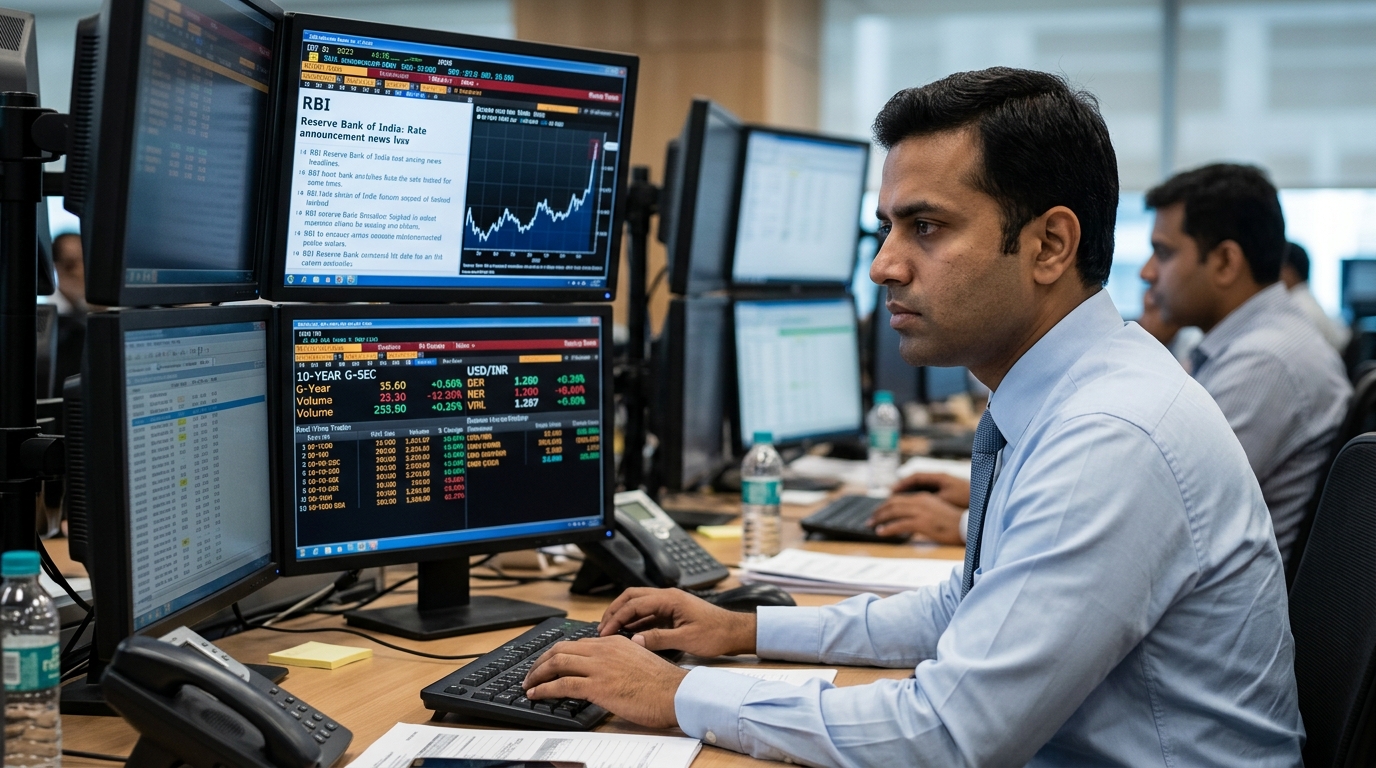
The Reserve Bank of India delivered its first rate increase since February 2023 on Wednesday morning, lifting the repo rate by 25 basis points to 5.50% and shifting its policy stance to calibrated tightening. The rupee did not rally. That gap between the decision and the currency’s response is where the real trading signal lives.
The RBI raised its repo rate from 5.25% to 5.50% and moved its stance from neutral to calibrated tightening, its first increase since February 2023. The rupee weakened anyway. USD/INR traded near 96.37 shortly after the decision before climbing toward 96.62 by late morning, as foreign outflows, elevated crude prices, and firm dollar demand left the rupee little reason to hold an initial gain.
That price action matters beyond India’s borders. The hike was widely expected, with eight of ten economists in a Business Standard poll calling for exactly 25 basis points. A fully priced move that still cannot lift its own currency sends a pointed message: India covers almost 90% of its oil consumption through imports, and elevated energy prices can widen the current account deficit by inflating the import bill. A tighter repo rate addresses domestic inflation; it does not plug that structural dollar drain.
Crédit Agricole was direct in its pre-decision note: “We do not think RBI is raising rates to support the INR, but rather to offset the weak currency’s upward pressure on inflation.” Governor Sanjay Malhotra confirmed as much. He framed the decision around rising inflation risks and resilient domestic growth rather than an explicit exchange-rate target. The RBI lifted its FY27 CPI forecast to 5.2% and its GDP outlook to 7.1%.
On Indian equities, the initial reaction was predictably negative. Indian equity benchmarks declined on Wednesday after the RBI shifted to calibrated tightening, and rate-sensitive sectors felt the pressure most acutely. The Sensex, which had fallen more than 500 points at its worst, recovered around 400 points from the day’s low after the full policy statement landed. That snap-back suggests the equity market found the 25-basis-point hike manageable, the stance change was the harder message to absorb.
Here is the link to the global picture that EM traders need to price today: the U.S. Treasury is holding a 10-year note auction this afternoon, with the previous yield at 4.834%. A weak result there would push Treasury yields higher, widen the spread against emerging-market sovereign debt, and amplify dollar strength, exactly the dynamic that made today’s RBI hike so ineffective for the rupee. A strong auction, by contrast, would cap yields and give EM currencies some breathing room.
The forward-looking signal in the RBI’s voting record is worth tracking. All six committee members backed the hike, but the stance change passed only 4-2, showing less agreement over how firmly the RBI should commit to further tightening. Geojit Investments Chief Investment Strategist VK Vijayakumar expects the RBI to deliver two more rate hikes from here. If that cycle develops alongside continued dollar strength, USD/INR above 96.70 becomes the base case, not a tail risk.
For traders with emerging-market exposure, the actionable read is this: do not position for an INR recovery solely on the rate hike. Watch the Treasury auction result this afternoon, monitor crude prices near $100, and treat Nifty sector rotation, banks recovering while autos and real estate lag, as the cleaner domestic trade until the currency picture clarifies.