June 8, 2026
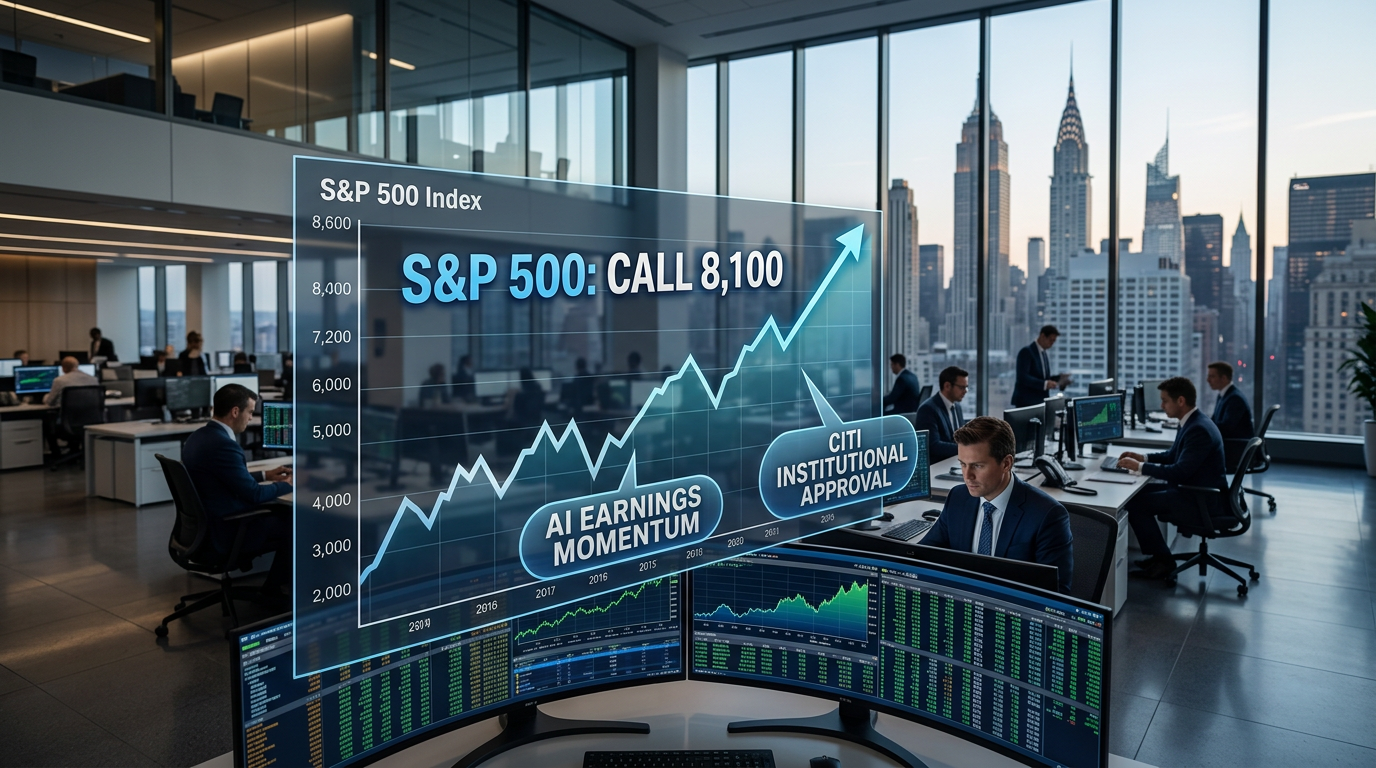
Citi Calls 8,100 on the S&P 500
AI earnings momentum just got a major institutional stamp of approval
Hey there, bargain hunter. The S&P 500 just had its worst single day since October, dropping 2.64% on Friday to close at 7,383.74 – erasing roughly $1.8 trillion in market value in one session. Stronger-than-expected nonfarm payrolls reignited fears that the Federal Reserve might actually hike rates before year-end. And right into that mess, Citigroup walked out and raised its 2026 year-end S&P 500 target to 8,100.
That is not a typo. Citi equity strategist Scott Chronert lifted the bank’s year-end 2026 target from 7,700 to 8,100. The new target implies upside of roughly 10% from the index’s last close. The timing matters. Raising a target into a selloff, with rate hike chatter picking back up, is a deliberate statement about where Citi thinks the fundamental story is going.
New AI Breakthrough Shocks Tech World
This technology could solve the world’s greatest scientific mysteries…
Treat or eradicate hundreds of deadly and rare diseases…
Reduce farming costs by $50 billion a year…
And create a new generation of AI millionaires.
ONE company is at the center of it all.
What Citi Is Actually Saying
This is not a valuation call. Chronert was explicit about that. The revision hinges on a massive acceleration in corporate profitability rather than expanding valuation multiples. That is a meaningful distinction. Citi is not betting on the market getting more expensive. It is betting on earnings growing into and through the current price level.
Chronert now projects index-level earnings to hit $350 in 2026 and has initiated a preliminary estimate of $400 for 2027. For context, that $350 figure is up from the $320 EPS forecast Citi set in December 2025. The revision is substantial. What forced it? Q1 earnings. S&P 500 earnings beat consensus estimates by approximately 13.4% that quarter – a degree of outperformance historically seen only in the early stages of post-recession recoveries, despite the absence of any recessionary backdrop today. Citi acknowledged it had never witnessed such a scenario in the past four decades.
Slight tangent, but it matters: since the beginning of this year, consensus EPS expectations for the S&P 500 have risen 16%, outstripping the index’s 8% price gain. In other words, the market has actually gotten cheaper on a forward earnings basis even as the index climbed. That is the kind of detail that tends to get overlooked when the headline number looks stretched.
The AI Supercycle Argument
Rather than a typical economic cycle, Chronert views the current technology landscape as a unique capital expenditure supercycle. Based on corporate fundamentals and price action, he suggested the market has likely entered the middle innings of this structural transition. Middle innings. Not the ninth. That framing is doing a lot of work in Citi’s bull case.
Chronert highlighted that the earnings weight of the market’s growth cluster has ballooned to 45%, a massive leap from just 15% three decades ago. That structural shift is part of why Citi thinks the old playbook – raise rates, equities suffer – may not apply cleanly here. Citi said in its June 5 note: “We have high confidence in continued earnings beats through year-end.”
Citi noted that impressive earnings from the Magnificent Seven tech companies have anchored the rise of the index, while the rest of the index is starting to strengthen more broadly. That broadening is what the bulls have been waiting on. Narrow AI-driven leadership eventually has to pass the baton, and early signs suggest it might be starting to.
Strange New Wonder Metal Outperforms Silicon Up to 100X
Nvidia just partnered with the tiny company that holds 250 patents.
Here’s why it could become the most important stock in the world.
Where the Risk Lives
Citi is not ignoring the problems. The firm’s bullishness arrives at a fraught moment for equity markets grappling with immediate geopolitical and macroeconomic headwinds. Wall Street is deeply divided: at the micro level, AI-driven earnings momentum is reshaping the fundamentals of U.S. equities at an unprecedented pace; at the macro level, inflation and employment data have forced nearly all institutions to abandon expectations of rate cuts in 2026 and even begin pricing in potential rate hikes.
Citi warned that as the index climbs toward 8,100, downside skew risk is accumulating. With interest rate swaps already fully pricing in a December rate hike, the future trajectory of U.S. equities will hinge critically on whether companies can deliver on their AI-related earnings promises.
Citi also cautioned that the “persistence of AI-driven growth beyond 2027 remains a key question.” That admission is worth sitting with. The bull case is time-limited in its current form. At some point, AI capex has to produce measurable productivity at scale, not just earnings beats from the companies building the infrastructure. Citi knows that. The note says it plainly.
The Cheap Investor Scorecard
- Citi 2026 year-end S&P 500 target: 8,100 (raised from 7,700)
- Implied upside from June 5 close of 7,383.74: roughly 10%
- Citi 2026 EPS forecast: $350 (raised from $320 set in December 2025)
- Citi 2027 EPS preliminary target: $400
- Q1 2026 earnings beat vs. consensus: approximately 13.4% – historically rare outside recession recoveries
- S&P 500 YTD gain through early June 2026: approximately 8% on price, but consensus EPS up 16%
- AI earnings cluster share of index weight: 45%, up from 15% three decades ago
- Rate risk: interest rate swaps pricing a December 2026 hike
- Macro offset: geopolitical headwinds from Middle East conflict, sticky inflation
- Watch item: Oracle earnings Wednesday – next real-time AI infrastructure read
Get Paid Every Time Oil Moves
Instead of guessing oil prices, some investors focus on the infrastructure behind it.
Pipelines act like toll roads – generating steady cash flow as energy moves.
Here is where I land on this. The 8,100 call is not reckless if the earnings thesis holds. A $350 EPS year with a 23x multiple gets you close. The problem is that 23x is still expensive by any historical standard, and the Fed might not be done tightening. Citi strategists cautioned that current euphoric sentiment could lead to volatility, which they view as a buying opportunity. That framing – use the dips – is consistent with a market that keeps going up but not in a straight line.
The Friday payrolls selloff brought the index back to a level where the math starts to look more reasonable. If you have been waiting for a re-entry point rather than chasing records, this week’s weakness is at least part of the answer. Whether the AI earnings story keeps delivering at a 13% beat rate is the only thing that actually matters from here.
The Cheap Investor