June 8, 2026
113% By 10 AM
Featured: Smucker’s Pricing Power Test
Hey Trader,
Before the market opens again, read this…
My top trader, Thomas Wood, just released a new strategy he calls Opening Bell Trades.
This simple system is designed specifically to help regular investors generate income from his #1 trade setup.
I’m talking about finding monster winners like these…
- 113% on GOOGL
- 240% on META
- 70% on CAG
- 37% on MCD
- 139% on GLD
Best of all, he looks for these trades every morning starting at 9:30 AM and by 10 he’s done.
Everything you need to know about how this works is in a free report called “The Opening Bell Trade Guide”…
Take a few seconds and download FREE right now before this link stops working.
This report won’t be free forever, so grab it now while you can.
Once it’s on your computer, you’ll have it for good-no matter what we charge other traders for it later.
No credit card required. No strings attached.
>> Get Your FREE “Opening Bell Breakouts” Trade Guide Here
This guide shows you the exact 15-minute window trade he uses, and how to spot the setups the big funds are watching.
FREE: Discover One Simple Options Trade You Can Make Each Morning – and Be Done by 10 AM.
To better trading,
Drew Day
Founder & CEO
Base Camp Trading
P.S. Inside, you’ll see why Thomas uses weekly options and how to use them to trade stocks like GOOGL, META, and TSLA with as little as $75. Go here to save a copy of the “Opening Bell Trade Guide” before its taken down.
Smucker’s Pricing Power Test
J.M. Smucker (NYSE: SJM) drops its Q4 fiscal 2026 results on June 9. And the number worth watching is not really revenue. It is the gap between what Smucker charges at the shelf and what consumers actually buy. That gap has been widening – and how it resolves will say a lot about whether brand loyalty in premium packaged foods still commands a real premium.
What the Numbers Say Right Now
The most recent quarter (Q3 FY2026, ended January 31, 2026) showed net sales of $2.34 billion, up 7% year over year. Strip out divestitures and currency, and comparable sales grew 8%. Adjusted EPS came in at $2.38, down 9% from the prior year but above the analyst consensus of $2.26 – enough to send the stock up more than 8% the following session.
The coffee segment was the engine. U.S. Retail Coffee sales hit $908.2 million in Q3, up 23% year over year. That growth was almost entirely price. Volume was flat at best. Net price realization accounted for a 10 percentage point contribution to that 23% top-line move. Coffee segment profit margin, meanwhile, compressed to 21.9% – down 630 basis points from the prior year. That is the squeeze in one line.
Free cash flow in Q3 jumped to $487 million from $151 million in the same quarter last year. That is a meaningful swing and one of the cleaner signals in the whole report.
What Is Actually Driving This
Arabica futures have roughly doubled since late 2023 and were hovering near $4 per pound heading into mid-2025. Smucker purchases approximately 500 million pounds of green coffee annually, making it one of the largest single buyers of imported beans in the U.S. The company sources primarily from Brazil and Vietnam. Imports from Brazil now face a 50% tariff. Vietnam faces a 20% duty. That is not a rounding error – it is a structural cost shift.
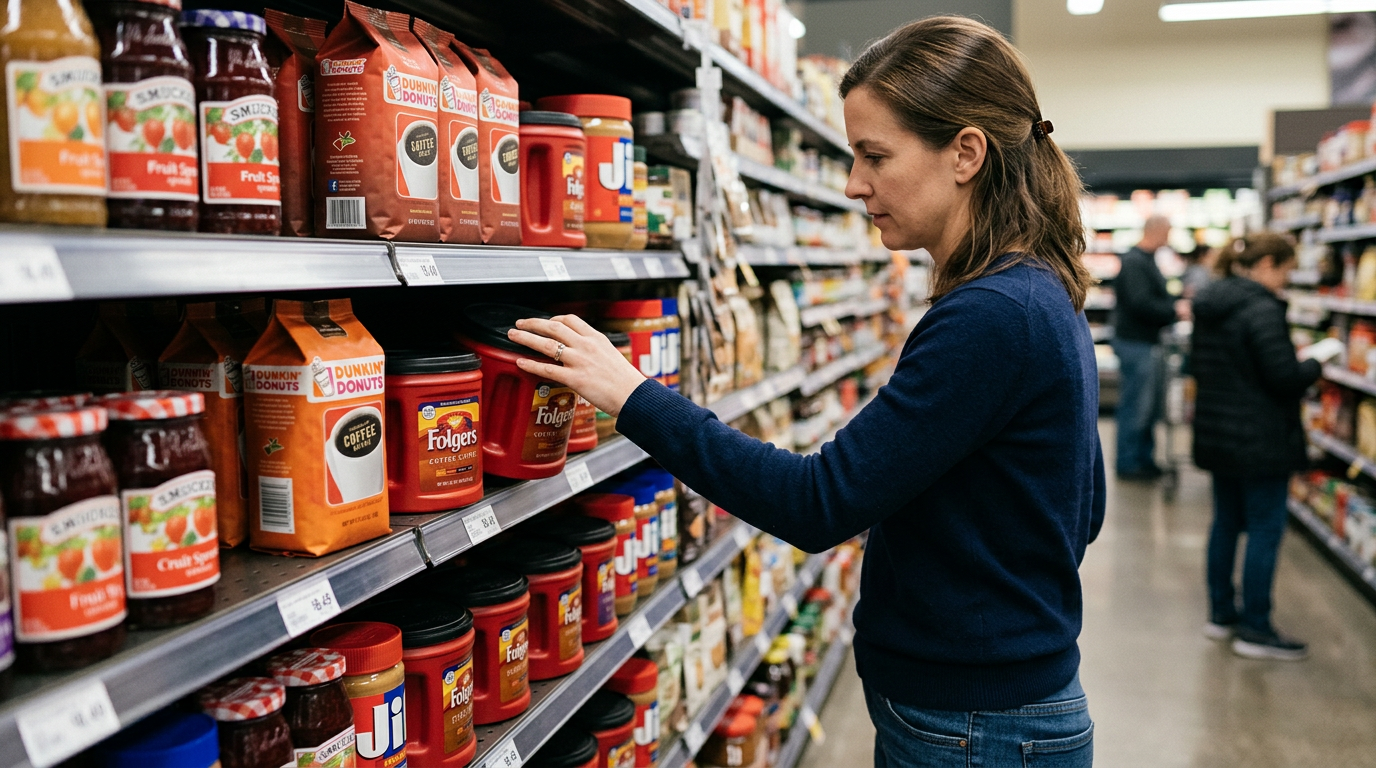
In response, Smucker raised Folgers, Dunkin’ at Home, and Cafe Bustelo prices in May 2025, again in August 2025, and again in early winter 2025 – four separate increases within roughly 12 months. The cumulative effect: an overall hike of more than 20% in consumer coffee costs. The U.S. average retail price for ground roast coffee hit $9.14 per pound in September 2025 – up 41% from a year earlier, per Bureau of Labor Statistics data.
Slight tangent, but it matters: at-home coffee consumption has actually held up better than most expected. Consumers trading down from $8 cafe lattes to a $15 can of Folgers are still a net win for SJM’s volume base. That dynamic is real, but it is not guaranteed to hold if retail shelf prices keep climbing.
Elon Musk: This is a “supersonic tsunami.”
This AI game-changer could rival the impact of the printing press, the steam engine, and electricity…
And roll out faster than mobile phones, personal computers, and even the internet.
Full-Year Picture and What Guidance Tells You
For the full fiscal year ending April 2025, SJM posted revenue of $8.73 billion, up about 7% year over year. Adjusted EPS for that year came in at $10.12, a modest 2% increase. Full-year free cash flow was $816.6 million.
For fiscal 2026, management is guiding for net sales growth of 3.5% to 4.0% and adjusted EPS of $8.75 to $9.25. Comparable sales, excluding divested businesses, are expected to grow 5.0% to 5.5%. That gap between total and comparable sales reflects the portfolio cleanup – Smucker sold the Voortman business in December 2024 and offloaded certain Sweet Baked Snacks value brands in March 2025. Adjusted gross profit margin is guided at approximately 35.0%.
One wrinkle: a fire at the Emporia, Kansas manufacturing facility in February 2026 trimmed approximately $25 million from expected Q4 sales. That is already baked into the updated guidance range. Free cash flow expectations for the year remain intact at $975 million.
Heading into the June 9 Q4 report, analysts expect adjusted EPS of approximately $2.65 per share – up roughly 15% from the $2.31 reported in the year-ago quarter. Revenue consensus sits around $2.27 billion, implying 6% growth.
The Bull, the Bear, and the In-Between
- Bull case: At-home coffee consumption stays durable. Price increases continue to flow through without meaningful volume defection. Jif, Uncrustables, and Cafe Bustelo provide diversification. Free cash flow of $975 million funds dividends ($4.40 per share annually) and debt reduction from the Hostess acquisition. If arabica costs normalize, margin recovery could be significant.
- Base case: Pricing holds in coffee but volume softens modestly. Other segments – Uncrustables, Meow Mix, pet food – carry part of the load. Adjusted EPS lands near the middle of the $8.75 to $9.25 range. Stock continues to lag the broader market but generates dependable cash returns.
- Bear case: Coffee price fatigue accelerates private-label trade-down. Volumes slip faster than historical elasticity models suggest. Tariff exposure on Brazilian and Vietnamese beans remains unresolved. Hostess brand pressure from GLP-1 drug adoption and scrutiny of highly processed foods compounds the headwind. Adjusted EPS undershoots guidance.
The Cheap Investor Scorecard
- Q4 FY2026 adjusted EPS vs. consensus of $2.65 – beat or miss?
- Coffee segment volume/mix: any improvement from flat, or continued pressure?
- Coffee segment profit margin – can it recover from 21.9% or does cost inflation hold it down?
- Comparable net sales growth confirmation: does 5.0% to 5.5% hold for the full year?
- Free cash flow delivery: is $975 million still on track after the Kansas facility fire?
- Management commentary on a fifth potential coffee price increase and consumer elasticity signals
- Uncrustables and Cafe Bustelo volume trends – the two brands management leans on when Folgers stumbles
- Any update on Hostess impairment charges – the GAAP loss line has been distorted by these for several quarters running
- Private-label coffee share data – this is the slow leak that most investors are not tracking closely enough
- FY2027 preliminary outlook – is $9.80 adjusted EPS (current analyst consensus) defensible given commodity headwinds?
Here is where I land on this: SJM is not a broken business. The cash flow is real, the brands are real, and the dividend has been steady. But the pricing cycle has entered territory where the next move is harder to call than the last three. Four price increases in 12 months works until it does not.
If Q4 confirms volume resilience and coffee segment margins start recovering even slightly, the stock at roughly 11x forward adjusted EPS starts looking like a reasonable entry for patient, income-oriented investors. If volume deteriorates faster than guided, the earnings support erodes quickly.
Watch the volume line on June 9. That is the one number that will tell you whether pricing power here is structural or just borrowed time.