June 2, 2026
Alphabet’s $80B AI Bet Just Hit Your Portfolio
The biggest equity raise in Big Tech history and what it means for GOOG holders right now
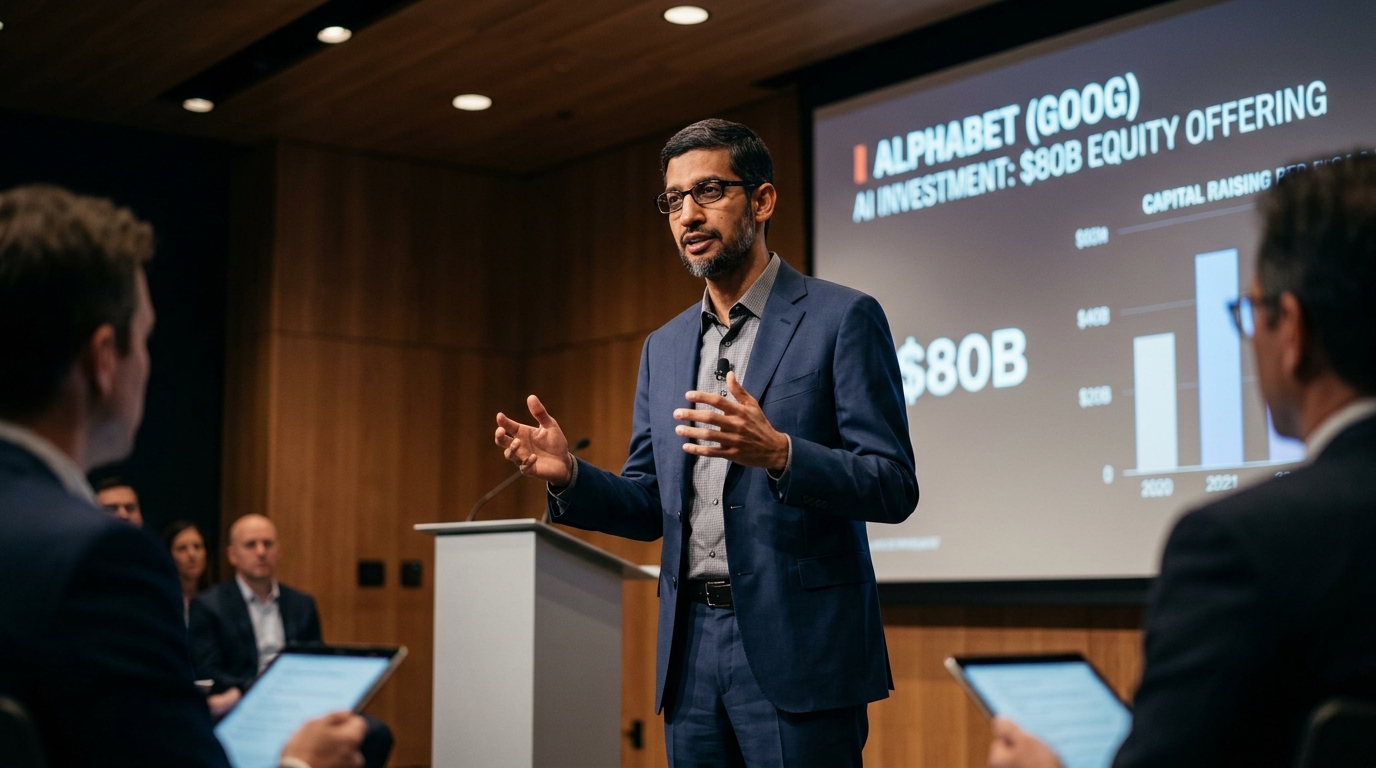
Alphabet just did something most companies with $4.5 trillion in market cap and a rock-solid balance sheet would never do. It went to the market hat in hand and said: we need $80 billion more.
That is not a typo.
What Happened
After Monday’s close, Alphabet announced plans to raise up to $80 billion through a combination of equity offerings. The structure breaks down like this:
- $30 billion via an underwritten public offering of common stock and mandatory convertible preferred shares
- $40 billion via an at-the-market program, expected to begin in Q3 2026
- $10 billion private placement to Berkshire Hathaway, split evenly between Class A shares at $351.81 and Class C shares at $348.20
Goldman Sachs, JPMorgan, and Morgan Stanley are running the books. The stated purpose: fund AI compute infrastructure to meet what Alphabet calls “unprecedented customer demand.”
GOOGL closed Monday at $372.58, down about 1%. Shares slipped another 1.5% in after-hours as the details landed. By Tuesday morning, the stock opened down 3.47%, underperforming a broader Software and IT Services sector that was actually up 2.75% on the day.
The next workplace upgrade may not be a bigger monitor.
It may be no monitor at all.
More than 1.5 million professionals have already signed up for an AI-powered virtual workspace that’s changing how people work, collaborate, and build.
The company behind it is still private.
For now.
Why the Market Flinched
Here is what is interesting. Alphabet does not need this money to survive. Full year 2025 revenue came in at $402.84 billion, up 15% year over year. Net profit hit $132.17 billion, up 32%. The balance sheet is healthy. Free cash flow is substantial. Analysts who cover this company have a “Strong Buy” consensus with a 12-month average price target of $429.97.
So why sell stock?
Because what is coming on the capex side is staggering. Management guided 2026 capital expenditures to $180 billion to $190 billion. That is roughly double the $91.4 billion spent in 2025. And the company has already signaled further increases in 2027. Issuing equity rather than debt keeps the balance sheet clean and brings in permanent capital, but it puts existing shareholders on notice: your slice of the pie is getting smaller.
At $80 billion against a roughly $4.54 trillion market cap, the math implies dilution of about 1.8%. In isolation, that is manageable. The part that is harder to model is the $40 billion ATM program, which creates a slow drip of new shares entering the secondary market over months. That kind of steady supply tends to put a ceiling on momentum even when fundamentals are moving in the right direction.
Slight tangent, but it matters: $30 billion of the ATM program is reportedly earmarked to cover 2026 tax obligations tied to employee equity awards. That is not infrastructure spending. That is a recurring corporate cost being funded through shareholder dilution. Worth keeping in mind when you hear the word “AI infrastructure” repeated in every headline.
The Next AI Winner Isn’t Making Chips
Most investors still think the AI boom is about semiconductors.
But a growing number of data centers are running into a different problem: not enough power.
One company has quietly built a $1.5 billion backlog supplying equipment these facilities depend on, yet Wall Street continues to value it like an old-school industrial stock.
The Berkshire Signal
The most interesting wrinkle here is Warren Buffett. Berkshire started building its Alphabet position in Q3 2025 and is now putting $10 billion more on the table through a private placement. That is a meaningful endorsement. Buffett does not typically anchor equity raises for companies he thinks are destroying shareholder value.
But Berkshire’s confidence in the long-term direction did not stop Tuesday’s selloff. Institutional endorsement and near-term dilution anxiety can coexist, and right now the latter is winning.
The Business Underneath
Google Cloud posted $20 billion in Q1 2026 revenue, a 63% year-over-year jump, with a reported $460 billion contract backlog. That backlog number is the one bears need to reckon with. You do not accumulate $460 billion in contracted cloud business unless your customers are building something real on top of your infrastructure.
Advertising remains resilient. Google Search is still the dominant entry point for commercial intent on the internet. DeepMind’s Gemini models are embedded across Search, YouTube, and enterprise. The core revenue engine is not broken. The question is whether the return on $180 to $190 billion in annual capex can justify the scale before investor patience runs out.
CEO Sundar Pichai has said plainly that demand for AI solutions is exceeding available capacity, and that the risk of under-investing is greater than the risk of over-investing. That framing matters. It is also exactly what every CEO says right before a cycle turns.
What to Watch
- Google Cloud revenue growth rate each quarter against the $460B backlog burn
- Whether the $40B ATM program accelerates or paces itself depending on stock price
- 2027 capex guidance – if it keeps climbing, free cash flow compression gets harder to ignore
- Gemini monetization metrics and AI-driven search revenue per query trends
- Any further Berkshire accumulation above $10B as a sentiment signal
SpaceX ‘Dark Energy’ Replaces Foreign Oil
For years, we’ve been told SpaceX is a rocket company. But according to new satellite images from 300 miles above the Earth’s surface, there is something very strange going on at SpaceX right now that has nothing to do with space. It could soon replace our need for foreign oil forever and ignite a $10 trillion boom for the stocks involved.
Bottom Line
If Alphabet’s AI infrastructure build actually generates returns proportional to the spend, the $80 billion raise will look like one of the better capital allocation decisions in tech history. If capex keeps climbing while monetization lags, you are looking at years of free cash flow pressure with a stock that is already priced for execution.
The business is strong. The dilution is real. The backlog is enormous. And the ATM program is going to be a slow, persistent overhead for the stock price through the back half of 2026.
Watch the Cloud numbers. That is where the answer is.