November 5, 2026
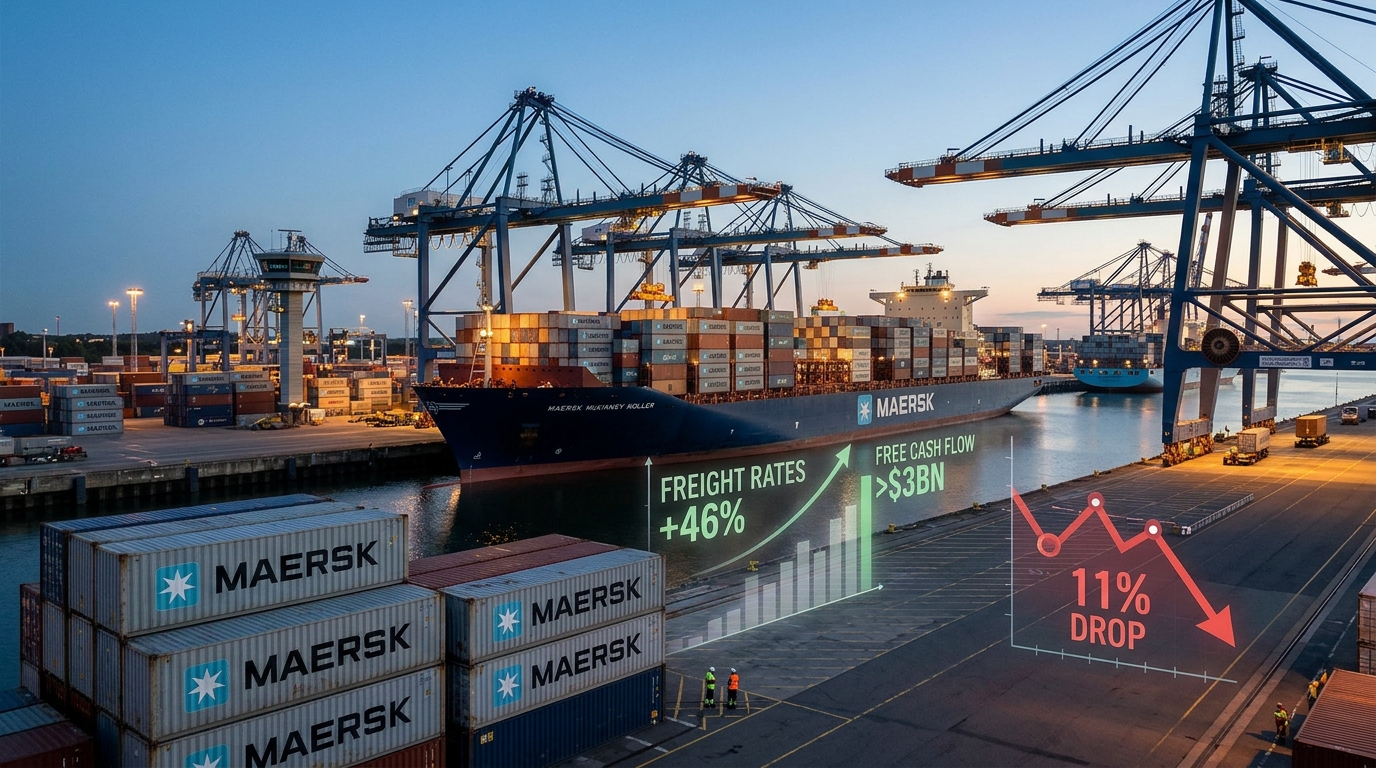
Maersk freight rates up 46%, free cash flow surging past $3 billion, and the market is treating it like bad news. Here is what the selloff is actually pricing.
Hey there, bargain hunter. When a company raises its full-year profit forecast and the stock drops 11%, the market is telling you something. The question is whether it is right.
Hidden in Tesla’s Filing: A $12 Billion “Super Startup”
Pull up Tesla’s most recent SEC filing. Page 5.
And you’ll see a single line showing $12 billion in revenue from a brand-new “super startup” Elon Musk has been quietly incubating inside Tesla.
This new “super startup” has nothing to do with cars or robots or space or AI…
But it sits at the center of what Blackstone calls “a $23 trillion investment opportunity.”
And on January 27, Elon is expected to pull back the curtain and reveal exactly what he’s building.
But Adam O’Dell already knows… and he reveals it all in this urgent video.
Scoreboard
In its verified 2026 updates so far, Maersk has pointed to strong demand, higher freight rates, and congestion as key drivers. In its 13 August 2026 guidance update, the company lifted full-year 2026 guidance again.
- Full-year 2026 underlying EBITDA guidance: $10.5–12.5 billion (from $8.0–10.0 billion).
- Full-year 2026 underlying EBIT guidance: $4.5–6.5 billion (from $2.0–4.0 billion).
- Full-year 2026 free cash flow: now expected greater than $0, versus a prior floor of at least -$1.5 billion.
The Real Reason Shares Fell
When an upgrade is widely anticipated, the surprise has to be in the details, not the headline. If the market has already modelled a stronger year, then “good news” can still translate into “sell the event” if any line item, segment mix, or forward-looking assumption fails to beat expectations.
Also, shipping is still a rates business. If the guidance lift is being driven mainly by pricing and disruption rather than sustainable volume growth, investors can treat it as transient and discount it quickly, especially if they believe congestion eases or more capacity hits the water.
What the Business Actually Does
Maersk is one of the world’s largest container carriers. It earns money by moving boxes between Asia, Europe, and the Americas, and collects a spread between the cost of running vessels and the freight rate shippers pay. When ports clog, effective capacity shrinks, rates rise, and Maersk generates more margin.
Jeff Brown Says “SpaceX Supercycle” Could 39x Your Money
According to legendary tech investor Jeff Brown…
Three words on page 37 of the SpaceX IPO filing…
Signal Musk is about to trigger a rare wealth supercycle…
And send billions into a sector nobody associates with tech.
Key Metrics
- Guidance matters most here because shipping profits swing fast. Maersk’s latest verified 2026 guideposts are underlying EBITDA of $10.5–12.5 billion and underlying EBIT of $4.5–6.5 billion.
- Free cash flow for 2026 is now guided to be positive (greater than $0), after earlier guidance implied potentially negative free cash flow.
Is It Cheap?
Valuation is only “cheap” if you have a view on the next rate cycle. If investors think 2027 is materially worse than 2026, then even a low multiple can be a value trap. If you think rates stay firm longer than consensus, the multiple can compress quickly on higher earnings.
On the spot market, trans-Pacific rates remain elevated. Recent Freightos Baltic Index reporting in late October 2026 has put Asia to U.S. West Coast rates around $8,100 per FEU and Asia to U.S. East Coast rates around $9,700 per FEU, still high versus pre-pandemic norms.
Bull / Base / Bear
Bull: Congestion persists into Q1 2027. AI and electrification capex keeps industrial cargo volumes firm. Maersk converts positive free cash flow into buybacks at a depressed share price, compressing the multiple further.
Base: Rates moderate in early 2027 as new tonnage arrives and Suez Canal traffic normalises. EBITDA steps down. The stock trades sideways from current levels. Investors clip the dividend.
5 Stocks to Buy for Q4 2026
This year has thrown the market a war with Iran, $100 oil and the Fed’s first rate hike since 2023. Stocks climbed anyway. This free report reveals 5 companies with the earnings and catalysts to finish 2026 strong. See which ones made our list.
Bear: The supply side wins. Linerlytica’s October 2026 figures have put the global containership orderbook at about 46.5% of the active fleet, a level bears view as a structural overhang if demand cools at the wrong time.
Action Plan
The 11% single-day drop is the entry conversation, not a buy signal on its own. A scale-in approach makes more sense than a full position: consider a first tranche here if you have no exposure, then a second tranche if the stock gives back another 8–10% on rate anxiety into year-end. The balance sheet and free cash flow profile can limit the downside case compared with more leveraged peers, but only if rates do not collapse.
Cheap Investor Checklist
- SCFI freight index level: watch weekly for signs of Q4 rate normalisation
- Vessel utilisation: needs to stay high to support current rate assumptions
- Free cash flow conversion: defend positive FCF for 2026 versus prior negative guidance
- Order book as a share of global fleet: 46.5% (Linerlytica, October 2026) is the structural risk number
- Suez Canal return traffic: any material resumption compresses effective capacity scarcity
- AI and data centre capex cycle: the demand tailwind that is hardest to model
- Share buyback announcements: a net-cash-leaning balance sheet earns its keep here
Bottom Line
If spot rates hold anywhere near current levels into Q4 and Maersk converts positive free cash flow into capital returns, the 11% selloff could look like a gift. If 2027 brings the new tonnage wave the bears have been modelling for two years, today’s price is not the bottom. The honest answer is that the market is marking up the probability of the second scenario. That is exactly where bargain hunters should be paying attention.