
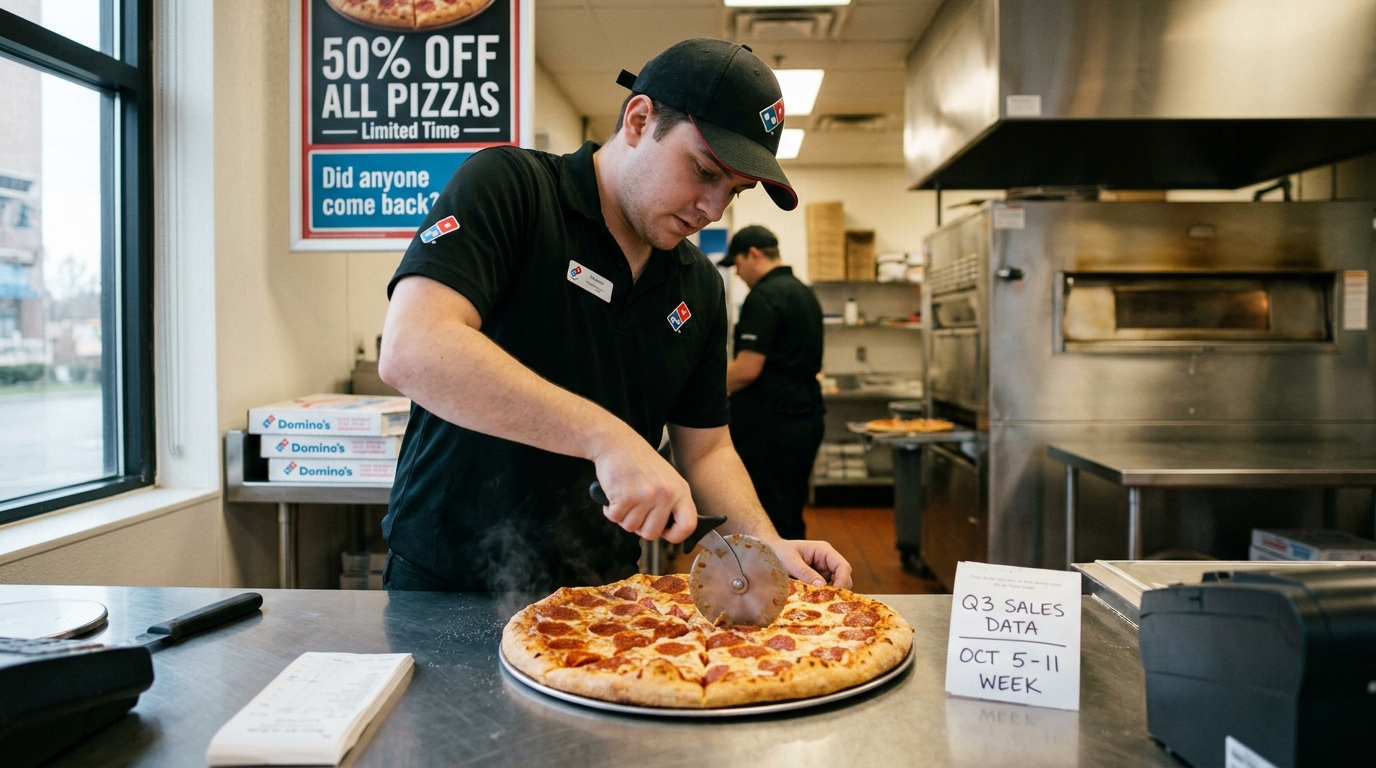
Hey there, bargain hunter. Domino’s just ran 50% off all menu-priced pizzas, not once, but repeatedly, across April 20-26, June 1-7, July 27-Aug. 2, and again October 5-11 for National Pizza Month. That is four separate half-price weeks in a single year. The Q3 report dropped at 6:05 a.m. ET this morning, and it is the first clean read on whether that barrage of deals bought real traffic or simply handed margin back to customers who were going to order anyway.
Scoreboard
Domino’s shares have traded near five-year lows hit back in June, and entering today the stock sat around $309 against a 52-week high of $442.35. The Street was looking for about $4.33 EPS on about $1.17 billion in revenue, which would represent roughly 6.1% earnings growth versus Q3 2025’s $4.08. On same-store sales, analysts projected U.S. comps of about 1.1%, a dramatic fade from the 5.2% growth posted in the same quarter last year.
The Real Reason This Quarter Matters
U.S. same-store sales grew only 0.1% in Q2, with order counts rising in both delivery and carryout. The miss came from average ticket, largely because the Premium Series launch did not deliver the mix the company needed as it lapped the prior year’s Stuffed Crust launch. In plain English: more people showed up, but they spent less per order. Discounting doubled down on exactly that problem.
The company has missed analyst EPS estimates in three straight quarters. The 8:30 a.m. call is where management will have to explain whether the promotional calendar was strategy or desperation.
Franchisee health is not a Domino’s-only concern. The collapse of one of Wendy’s largest franchisees shows how promotional discounting and cost pressure can hollow out operator economics across the industry.
How the Business Actually Works
Domino’s is the world’s largest pizza company, with more than 22,500 stores across over 90 markets. It operates through a predominantly franchise-based system, with digital ordering generating more than 85% of U.S. retail sales. The company reported global retail sales of more than $20.6 billion in the trailing four quarters ended June 14, 2026. Because it earns royalties on franchisee sales, a same-store comp swing flows almost entirely to the bottom line. Half-price weeks hurt franchisee revenue directly.
Data That Actually Moves This Stock
- Q2 2026 EPS: $4.07, missing the $4.17 consensus
- Q2 U.S. same-store sales: just 0.1% year-over-year
- Q2 revenue: $1.194 billion, with supply-chain sales of $732 million, up 6.5%
- H1 2026 U.S. same-store growth: 0.5%, against full-year guidance originally set at roughly 3%
- Supply chain Q3 estimate: revenues projected to rise 6.2% to $740 million
- Analyst price target vs. current price: average target of $373.15 against a pre-report price of $308.58
Is It Cheap?
The stock trades at roughly 15x forward earnings. That is a level that would have looked absurdly cheap three years ago when DPZ routinely commanded 27-28x. Peers tell a similar story: Yum Brands and McDonald’s both trade at premiums to DPZ, despite weaker unit economics on return on assets.
The discount is real. So is the reason for it.
Bull / Base / Bear
Bull: The half-price weeks drove a genuine order-count surge that shows up in Q3 comps above 2%. Management guides the second half strongly, franchisee economics stabilize, and the stock re-rates toward 20x on 2027 estimates, implying a price north of $400.
Base: U.S. comps land around 1%, EPS meets the consensus, and the stock grinds sideways. Analysts project revenues of $5.6 billion and earnings of $733 million by 2029, assuming 3.8% yearly revenue growth. That is a slow, uninspiring path from here.
Bear: Weak consumer demand, intensifying competition from local pizza chains, and shifting eating habits linked to GLP-1 drugs all compound. Comps disappoint again, franchisee pipeline shrinks further, and the multiple compresses below 15x. The stock revisits June lows near $282.
Action Plan
Do not chase the stock on an EPS beat alone. The metric that matters today is U.S. same-store sales, specifically whether order counts held after promotions ended. If comps come in above 1.5% with management commentary confirming that traffic, not ticket inflation, drove it, a starter position in the $300-$310 range makes sense. Scale a second tranche only after the Q4 guidance lands. If comps disappoint again or management hedges on the full-year same-store target, patience wins.
Cheap Investor Checklist
- U.S. same-store sales: at or above 1.5%?
- Order count growth confirmed separately from ticket data?
- Full-year same-store guidance maintained or raised?
- Supply-chain revenue above $740 million?
- Franchisee net store additions on track (approximately 175 domestic)?
- EPS at or above $4.33 without one-time items flattering the number?
- Management commentary on post-promotion traffic retention?
- Any update on DPC Dash investment, which moved results in Q2?
- Forward P/E below 16x on 2027 estimates after reaction? That is historically cheap for this franchise.
Bottom Line
If same-store sales recover and management can show that the promotional calendar built recurring customers rather than one-time bargain seekers, DPZ at roughly 15-17x forward earnings is genuinely mispriced. If the comps disappoint for a fourth consecutive quarter, the discount to historical multiples is a value trap, not a value opportunity. Wait for the 8:30 a.m. call before deciding which story this is.