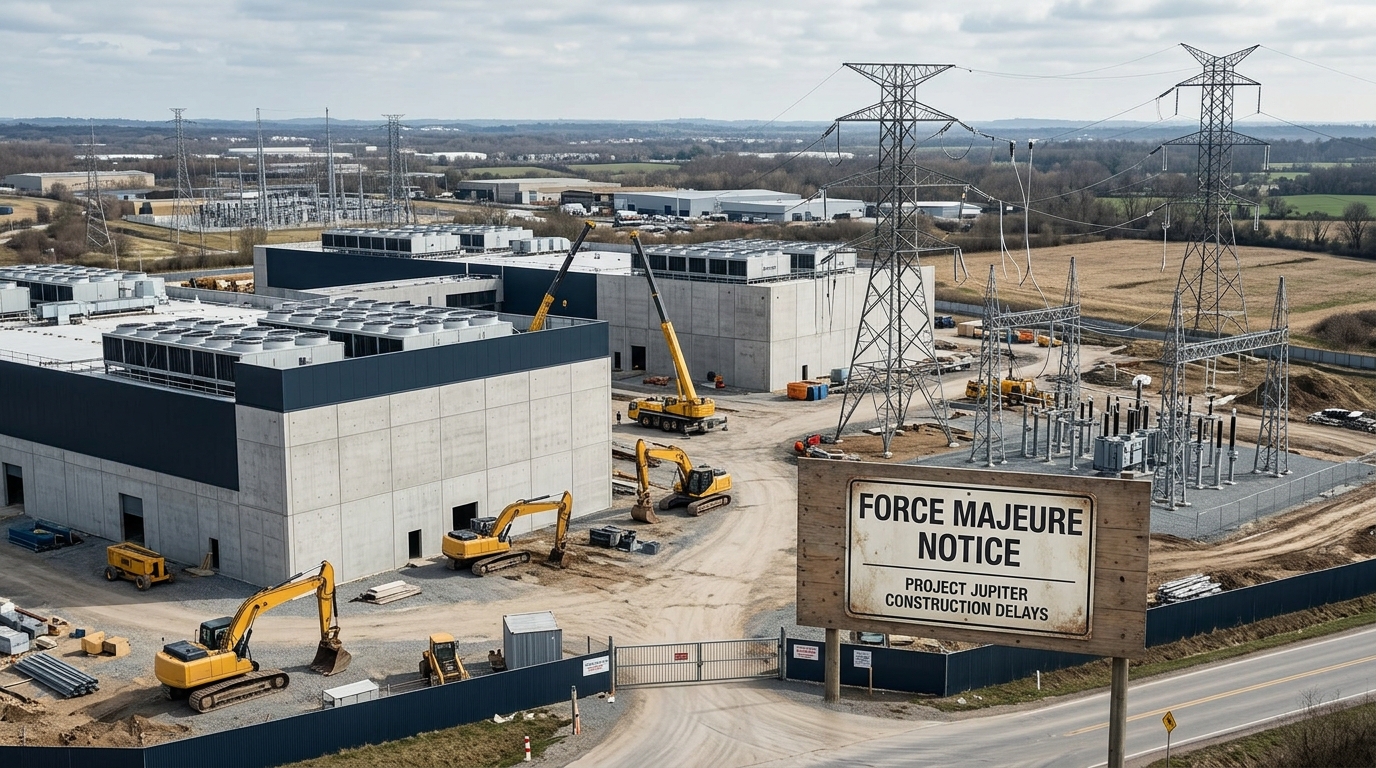
The question every serious data-center investor has been sidestepping is now in plain sight. Oracle issued a force majeure notice to the developer of Project Jupiter, a Blue Owl-backed Stack Infrastructure unit, citing delays tied to securing power for the project. The market treated it as an Oracle problem. Oracle shares were down roughly 3% to 4% on September 24, 2026, but the paperwork risk landed on the lender. Blue Owl, already bruised, traded around $9.25 on September 24, 2026, down about 46% over the prior 12 months.
Why Wall Street Cares
The 1,400-acre Project Jupiter campus, which secured about $18 billion in loans from a consortium of banks, is part of Oracle’s broader deal to supply OpenAI with AI computing capacity. That financial architecture is the point. Several key details of the contract structure have not been disclosed publicly, including whether Oracle can terminate the lease “under any circumstances,” the precise allocation of responsibility for securing power, and whether Oracle is explicitly on the hook for “debt costs” during a delay. What is clear is that the notice does not, by itself, unwind the deal. What it does is extend the window before higher rent payments begin, preserving Oracle’s optionality while leaving Blue Owl’s return timeline exposed to every permit denial that follows.
The Bull Case
Both parties want this framed as routine contract management. Oracle has said the project remains on its planned schedule and that it is committed to New Mexico. Blue Owl’s position is equally firm: “This notice does not change the financial commitments to this multi-year project.” If both sides agree that a force majeure event tied to meeting power commitments has occurred, Oracle could win a multi-year delay on rent when those payments commence, but would still owe rent for the full lease term once payments begin. On that reading, it is a timing shift, not a write-down.
The Bear Case
The permitting chain tells a different story. The project relies on a roughly 17-mile natural gas pipeline called the Green Chile Project, associated with Energy Transfer and Transwestern. That pipeline’s in-service target has been pushed back to February 1, 2027 from an earlier expectation that it would begin service in September 2026, after repeated denials by the New Mexico State Land Office for rights-of-way across state trust lands, with the commissioner citing climate and resource concerns. Separately, the New Mexico Environment Department has not yet issued the air-quality construction permit for the updated fuel-cell microgrid plan, and the application is in public review. That is two independent regulatory gates, neither of which Oracle fully controls, feeding into a 2028 deadline that already looks tight.
Even if the force majeure notice is intended as a precautionary step, it risks alarming lenders backing the project. Loans tied to Project Jupiter have been privately quoted in stressed territory, around 89 to 91 cents on the dollar. Meanwhile, Fitch Ratings reported that the U.S. private credit default rate rose to a record 6.3% for the trailing 12 months ended August 2026. Project Jupiter is the kind of position that was written at the peak of confidence in AI capex demand, when permits felt like a formality.
What Investors Are Missing
The coverage has been almost entirely Oracle-focused, which misreads where the stress actually concentrates. Oracle retains the lease regardless. The company that cannot wait indefinitely is Blue Owl, holding about $3 billion in equity against a campus that cannot generate full rent until power arrives. Oracle reported capital expenditures of $55.7 billion in fiscal 2026, up from $21.2 billion the previous year, and free cash flow of negative $23.7 billion. That context matters: Oracle is spending aggressively across a multi-campus footprint and has every incentive to preserve contractual flexibility. The lender does not have the same latitude.
The broader implication runs past this one campus. Bloomberg Law described Project Jupiter as a symbol of the growing backlash against the AI data center boom and a political flashpoint ahead of the U.S. midterm elections. If one hyperscaler can invoke force majeure because a short pipeline cannot get a permit, investors in every private-credit data-center vehicle need to ask how many other campuses are carrying the same power-and-permit risk in a drawer somewhere.
Stocks to Watch
Oracle (ORCL). The legal posture is defensive, not a retreat. Oracle’s AI commitments remain large and the lease appears to remain in force. The selloff prices in more execution risk than the contract necessarily transfers to Oracle.
Blue Owl Capital (OWL). The equity holder with about $3 billion at stake and a return profile that depends on rent commencing on schedule. Loans quoted below 90 cents on the dollar are the market’s honest assessment of that timeline.
Bloom Energy (BE). Bloom and the financial press have frequently referenced a backlog around $20 billion, though the composition and firmness of that figure is debated. Project Jupiter’s planned power system has been discussed publicly at about 2.45 GW, making it one of the largest single-site deployments associated with Bloom’s data-center opportunity set. A slip on gas delivery can become a multi-quarter revenue push to the right.
Digital Realty (DLR). The cleaner read on AI data-center demand: campuses already energized, with power secured rather than permitted. If Project Jupiter’s difficulties reset how the market prices construction and permitting risk, pre-powered, operational capacity commands a wider premium.
Vertiv (VRT). Cooling and power infrastructure vendor with exposure across the data-center build cycle. A slowdown in new campus commissioning delays Vertiv’s equipment pull-through, but it also concentrates demand into the projects that do clear permitting, which tend to be Vertiv’s largest customers.