
September 1, 2026
Bonus Content: The CAFE Rollback Guts Tesla’s Credit Income. GM and Ford Look Cheaper for It.
Dear Fellow Investor,
Mark this date:
On September 30th, 2026…
The biggest scam in the history of gold markets will be exposed…
It’s the math that keeps bankers up at night…
The gold chart that has Wall Street shaking in its loafers…
That’s the day the public will see that their gold ETFs are nothing but paper…
The rush from ETFs to real assets will be unlike anything we’ve seen in 300 years.
One stock on the receiving end of this epic transfer, is set to explode 1,000% as ETF holders could get wiped out.
This isn’t a hunch – it’s math.
See all the evidence for yourself right here and take your position before it’s too late.
“The Buck Stops Here,”
Dylan Jovine, CEO & Founder
Behind the Markets
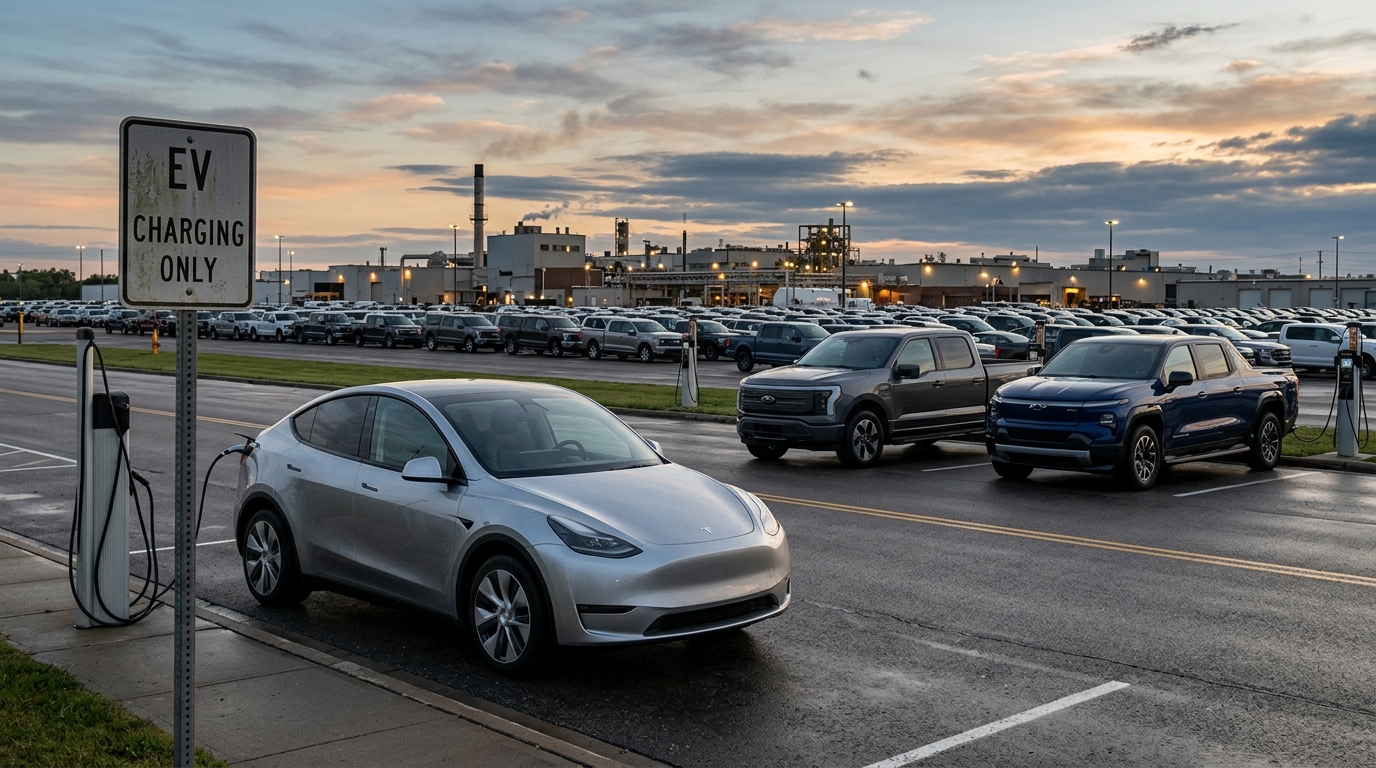
The CAFE Rollback Guts Tesla’s Credit Income. GM and Ford Look Cheaper for It.
Hey there, bargain hunter. Washington is pushing one of the quietest wealth transfers in recent auto history, and it lands on the same morning automakers are posting their August sales tallies.
Scoreboard
The Trump administration is moving forward on sharply lower vehicle fuel economy requirements, continuing the rulemaking it proposed in December 2025. The proposed SAFE Vehicle Rule III slows the required pace of improvement for passenger cars and light trucks, changes how some crossovers and small SUVs are classified, and projects an industrywide light-duty fleet average of about 34.5 mpg by model year 2031, far below the roughly 50.4-mpg requirement projected under the Biden-era 2027 to 2031 standards. NHTSA separately moved on August 28, 2026, to reverse the standalone medium- and heavy-duty engine rule.
On the sales side: Ford reported August 2025 U.S. total vehicle sales of 190,206, up 3.9% from the same month last year. GM’s August figures are expected to land today as well.
What Actually Happened
The headline is about miles per gallon. The real story is about credits, and who owns them.
For over a decade, automakers that couldn’t meet fuel economy targets bought compliance credits from Tesla, which had a structural surplus. That single revenue stream made Tesla nearly $11.8 billion over the last decade. The mechanism worked because CAFE penalties and credit trading gave buyers like GM and Ford a financial reason to pay up.
What changed is narrower, but still painful for Tesla: the administration targeted the accounting multiplier that inflated EV treatment in the CAFE math. The fuel content factor was removed from the Petroleum Equivalency Factor calculation for electric vehicles, effective February 19, 2026, reducing the compliance value of EVs in the CAFE framework.
The idea that credit economics get softer as standards soften is directionally right. But a blanket claim that financial penalties are removed, and that CAFE penalties are gone, is too strong as written.
Data: Tesla’s Credit Cliff
- Credits grew from $169M in 2015 to a peak of $2.76B in 2024, before retreating to $1.99B in 2025.
- The policy shift and weaker demand for credits showed up fast: Tesla booked $146 million of automotive regulatory credits in Q2 2026.
- Automotive gross margin was 16.9% in Q2 2026.
- Tesla reported negative free cash flow of about $1.1 billion in Q2 2026, driven by a sharp jump in capex.
- NHTSA has proposed eliminating the inter-manufacturer credit trading system starting in model year 2028.
Is It Cheap? The Truck Makers vs. Tesla
Here is where it gets interesting for bargain hunters. The rollback removes a compliance cost that was a silent subsidy for Tesla’s margins and a headwind for Detroit.
GM’s forward PE ratio sits around 6x in recent data. Ford is also in the single digits on forward earnings in many market data snapshots. Both names are priced for a world where compliance costs bite and EV subsidies prop up rivals. That world may be changing, but the exact multiple and the sector median figures in the draft are not consistently verifiable as stated.
Full-size pickups continue to dominate the top of the market: the Ford F-Series and Chevrolet Silverado hold the top two pickup sales spots through June 2026. Trucks carry the industry’s fattest margins. Looser CAFE rules can give GM and Ford more room to lean into that mix without as much compliance pressure.
Bull / Base / Bear
Bull: Credit obligations fade into the background by model year 2028, truck demand holds, GM and Ford redirect meaningful compliance spending to their own bottom lines. Both stocks rerate toward higher multiples.
Base: Rules face legal challenges that slow implementation. Credit values fade gradually rather than disappearing overnight. GM and Ford absorb a modest tailwind while tariff and demand pressures offset it.
Bear: GM’s weakness in hybrids remains a structural problem as consumer preference shifts toward fuel efficiency without full EV commitment. GM delivered 1,335,461 vehicles in the U.S. in the first half of 2026, down 6.8% year over year. Volume declines can overwhelm any regulatory tailwind.
Action Plan
If you want domestic auto exposure, GM at roughly 6x forward earnings is a cheaper entry than Tesla, which is losing a high-margin revenue line and posting negative quarterly free cash flow while betting on robotaxis and humanoid robots. Ford at a single-digit forward earnings multiple is similarly priced for pessimism, with F-Series as a floor.
Scale in on GM in two tranches: a starter position today, and a second tranche if August sales disappoint and the stock dips. Watch for any court challenge to the final rule as the primary risk to the credit-tailwind thesis.
Cheap Investor Scorecard
- Tesla Q3 2026 credit revenue: watch for further drops from Q2’s $146M level
- GM valuation: does it stay around ~6x forward earnings, or re-rate?
- Ford August sales: confirm whether the bounce is a trend, not a blip
- CAFE rule legal challenges: any injunction restores Tesla’s credit pipeline
- NHTSA credit trading elimination proposal for MY2028: the hard deadline for the thesis
- GM truck market share: holds above 25% in full-size pickups?
- Tesla automotive gross margin: needs to recover above 18%
Bottom Line
If the CAFE reset survives legal challenge and the MY2028 trading proposal becomes reality, the regulatory math that made Tesla a compliance landlord collecting rent from Detroit for ten years weakens fast. GM and Ford are priced as though the penalty structure stays intact. The cheaper way to own U.S. autos today is the trucks, not the credits.