
August 14, 2026
The Royalty Stocks the Market Is Mispricing
Featured: The Royalty Stocks the Market Is Mispricing
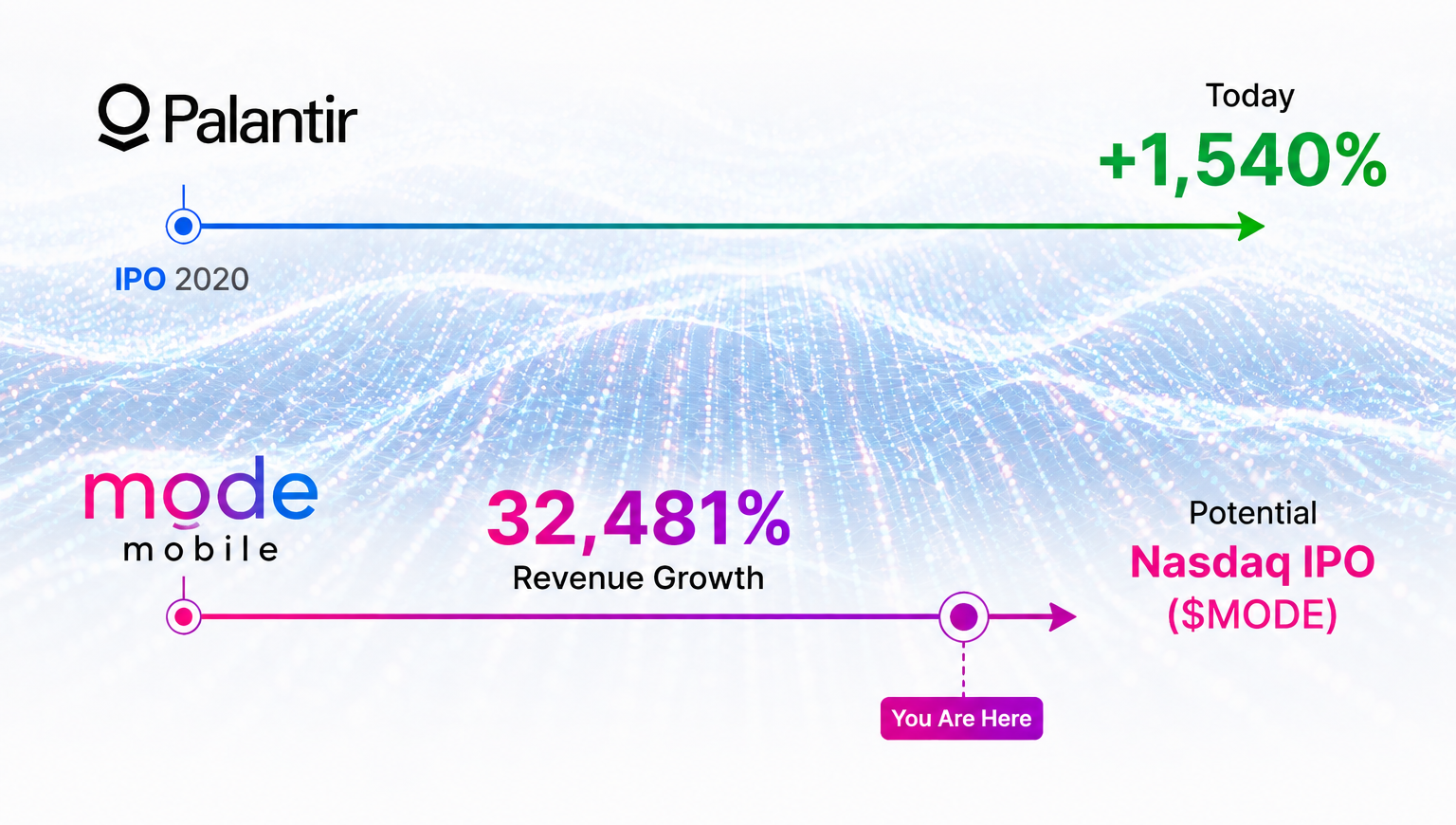
Anyone who invested in Palantir at its IPO in 2020 could be sitting on nearly 1,540% gains right now.
But that great return is already in the past, and the stock is now one of the S&P 500’s most expensive.
And while Palantir was climbing on the back of your public information, another company was redefining big data.
Mode Mobile has already delivered 32,481% revenue growth before even going public.
Mode has:
- 490M+ users
- $1B+ paid to users
- $115M+ in real revenue
- Nasdaq ticker secured for potential IPO
- Pre-IPO shares available for a limited time
Mode’s model pays users for their screen time and turns Big Tech’s free data mining play into a cash-generating engine for everyone.
Palantir now trades at ~85x forward earnings, which means Wall Street has already priced in massive expectations.
But Mode?
Still private.
That means the market hasn’t had its say yet.
Right now, investors can get Mode Mobile shares at early-stage pricing.
When the Nasdaq ticker potentially goes live, that window could close fast.
60,000+ shareholders have already invested over $100M in Mode, and pre-IPO shares are still available at $0.52/share.
But the opportunity to get in on that price closes on August 14.
Palantir’s moment has passed.
Mode’s may just be starting.
⏰ Last chance to invest at $0.52/share – price changes 8/14.
The Royalty Stocks the Market Is Mispricing
Hey there, bargain hunter.
Here is a question worth sitting with: how does a business post record revenue, record operating cash flow, and record earnings, while the market still prices its equity as though the good times are temporary?
That is the situation in gold royalties right now. The metal itself is up more than 70% since the start of 2025. Royalty companies are converting that into the strongest financial results in their histories. And yet equity valuations, measured against the companies’ own history and against the current gold price, have not caught up. The multiple compression is visible in the data. The reason for it is not. That disconnect is where we start.
The Scoreboard
Gold spot is trading near $4,370 per ounce as of this writing, roughly 22% below its January 29 all-time record of $5,626 but well above the Q2 trough. The royalty sector has broadly outperformed producers year-to-date, with Wheaton Precious Metals (WPM) up approximately 70% and Franco-Nevada (FNV) up roughly 60%.
But those returns look less impressive once you account for what the underlying businesses are actually earning. Wheaton delivered Q2 revenue of $503 million and operating cash flow of $415 million. The company ended the period with $1 billion in cash, zero debt, and a $2 billion undrawn revolving credit facility. Franco-Nevada reported record quarterly revenue of $369 million, up 42% year-over-year, with operating cash flow surging to $430 million. Net income more than doubled.
These are not marginal improvements. These are businesses operating at a structurally higher level of profitability than they were twelve months ago. The gold price made it happen. The royalty model amplified it. And the equity market, so far, is treating the results as if they might not last.
What Actually Happened: The Fiscal Trigger
To understand why gold is where it is, you need to understand what happened to the federal balance sheet this year. The story starts with a court filing.
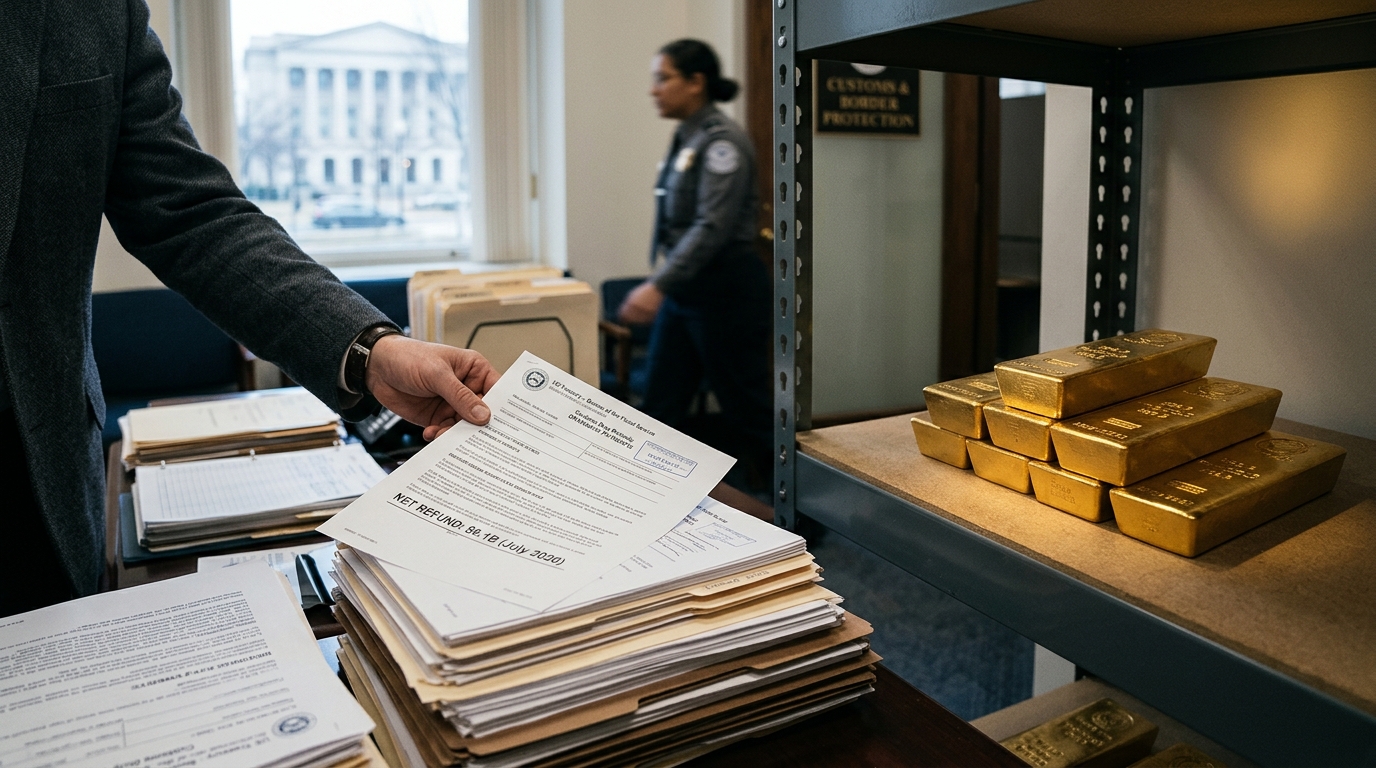
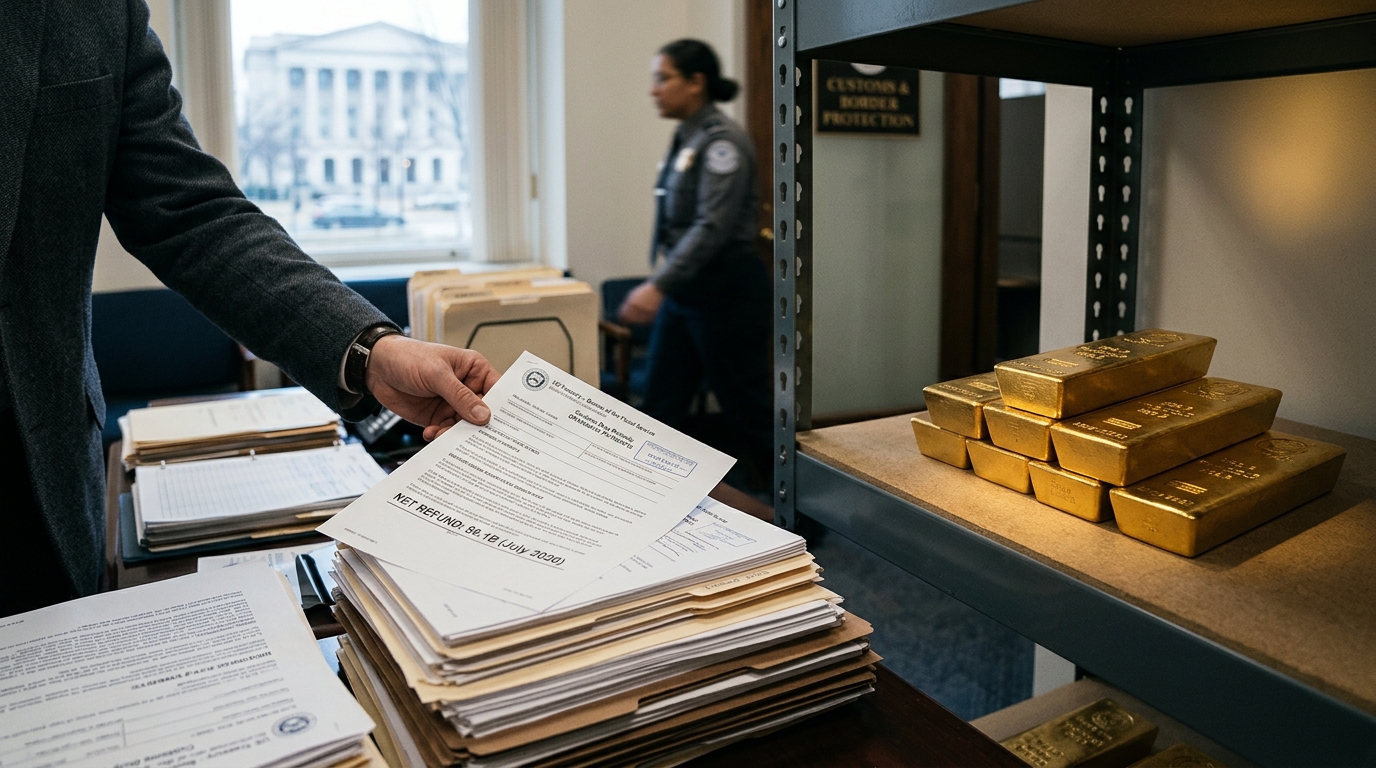
On August 5, CBP executive director Brandon Lord confirmed in a declaration filed with the U.S. Court of International Trade that the agency had paid out $100 billion in IEEPA tariff refunds as of July 31. The Supreme Court’s 6-3 ruling on February 20 invalidated the Trump administration’s tariff program as an overreach of executive authority. Federal Judge Richard Eaton subsequently ordered full refunds to importers. CBP built a dedicated portal called CAPE to process the claims, which went live in late April. By end of July, the system had received 252,496 refund declarations covering 25.1 million import entries.
The arithmetic is striking. The $100 billion paid represents approximately 60% of the roughly $166 billion collected under the IEEPA regime. Another $66 billion remains in the pipeline. Some of the largest single refunds already disbursed: Apple received $2.19 billion in its fiscal third quarter. Walmart expects $2.4 billion. Ford anticipates $1.3 billion. Amazon has received $600 million.
The Congressional Budget Office now projects the fiscal 2026 deficit at $2.1 trillion, up $200 billion from its February forecast, driven almost entirely by a $250 billion shortfall in customs and tariff revenue. Full-year federal spending is tracking close to earlier projections. This is a revenue problem, not a spending problem, and the refund program is at the center of it.
What the Market Is Really Saying
Markets generally understand that gold benefits from fiscal deterioration and inflation. What is less well understood is the inflationary asymmetry baked into the refund cycle itself.
Prices rose when tariffs hit in 2025. Those increases landed on consumers at the retail level after being passed through supply chains. The refunds, however, are flowing to importers of record: the companies that paid duties at the border. Most consumers are not receiving a check. The companies that raised prices and absorbed tariff costs have little operational incentive to cut prices retroactively. Tracing which tariff drove which price increase is practically impossible. New York resident Tyasia Johns has already filed a class-action against Five Below, alleging the company passed IEEPA costs to consumers through price increases, saw a 22.9% year-over-year jump in net sales to $4.76 billion in 2025, and has shown no intention of returning the refunds it received.
That asymmetry matters for inflation. The refund cycle injects corporate spending capacity into an economy where consumer-facing prices are not declining. Wednesday’s July CPI held at 3.4% annually, with core at 2.5%, both matching Wall Street’s forecast. In-line is not the same as benign. Headline inflation is still 140 basis points above the Fed’s 2% target. The Fed held for a fifth straight meeting, though three FOMC members dissented in favor of a 25-basis-point hike, the first three-dissent vote in this cycle.
More deficit, more Treasury issuance, more competition for capital, a Fed that cannot cut without risking inflation re-acceleration. That is gold’s structural environment. And it is not a trade.
He went 11-for-11 during the last Fed shock. Another one is about to hit.
In 2022, when the Federal Reserve made its most dramatic pivot in history and the S&P lost nearly 20%, Larry Benedict didn’t lose a single trade.
He knew where the money was going and positioned his readers to profit.
Trump is now installing his own Fed Chair, something Wall Street is already calling a generational shift.
Larry says his readers will be ready for it.
Click here to find out the one ticker he’s positioning in, completely free.
Deep Dive: How the Royalty Model Works
Royalty and streaming companies do not mine gold. They finance mines.
A streaming company like Wheaton provides upfront capital to a miner in exchange for the right to purchase a fixed percentage of future production at a predetermined cost, typically well below spot price. Wheaton can currently acquire gold and silver at average costs of around $473 and $5.75 per ounce respectively through 2029. When gold trades at $4,370, that fixed-cost structure produces extraordinary margins. The company’s operating margin in the most recent quarter was 65.5%. Franco-Nevada, which runs a slightly more diversified book that includes oil and gas royalties alongside precious metals, reported a gross margin of 73.6% in the comparable period.
Franco-Nevada’s portfolio spans more than 430 assets across the Americas, Africa, and Australia, with gold contributing roughly three quarters of revenue. The company has raised its dividend for 18 consecutive years, including through a period in late 2023 when the forced shutdown of the Cobre Panama mine eliminated close to 20% of its revenue overnight. The company still raised the dividend. It ended that year with $1.4 billion in cash and no debt. That kind of balance sheet resilience is not accidental. It is structural.
Wheaton’s portfolio consists largely of long-life, low-cost assets with production expected to grow from 600,000 to 670,000 gold equivalent ounces in the near term to an average of 950,000 GEOs annually from 2030 to 2034. The April completion of a $4.3 billion silver streaming agreement with BHP on the Antamina mine in Peru, the largest precious metals streaming transaction on record, added meaningful long-duration exposure to the portfolio.
The Data Section
Wheaton Precious Metals (WPM)
- Q2 2026 revenue: $503 million; operating cash flow: $415 million; net earnings: $292 million
- Balance sheet: $1 billion cash, zero debt, $2 billion undrawn credit facility
- Production growth trajectory: 870,000 GEOs by 2029, ~950,000 GEOs average 2030 to 2034
- Fixed acquisition costs: ~$473/oz gold, ~$5.75/oz silver through 2029
- Operating margin: ~65.5%; gross margin: ~70.2%
- YTD stock return: approximately 70%
- Recent dividend: $0.195 per share with ex-date of August 20, 2026
Franco-Nevada (FNV)
- Q2 2026 revenue: $369 million, up 42% year-over-year; operating cash flow: $430 million, up 121%
- Net income: $247 million, more than doubled year-over-year; record adjusted EBITDA margins
- Portfolio: 430+ assets globally; gold ~75% of revenue
- 18 consecutive years of dividend increases
- Gross margin: ~73.6%; current market cap: approximately $38.7 billion USD
- YTD stock return: approximately 60%; analysts citing 30% further upside as of June 2026
Sector-wide valuation context
- Next-12-month EV/EBITDA for senior producers: roughly 11x, versus 15x+ at prior cycle peaks
- Price-to-NAV ratios: compressed to approximately 1.3x to 1.9x, versus 2.2x+ in earlier cycles
- Mining equities are collectively pricing in a gold price of approximately $3,354 per ounce through P/NAV methodology, per Bank of America analysis, despite spot near $4,370
- That implies roughly a 19% discount to net asset value at current spot
- Several quality names trading at single-digit forward P/E despite record earnings
Is It Cheap? The Mispricing Test
Here is the question The Cheap Investor always asks: why has the market discounted these companies, and is the reason temporary or structural?
The discount is real and measurable. EV/EBITDA multiples for producers are sitting near the bottom of their five-year ranges. P/NAV ratios are compressed relative to prior bull market periods. Analysts are still using consensus gold price forecasts substantially below current spot to derive NAV, which means valuations built on those models are systematically understating what these businesses are worth at today’s prices.
The reason for the discount appears to be investor caution built up across prior cycles, combined with a market rotation away from commodities and toward technology. Neither of those is a fundamental argument against the business. Both are sentiment-driven, and both are reversible.
The royalty model adds a layer of insulation that traditional producers do not offer. Operational risk lives with the miner, not the royalty holder. Cost inflation hits the miner’s margins; the royalty company’s acquisition cost is fixed at deal inception. When gold moves from $2,800 to $4,370, the royalty company captures almost all of that incremental margin. When costs at the mine site rise 15%, the royalty company bears none of it.
That is not a momentum argument. It is a business quality argument. And at current multiples, quality is available at a price that the underlying fundamentals do not justify.
Bull, Base, and Bear
Bull case. Gold holds above $4,000 through year-end. The Fed holds rates steady as inflation gradually eases, keeping real rates low enough to sustain gold demand. Central banks maintain their Q2 pace of buying. Equity analysts, forced to revise their gold price assumptions upward, raise NAV estimates. Multiples re-rate toward historical norms. At 2.2x NAV — the level seen at prior cycle peaks — royalty companies would trade materially higher than today. The fiscal deficit dynamic does not resolve before 2027 at the earliest, keeping Treasury supply elevated and the structural case for gold intact.
Base case. Gold consolidates in the $3,800 to $4,500 range for the next two to three quarters. The royalty companies continue generating record free cash flow at current prices, grow dividends, and fund additional streaming transactions. Equity multiples creep higher as earnings revisions force analysts off conservative gold price assumptions. Investors who bought near current levels earn a combination of stock appreciation and growing dividends. The wait is measured in quarters, not years.
Bear case. The remaining $66 billion in tariff refunds clears without triggering consumer price reductions, but also without accelerating inflation further. The Fed hikes in September after August CPI surprises to the upside. Dollar strength returns, putting pressure on gold even as the structural fiscal story remains intact. Royalty company equity prices pull back 15% to 20% from current levels. The thesis is not broken, but the timeline extends and investors face a test of patience.
Action Plan for the Bargain Hunter
The royalty model is not a speculative position on gold’s next move. It is a long-duration business with fixed costs, growing production, and a structural advantage over traditional miners that compounds with time. Treat it accordingly.
For investors without existing exposure, the current entry represents a better risk-adjusted starting point than the January peak. Both WPM and FNV have pulled back from their highs while earnings power has continued to grow. The margin of safety has improved, not deteriorated, since the beginning of the year.
Consider building in two tranches. A first position now at current prices, a second position if the bear-case scenario materializes and gold pulls back toward $3,800. Do not wait for a perfect entry point that may never arrive. These are businesses with genuine competitive advantages, and the fiscal environment that is supporting gold prices is not resolving quickly.
For investors already holding producers, this is worth evaluating as a complement rather than a replacement. The royalty model does not eliminate commodity risk, but it concentrates the exposure on price rather than on costs, jurisdiction risk, or execution. At a moment when the gold price itself is providing the tailwind, that concentration makes sense.
The Cheap Investor Scorecard
- Business quality: Exceptional. Fixed-cost model, no operational risk, scalable without capital intensity. Pass.
- Financial strength: WPM: $1B cash, zero debt. FNV: 18 consecutive dividend increases through a period that included a 20% revenue wipeout. Pass.
- Valuation vs. history: EV/EBITDA ~11x vs. 15x+ at prior peaks. P/NAV 1.3x to 1.9x vs. 2.2x+ historically. Pass.
- Valuation vs. peers: Gold equities pricing in ~$3,354/oz despite spot at $4,370. Meaningful discount to intrinsic value at current prices. Pass.
- Competitive position: Wheaton and Franco-Nevada have first-mover advantages in streaming deal flow, balance sheet credibility that smaller competitors cannot match, and portfolios of long-life, low-cost assets that are difficult to replicate. Pass.
- Free cash flow: Both companies generating record free cash flow. WPM operating cash flow $415M in Q2 alone. Pass.
- Management execution: Franco-Nevada has raised its dividend 18 straight years. Wheaton completed the largest streaming deal on record in April 2026. Track record is strong. Pass.
- Catalyst strength: Fiscal deficit at $2.1 trillion, Fed on hold with three dissents, central banks buying at record pace. Multiple catalysts, not a single binary event. Pass.
- Margin of safety: Equity pricing implies gold at ~$3,354. Spot is $4,370. That gap is the margin of safety, and it is not trivial. Pass.
- Long-term potential: Production growth pipelines extend to 2034 and beyond. Streaming deals compound in value as gold prices rise. The fiscal dynamics driving gold are structural, not cyclical. Pass.
Scorecard result: 10 of 10 criteria pass. This does not guarantee positive returns. It means the available evidence does not reveal a reason to discount these businesses below what their fundamentals warrant.
The Bottom Line
The market is pricing gold royalty equities as though the gold price will revert to $3,354 per ounce. It is pricing that scenario even as the companies are generating record earnings, paying record dividends, and completing the largest streaming transactions in the industry’s history.
The $100 billion in tariff refunds confirmed in federal court filings this week is not just a fiscal curiosity. It is evidence that the biggest revenue experiment in recent trade policy history has been unwound at the worst possible moment for a government already running a $2.1 trillion deficit. The consumers who paid higher prices in 2025 are not getting checks. The companies that collected those revenues are. The Fed has no room to accommodate the resulting fiscal pressure. That combination does not resolve in a quarter.
If gold holds above $3,800 through year-end, these businesses will earn their way into a much higher valuation simply by reporting what their income statements already show. If multiples re-rate toward historical norms as analysts revise their gold price assumptions upward, the return from here is substantial. If you are wrong and gold corrects sharply, you own businesses with pristine balance sheets, fixed costs, and management teams that have navigated exactly that scenario before.
That is the bargain hunter’s framework: asymmetric upside, identified mispricing, and a margin of safety built into the entry price. The July CPI reading gave the Fed one more month to hold. It gave patient investors one more month to act before the gap between what these businesses earn and what the market pays for them becomes too obvious to ignore.
As always, do your own diligence. Position sizes should reflect your risk tolerance, not the strength of anyone else’s conviction.
Until next time,
The Cheap Investor