August 13, 2026
GOOGL: Discount or Value Trap?
The DeepMind overhaul scared the market. The fundamentals tell a more complicated story.
First a message from Profits Run
If you still haven’t downloaded my “Simple Options Trading For Beginners” book…
…please take a few seconds and download it right now before your new temporary download link expires.
I eventually plan to charge for this book, so do yourself a favor and download it now…
That way, no matter how much it is in the future, you’ll have a copy on your computer already.
Make sense?
FREE: Simple Options Trading For Beginners << Download Now
Good Trading,
Bill Poulos
P.S. Go here to save a copy of my “Simple Options Trading For Beginners” book to your computer before I start charging for it.
GOOGL: Discount or Value Trap?
Hey there, bargain hunter.
Here is a question worth sitting with. When a company controls 90% of the global search market, grows its cloud division at 82% year-over-year, counts nearly 90% of the Fortune 100 as enterprise AI customers, and trades at a trailing P/E near 18 — the lowest in seven years — is the market onto something real, or is it making the oldest mistake in value investing: extrapolating a temporary setback into a permanent verdict?
That is the Alphabet (GOOGL) question in August 2026. The answer is not obvious. But it is worth working through carefully, because the difference between a genuine bargain and a value trap often hides inside exactly this kind of noise.
The Scoreboard: What Just Happened
On August 5, Alphabet announced the most significant restructuring of Google DeepMind since Google acquired the London lab in 2014. Demis Hassabis stepped back from day-to-day operations and was elevated to Chair of Google DeepMind and Alphabet’s first Chief Scientist, retaining his role at Isomorphic Labs. Koray Kavukcuoglu, DeepMind’s CTO for thirteen years, was named SVP and became the sole remaining Gemini lead, reporting directly to Sundar Pichai. The same day, Jeff Dean departed after 27 years to co-found Discovery Loop, a public benefit corporation, alongside Sanjay Ghemawat, Oriol Vinyals, and Quoc Le. Alphabet is a founding investor in that venture and is supplying compute for the first year.
GOOGL fell roughly 4% on the announcement. The stock has since traded between $314 and $384 over the past month, sitting near $344 with a 52-week range of $196.60 to $408.61. That puts it roughly 15% below its all-time closing high of $402.38 reached in May, and about 21% off the peak by some measures. The coverage fixated on the departures. Most of it missed the actual cause.
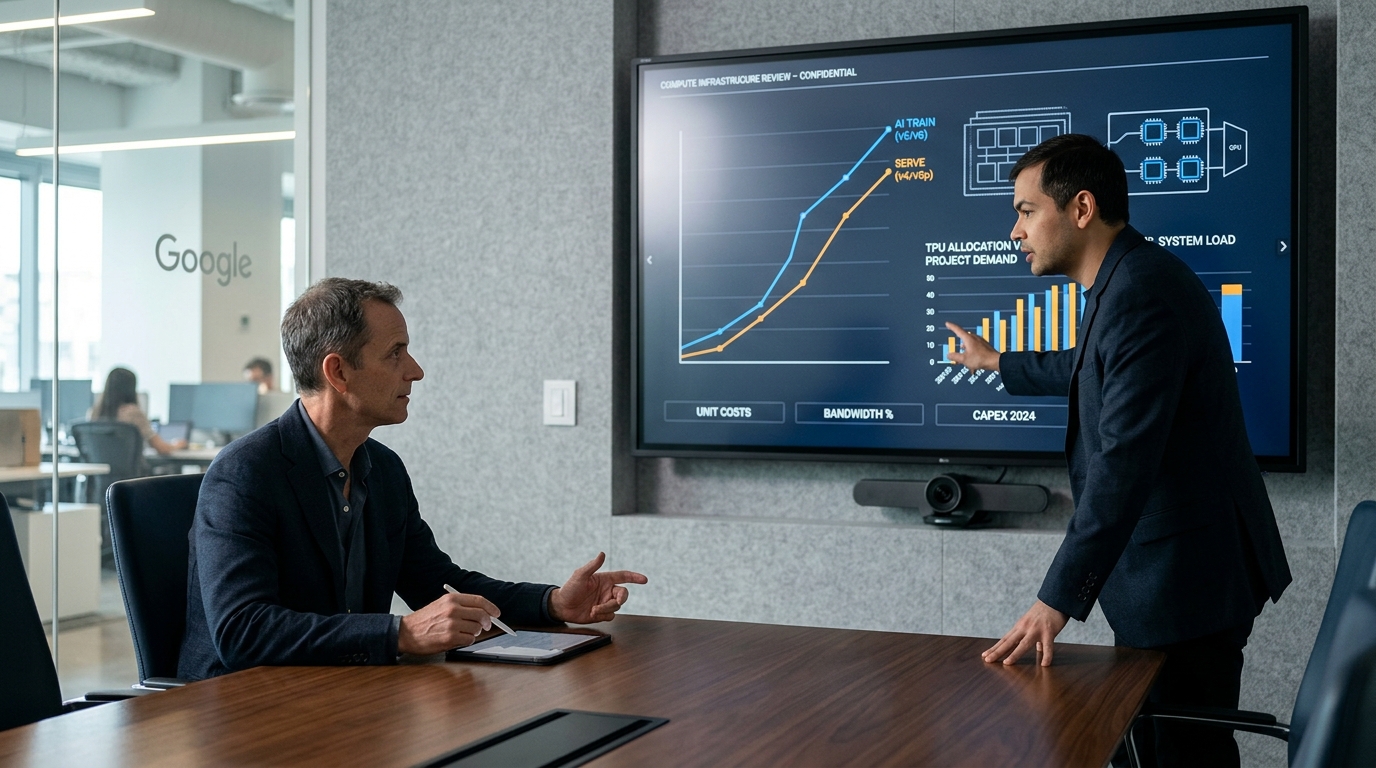
The underlying trigger was not a talent crisis. It was a compute allocation crisis. Google’s own AI researchers had been competing with external cloud customers for TPU access, a collision between internal model development and external cloud revenue that produced the Gemini 3.5 Pro delays and, eventually, the departures. The restructure is Alphabet admitting that the internal market for its own infrastructure had broken down, and attempting to fix the power structure before the Gemini 4 ramp begins.
The Real Reason: Expectations vs. Reality
Markets expected a steady Hassabis, predictable Gemini releases, and a research lab that retained its founding talent. They got the opposite on all three counts inside a single week. That is a perception shock, and perception shocks are precisely when the gap between market price and business reality tends to widen.
What did Q2 2026 actually show? Revenue of $119.8 billion, up 24% year-over-year, beating Wall Street consensus of $117 billion. Google Cloud at $24.8 billion, up 82%, with operating margin more than tripling to 35.6%. Cloud backlog reached $514 billion, up over $50 billion sequentially. Search revenue grew 17% to $63.3 billion, demonstrating that AI-integrated query expansion is accelerating the core business rather than cannibalizing it. The Gemini app crossed 1 billion monthly active users this week, confirmed by Pichai.
The EPS headline requires a correction. Diluted EPS of $9.11 cleared consensus of roughly $2.90 by a wide margin, but approximately $98 billion in other income, primarily unrealized gains on equity stakes including Anthropic and SpaceX, drove most of the beat. Operating EPS of $2.85 was roughly in line. Investors pricing the stock on the headline number are measuring the wrong thing.
The genuine concern sits in the cash flow. Free cash flow turned negative at -$5.9 billion in Q2 as capital expenditures hit $44.9 billion in the quarter alone. Full-year capex guidance was lifted to $195 to $205 billion. Alphabet also issued $25 billion in investment-grade bonds in early August to shore up its balance sheet. Share buybacks, which ran to $61.5 billion in 2023 and $28.3 billion in the first half of 2025, have effectively stopped in 2026 as capital gets redirected to infrastructure. The commercial engine is accelerating. The cash engine is, for now, running in reverse.
Deep Dive: How This Business Actually Makes Money
Alphabet is, at its core, the world’s most profitable advertising business with an increasingly large cloud division attached to it. Advertising still accounts for roughly 75% of revenue, down from 88% in 2017 but still the dominant engine. Search revenue at $63.3 billion in Q2 alone reflects a business that processes more queries than any competitor by an order of magnitude, monetizes each query through the most sophisticated auction system ever built, and sits behind default agreements across Android, Chrome, iOS, and most major browsers.
Google’s search share sits at approximately 90% globally according to StatCounter data. That figure has been remarkably durable despite years of predictions about its erosion. The moat here is not just habit. It is a self-reinforcing data loop: more queries generate better relevance signals, which attract more advertisers, which fund better tooling, which generates more queries. That loop has been running for two decades and has survived prior existential threats including the mobile transition and the rise of social media advertising.
Google Cloud is the growth engine. The shift from $17.7 billion in Q4 2025 annualized to $24.8 billion in a single quarter reflects an organization winning enterprise AI infrastructure contracts at a pace that outran even internal expectations. The $514 billion backlog is not a vanity figure. It represents contractually committed future revenue, which means the revenue visibility here is structurally better than the stock’s current multiple implies. Nearly 90% of the Fortune 100 is on Gemini Enterprise. That is customer concentration, yes, but it also means switching costs are building inside Alphabet’s largest potential accounts.
YouTube, subscriptions, Waymo, and Other Bets round out the picture. YouTube ad revenue grew 9% to $11.4 billion in Q2, moderate but stable. Waymo is expanding its commercial robotaxi operations in multiple cities and represents optionality that carries no meaningful valuation premium at current prices. Return on invested capital sits near 25%, a five-year incremental ROIC of approximately 29.9%. These are not numbers that describe a business in structural decline.
The Data Section: Key Metrics
- Q2 2026 Revenue: $119.8 billion, up 24% year-over-year
- Google Cloud Revenue: $24.8 billion, up 82%; operating margin 35.6%
- Google Search Revenue: $63.3 billion, up 17%
- Cloud Backlog: $514 billion, up over $50 billion sequentially
- Gemini App MAU: 1 billion monthly active users (confirmed August 2026)
- Operating Income: $40.8 billion, up 30%
- Free Cash Flow (Q2): -$5.9 billion
- TTM Free Cash Flow: $53.3 billion
- Full-Year Capex Guidance: $195 to $205 billion
- ROIC (5-year incremental): approximately 29.9%
- Return on Equity: 48.7%
- Debt/Equity Ratio: 0.19
- Current Ratio: 2.72
- Search Market Share: approximately 90% globally
- Share Buybacks in 2026: effectively suspended; $28.3 billion in H1 2025 for comparison
Is It Cheap? Valuation vs. Peers and History
This is the critical question. The trailing P/E on GOOGL sits near 18 as of early August, a figure that represents the lowest multiple Alphabet has carried since 2019. The EV/EBITDA ratio is approximately 24.6. The forward P/E, using operating earnings rather than GAAP, is closer to 20 to 21. The PEG ratio on a GAAP trailing basis is approximately 0.77, which means the stock is growing earnings faster than its multiple implies on a historical basis.
Compare that against the peer group. Microsoft has traded at a consistent premium to Alphabet for several years, often at 30 to 35 times earnings, on the strength of its Azure and Office moats. Meta, which is also growing revenue at a double-digit pace and has demonstrated strong AI monetization, carries a meaningfully higher multiple than Alphabet today despite Alphabet’s faster cloud growth and larger revenue base. The market, in other words, is pricing Alphabet at a discount to peers who are growing more slowly.
That discount has a clear cause: the market is worried about three things simultaneously. First, that the Gemini model delays indicate a permanent competitive shortfall. Second, that the negative free cash flow represents a structural deterioration rather than a temporary investment cycle. Third, that the departures of Jeff Dean and the Gemini co-leads signal an irreversible talent exodus. The question The Cheap Investor always asks is whether these concerns are temporary or structural. The honest answer is: probably a mixture of both, and the ratio of temporary to structural is exactly what is unresolved.
One counterargument that deserves attention: GuruFocus assigns Alphabet a GF Value of approximately $247 to $249, suggesting significant overvaluation relative to a model that anchors on historical multiples and growth. That perspective matters. A business trading at 18 times trailing earnings with negative quarterly free cash flow and an unresolved model execution question is not a screaming bargain. It may be a reasonable bargain. Those are different things.
The Mispricing Test: Cheap, Fairly Valued, or a Trap?
Let us answer the four questions directly.
Why has the market discounted this company? Three reasons operating simultaneously: leadership uncertainty around Gemini delivery, a free cash flow profile that has gone negative for the first time since the 2004 IPO, and the optics of high-profile researcher departures arriving in the same week. Fear is compounding.
Is the problem temporary or structural? The compute allocation problem that caused the Gemini delays is being addressed directly by the August 5 restructure, which consolidated Gemini authority under a single SVP and, based on reporting, is expected to ease TPU prioritization conflicts between DeepMind and the Cloud division. That is a manageable organizational problem. The capex cycle is a different issue: $205 billion in full-year spending with management confirming further significant increases in 2027 is not temporary. The question is whether it is productive. Cloud growing 82% on that investment argues it is.
Is Wall Street extrapolating short-term weakness too far into the future? Yes, partly. The Gemini 3.5 Pro delay matters, but Alphabet’s search dominance, its $514 billion Cloud backlog, and its 1 billion Gemini monthly users are not consistent with a company whose competitive position is permanently impaired. The departures of key researchers are real, but reporting from Google itself noted that AI staff departures in the first half of 2026 ran below the same period in prior years. Context is being ignored.
What could invalidate the thesis? A Gemini 4 launch that arrives late and underperforms on public benchmarks. Cloud growth decelerating from 82% into the 50s or 60s before the capex cycle turns productive. A formal antitrust remedy that materially disrupts Google’s search distribution agreements. Any of these would shift the question from temporary to structural.
Our verdict: Alphabet is not a value trap. But it is also not a deep bargain in the classic sense. It is a high-quality business with a temporary execution problem, trading at a historically low multiple, with a capital allocation cycle that will either prove itself or expose itself over the next 12 to 18 months. The margin of safety is moderate, not wide. Patient investors who can tolerate that ambiguity are in a different position than those who need near-term resolution.
Building the Investment Case
What does the market believe? That Alphabet is losing the frontier AI race, that the Gemini delays reflect a capability gap rather than an organizational problem, and that the capex cycle will destroy value rather than create it.
What does the evidence suggest? A 90% global search share that is still growing revenue at 17%. A cloud business that added $50 billion to its backlog in a single quarter. A restructure that was specifically designed to fix the compute allocation collision rather than retreat from the frontier. Sergey Brin working the floor three to four days a week and telling key staff, according to reporting, that Gemini is trailing where it cannot afford to trail — which is not the posture of a company that has accepted defeat. And Apple, in a partnership confirmed earlier this year, choosing to integrate Gemini models into its AI stack, which represents distribution to approximately 1.5 billion active iPhone users.
Where is the disconnect? The market is pricing in the worst interpretation of every negative headline simultaneously. The departures are being read as permanent talent loss rather than a restructured relationship: Alphabet is a founding investor in Discovery Loop, supplying it with compute, and maintaining access to the research output of the people who left. The capex is being read as destruction rather than deferred return. The restructure is being read as retreat rather than consolidation of authority for faster execution.
What catalyst could narrow the gap? A credible on-time Gemini 4 delivery. Q3 Cloud growth sustaining above 70%. An explicit compute reservation policy for internal research teams, which would confirm that the TPU allocation problem has been structurally resolved. Any of these, arriving before the next earnings call, would force a re-rating at a P/E that is already low by every historical measure.
How long might investors need to wait? Q3 earnings in late October 2026 is the first major checkpoint. Gemini 4 delivery is the second. Neither has a confirmed date. Investors who need resolution in 30 days are in the wrong position. Investors with a 12-to-18-month horizon and tolerance for near-term volatility are in a more defensible one.
Bull, Base, and Bear: Three Scenarios
Bull case. Kavukcuoglu ships Gemini 4 on schedule and establishes a predictable monthly release cadence. Q3 Cloud growth holds above 75%. The capex cycle begins showing returns in operating cash flow by mid-2027, and the P/E re-rates from 18 toward 24 to 26, which is closer to the historical norm and still a discount to Microsoft. At $344 today, that implies a stock that closes toward the analyst consensus target of $427 or beyond on a 12-to-18-month horizon.
Base case. Gemini 4 arrives slightly late but delivers credible benchmark improvements. Cloud growth decelerates from 82% to the mid-60s, still strong but enough to raise questions. Capex stays elevated through 2027 without a clear inflection in free cash flow. The stock trades sideways in a range of $320 to $390 while the market waits for evidence. Investors earn modest returns and collect the quarterly dividend of $0.22 per share while the thesis develops.
Bear case. Gemini 4 misses benchmarks or arrives into a market where Claude and GPT have extended their leads. Cloud growth decelerates below 60%. The $205 billion capex commitment becomes impossible to defend at any reasonable multiple, and antitrust remedies begin materially disrupting search distribution agreements. In this scenario, the stock revisits the lower end of its 52-week range. The $196.60 low is not the floor of a bear case; it is a data point that shows how far sentiment can move this stock when the news is bad.
The Cheap Investor Scorecard
| Dimension | Rating | Key Observation |
|---|---|---|
| Business Quality | Strong | 90% search share, durable ad moat, 1 billion Gemini users |
| Financial Strength | Adequate | Current ratio 2.72, D/E 0.19 — but FCF negative in Q2, debt issuance accelerating |
| Valuation | Moderate Discount | Trailing P/E near 18, lowest since 2019; below Microsoft and Meta on growth-adjusted basis |
| Competitive Position | Strong | Search network effects, TPU cost advantage, $514B Cloud backlog, Apple Gemini partnership |
| Balance Sheet | Adequate | Low debt ratio but contractual commitments exceed $800B; $25B bond issuance in August |
| Cash Flow | Concern | Q2 FCF -$5.9B; TTM FCF $53.3B — investment cycle is compressing near-term returns |
| Management Execution | Mixed | Strong Cloud growth; Gemini 3.5 Pro and 3.6 Flash have missed targets; restructure is correct diagnosis |
| Catalyst Strength | Moderate | Gemini 4 delivery and Q3 Cloud growth are near-term; neither is confirmed |
| Margin of Safety | Moderate | P/E at 7-year low offers some protection; not a wide-margin opportunity at current price |
| Long-Term Potential | High | TPU stack, Waymo optionality, Cloud trajectory, 90% search moat all intact |
Action Plan for Patient Investors
The Cheap Investor does not ask what the hot money is doing. It asks what a patient investor with a three-to-five-year horizon would pay for this business knowing what the evidence actually says.
At $344 with a trailing P/E near 18, GOOGL is offering a price that reflects fear about execution, not a verdict on the durability of the business. The search moat has not deteriorated. The Cloud trajectory has accelerated. The Gemini delays are real but are being addressed at the organizational level. The capex cycle is large and disruptive to near-term cash flow, but it is building the infrastructure stack that Cloud growth of 82% requires to sustain.
For investors who want exposure, a scaled approach is more disciplined than a full position today. An initial position at current prices, with a planned addition if the stock revisits the $310 to $320 range on a Gemini miss or capex-related sentiment pressure, and a final addition if Q3 Cloud growth confirms the trajectory, gives you three entry points across the range of plausible scenarios. This is not a call to act quickly. It is a call to think about what you are willing to own and at what price the thesis becomes unambiguously attractive versus merely reasonable.
The risk to monitor most closely is not the departures. It is Cloud deceleration. If Q3 growth falls below 65%, the spending pace becomes genuinely hard to defend and the multiple compression could continue. That number, due in late October, is the single most important data point for this thesis over the next 90 days.
Cheap Investor Checklist
- Track Gemini 4 delivery: On-time shipment with credible benchmark results is the primary catalyst. A second delay reopens the permanent-impairment narrative. Watch for a release announcement before Q3 earnings in late October.
- Watch Q3 Cloud growth closely: 82% is the Q2 baseline. Anything above 70% sustains the investment thesis. A deceleration into the 50s reopens the capex-to-revenue debate and should prompt a reassessment of position sizing.
- Monitor the TPU allocation question: Any public disclosure of an explicit compute reservation policy for internal DeepMind research teams would be the most structurally bullish outcome from the August 5 restructure. It has not been confirmed.
- Follow Discovery Loop’s next financing round: Discussions are reportedly underway for $1 billion at an approximately $10 billion valuation. If that round closes, it tells you something about how sophisticated investors value the research talent that left — and whether the market should read it as a threat or as Alphabet maintaining optionality through a founding investor stake.
- Watch antitrust developments: The DOJ search remedies case continues. Any ruling that meaningfully disrupts Google’s default search agreements is the most underappreciated long-term risk in this thesis. Default positioning accounts for a meaningful share of Search revenue.
- Check free cash flow recovery: The investment thesis depends on the capex cycle producing operating cash flow growth that eventually restores and exceeds prior FCF levels. The TTM FCF of $53.3 billion is the baseline. If Q4 2026 and Q1 2027 do not show improvement, the duration of the cash flow trough is longer than the thesis assumes.
- Monitor capital returns: Buybacks have effectively ceased in 2026. Any announcement of a resumed repurchase program, even at a reduced pace, would signal that management believes the capex peak is approaching and that the balance sheet can support returning capital.
Bottom Line
Alphabet is not a broken company trading at a distressed multiple. It is a dominant company with a temporary execution problem trading at a historically low multiple. Those are different situations with different implications for patient investors.
If Gemini 4 ships credibly and Q3 Cloud growth holds above 70%, the current P/E near 18 will look like a gift. If Gemini 4 misses again and Cloud growth decelerates sharply, the capex burden makes a further de-rating plausible and the current price provides only moderate protection.
The Cheap Investor’s assessment: GOOGL is a quality business offering a moderate discount. It is worth owning on a patient, scaled basis. It is not a wide-margin opportunity that demands urgency. The market is getting the short-term story approximately right and the long-term story approximately wrong. For investors who can live with that gap for 12 to 18 months, there is a reasonable case to build here. For those who need near-term resolution, there are cleaner opportunities elsewhere.
The $514 billion backlog is real. The 90% search share is real. The 1 billion Gemini users are real. The question is whether Kavukcuoglu can make the model delivery calendar real too. Everything else is noise.