
August 9, 2026
CVX: Two Businesses, One Ticker
Chevron’s commodity earnings are already exceptional. What the market hasn’t priced is the business sitting underneath them.
First a note from Stansberry Research
SpaceX S-1 Filing Reveals Elon’s Hidden AI Master Plan

Wall Street completely missed the most important part of the largest IPO in history.
Buried inside the S-1 filing is something that could be worth far more than the entire rocket business – unlike anything we’ve seen before.
Rob Spivey – whose institutional research is followed by Goldman Sachs, JPMorgan Chase, BlackRock, and Fidelity – just went on location at SpaceX’s Starbase HQ to reveal everything he has discovered about Elon’s hidden master plan.
The last time Wall Street missed a story this big, early investors had the chance to turn every $1,000 into $14,000.
Get the name and ticker of the No. 1 stock at the center of it FREE (not Tesla or SpaceX).
CVX: Two Businesses, One Ticker
Hey there, bargain hunter.
Here is a question worth sitting with: when does the market stop pricing a business for what it was and start pricing it for what it is becoming?
Chevron reported Q2 2026 earnings on July 31. The numbers were not subtle. $12.1 billion in net income. $6.06 adjusted EPS against a consensus of $5.11. A 20% production increase year over year. Adjusted free cash flow of $15.4 billion in a single quarter. The company also revealed it had hit its $3 billion structural cost-reduction target six months ahead of schedule. The stock barely moved.
That reaction is the tell. When a business delivers results that large and the stock shrugs, the market has already decided what kind of company this is. An oil company. Commodity-driven. Cyclical. A hold until crude rolls over.
What the market has not yet resolved is whether that framing is still complete. Because buried inside the same earnings cycle, Chevron confirmed it had signed a 20-year, 2.67-gigawatt power purchase agreement with Microsoft to supply dedicated electricity to a data center campus in Pecos, Texas. The project, called Kilby, runs entirely off-grid, carries no ERCOT interconnection, and is structured to generate cash flows largely insulated from oil and gas price cycles.
That is not an oil business. That is a contracted infrastructure business attached to an oil company’s balance sheet. The question every disciplined investor should be asking is whether the market will ever price it as such, and if so, when.
The Scoreboard
Let’s put the numbers in one place before we go further.
- Q2 2026 adjusted EPS: $6.06 vs. $5.11 consensus. Beat of roughly 19%.
- Q2 net earnings: $12.1 billion ($6.11 per diluted share)
- Revenue: $70.06 billion vs. $62.26 billion forecast. Beat of roughly 12.5%.
- Operating cash flow: $22.6 billion
- Adjusted free cash flow: $15.4 billion
- Return on capital employed: 21.4%
- Production growth year over year: 20%, driven by legacy Hess assets, Permian Basin, and Gulf of America
- Debt retired in Q2: $8.4 billion. Net debt to cash flow from operations: 0.6x.
- Structural cost reductions: $3 billion achieved, six months early
- Hess synergies: $1.5 billion annual run-rate, 50% above the initial target, ahead of schedule
- Quarterly dividend declared: $1.78 per share, payable September 10, 2026
- Q3 guidance headwinds: Upstream turnarounds and downtime expected to reduce production by 150-200 MBOED; downstream downtime projected to impact earnings by $175-$225 million
- Full-year capex guidance: $18-$19 billion, with management expecting to finish at the low end
The forward picture includes a share repurchase authorization of $2.5-$3.0 billion for the coming quarter, and management reaffirmed 2030 targets of 2-3% annual production growth, greater than 10% annual adjusted free cash flow growth, and more than 3% improvement in return on capital employed at flat commodity prices.
This is not the operating profile of a company running on fumes. It is the operating profile of a company that is quietly compounding while analysts wait for the next commodity catalyst to care about it.
The Saudi Royal Family Trusted Him. Now He’s Talking
The governments of Saudi Arabia and Kuwait once trusted Larry Benedict with their money. Barron’s ranked his fund in the top 1% on the planet. Now he’s sharing his oil trading strategy with regular folks, for free.
What Actually Happened: Perception vs. Reality
The market’s current read on Chevron goes something like this: strong quarter, yes, but Brent was elevated, Hess was a tailwind, and Q3 is going to be messier with planned downtime. Price accordingly and move on.
That read is not wrong. Brent crude averaged $104 per barrel in Q2 2026, up sharply from $68 a year earlier. Higher commodity prices explain a meaningful portion of the earnings jump. The Hess assets contributed significant volume. These are cyclical inputs, and the market is right to discount them partially.
What the market is discounting entirely is Project Kilby.
On June 22, 2026, Chevron’s wholly owned subsidiary Energy Forge One LLC signed a 20-year power purchase agreement with Microsoft to build a co-located, gas-fired generation facility on more than 2,000 acres in Reeves County, West Texas, near Pecos. The facility is designed to supply electricity directly to a Microsoft AI data center campus. It operates 100% behind the meter with no utility involvement and no grid interconnection. Peak capacity is 2.67 gigawatts, with a longer-term expansion target to 5 gigawatts into the 2030s.
The capital outlay is estimated between $7 billion and $9 billion, depending on the source. Chevron has stated it is targeting mid-teen returns on the development. Final investment decision is targeted before year-end 2026. First power delivery is scheduled for 2028.
The duration is the critical variable that the oil-company framing misses. A 20-year contracted cash flow stream from a dedicated infrastructure asset is not priced anything like a barrel of crude. It is priced like a pipeline. Or a toll road. The market has not yet decided which lens to apply to Chevron’s growing contracted power book, and that indecision is where the potential opportunity lives.
What the Business Actually Is
Chevron is one of the world’s largest integrated energy companies. It produces crude oil and natural gas, refines transportation fuels, manufactures lubricants and petrochemicals, and operates through two primary segments: Upstream and Downstream. The Hess acquisition, which closed July 18, 2025, added meaningful Guyana deepwater exposure and additional U.S. onshore position. U.S. refinery crude unit throughput hit a record 1.07 million barrels per day in Q2 2026, reflecting capacity utilization above 97%.
That is the traditional business. It is excellent. It generates more cash in a single quarter than most S&P 500 companies generate in a year. The Permian Basin alone is expected to require roughly $3.5 billion in capital in 2026 while delivering 25% improvement in capex per barrel of oil equivalent compared to last year. These are not the economics of a struggling legacy industry player. They are the economics of a mature machine that has been quietly getting more efficient.
The new business is different in kind, not just degree.
Chevron New Energies, an internal business unit, is building out the company’s power and data center infrastructure ambitions. Project Kilby was developed in collaboration with Joulent LLC, the energy venture of Engine No. 1, which holds a 50% equity option in the project. The facility draws on natural gas from Chevron’s existing Permian Basin reserves, uses non-potable brackish groundwater rather than freshwater, and is designed to operate independently of the regional grid. The fuel source is already owned. The land is secured. The off-take contract runs 20 years with Microsoft as counterparty.
Chevron has also stated that it is in discussions on additional power opportunities beyond Kilby, both with Microsoft and with other potential customers. The long-term expansion target of 5 gigawatts is not speculative ambition from a company with no relevant capabilities. It comes from a company that controls Permian Basin gas, owns large-scale project execution infrastructure, and has already secured turbine capacity from GE Vernova for the initial buildout.
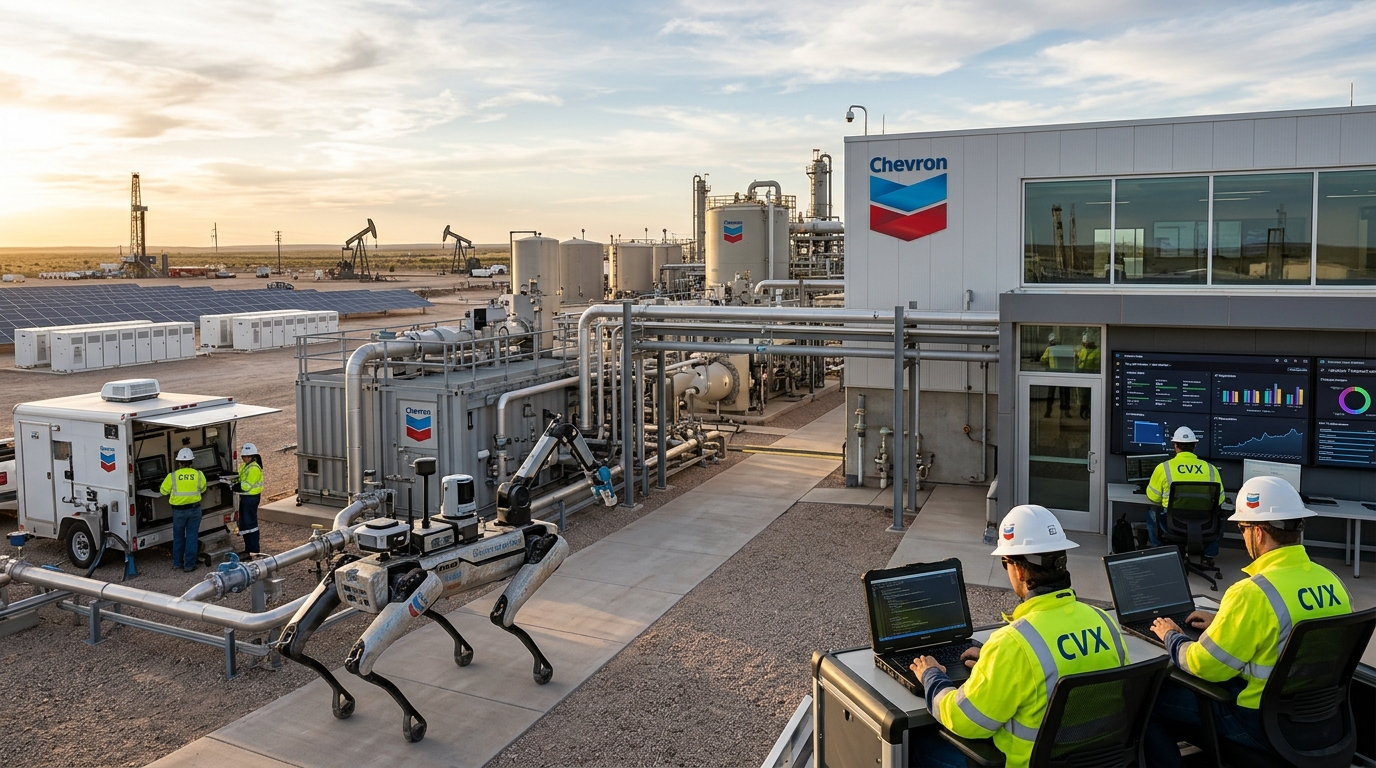
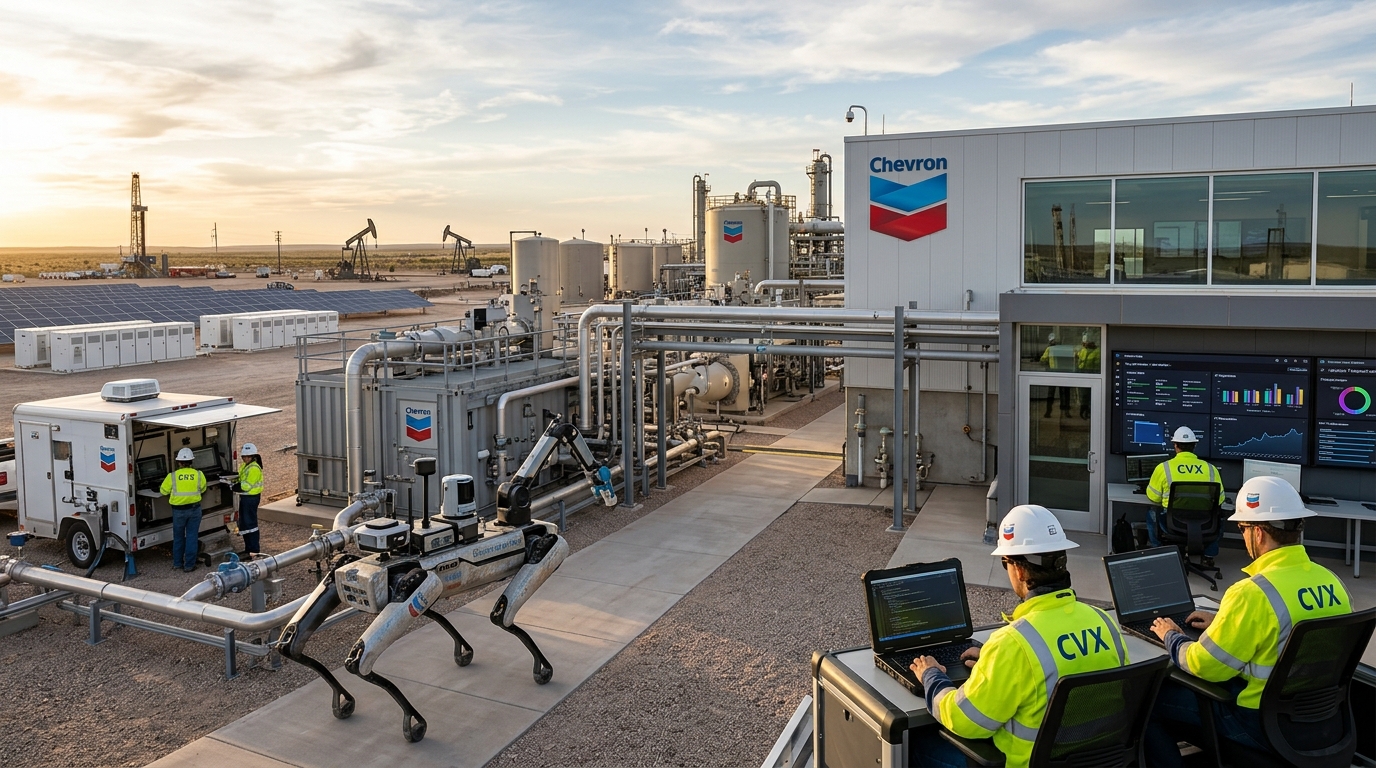
Inside its own operations, Chevron is simultaneously deploying agentic AI. DataRobot announced in June 2026 that it is collaborating with Chevron to apply AI agents to autonomous inspection operations across its facilities, using NVIDIA software and compute within Chevron’s digital systems. The stated focus is improving how robotic inspection missions are planned and executed. Chevron has framed this work inside its Facilities and Operations of the Future initiative. The two developments are connected: a company that converts gas into contracted compute power, and applies AI to run its own physical plant more efficiently, is compressing costs while expanding its revenue architecture simultaneously.
The Macro Context: Why This Matters Now
Data center operators cannot get power from the grid fast enough. Goldman Sachs research projects U.S. data center power demand will more than double to 66 gigawatts in 2027 from 31 gigawatts in 2025. Grid connection timelines can run years. Permitting is slow. Transmission buildout is slower.
Chevron can move faster in co-located power because it already controls the fuel, owns the land, and has large-scale construction execution capabilities that most utilities do not. The Kilby site covers more than 2,000 acres in Reeves County. Permian Basin natural gas has historically faced limited pipeline takeaway capacity, resulting in routine flaring. Kilby converts that stranded molecule into a contracted, long-duration revenue stream. The economics of the input become the economics of the output.
ExxonMobil is working a similar angle from a different direction. XOM is targeting a final investment decision on its first Low Carbon Data Center concept by late 2026, pairing natural gas-fired generation with carbon capture and storage to supply data center demand. NextEra Energy has also presented a partnership concept with ExxonMobil involving an initial 1.2-gigawatt carbon-abated, gas-fired plant on a 2,500-acre site in the U.S. Southeast. The difference is that ExxonMobil’s data center power approach, at least as publicly described, was still in the customer-marketing phase as of early 2026, without a signed off-take agreement at the scale Chevron has already secured.
Chevron has a signed 20-year PPA with Microsoft at 2.67 gigawatts. That is the relevant competitive distinction. The race to supply contracted power to hyperscalers has a leader at the moment, and it is wearing a Chevron badge.
Is It Cheap? The Valuation Case
CVX is currently trading near $186. The 52-week range runs from $146 to $214. The consensus average 12-month price target among analysts covering the stock sits near $217, with a high estimate of $236. TD Cowen raised its target to $205 from $200 on August 5. Twenty of the analysts covering the company currently recommend buying the stock.
The trailing PE ratio sits around 18.9x, with a forward PE near 13.2x on current consensus earnings estimates. The EV/EBITDA stands at roughly 5.3x based on reported figures. The EV/FCF is approximately 15.8x. Annual dividend of $7.12 per share implies a yield of approximately 3.7% at the current price, with 19 consecutive years of dividend increases and a five-year dividend growth rate of roughly 6%.
Now the historical context. CVX’s 10-year median EV/EBITDA has been approximately 7.7x. The current multiple of roughly 5.3x sits below that median. The forward PE of 13.2x compares to a 10-year historical average closer to 18-22x. On those metrics alone, the stock does not appear expensive relative to its own history.
The complication is the earnings quality question. A meaningful portion of the Q2 beat was driven by Brent averaging $104 per barrel, a level that reflects Middle East geopolitical risk premiums that have historically been temporary. If Brent retreats toward $75-$80, forward earnings estimates compress, and the valuation picture looks less straightforward.
Here is where the Kilby thesis matters most to a valuation discussion. Contracted infrastructure cash flows are worth more per dollar than commodity cash flows. A 20-year PPA with Microsoft carries a meaningfully different risk profile than a barrel of crude priced to Brent. If the market eventually assigns even a modest utility-style premium to the contracted power revenue stream, the effective multiple on Chevron’s blended business rises. The question is not whether that re-rating is warranted. It is whether the market will do it before or after first power delivery in 2028.
At $186, you are buying the oil business at a discount to its own history, and receiving the power business for approximately nothing. That is the Cheap Investor’s kind of trade.
Oil Surge Predicted…But Are You Ready?
Do you own oil and gas stocks? Or are you thinking about buying some?
If so, you need to see my #1 oil play for 2026 But it’s NOT oil stocks, futures, or anything you’ve likely heard about.
Rather, it’s an unusual way to potentially bank monthly income from the oil and gas markets.
Cheap, Fairly Valued, Expensive, or Value Trap?
This is the defining question, and it requires a straight answer.
Chevron is not a value trap. A value trap is a business where the apparent discount reflects permanent impairment: a shrinking competitive position, deteriorating cash generation, structural revenue decline, or a balance sheet heading in the wrong direction. Chevron is running in the opposite direction on every one of those dimensions. It retired $8.4 billion of debt in a single quarter. It hit its cost-reduction target six months early. It exceeded its Hess synergy targets by 50%. Production is growing. Margins are expanding. The dividend has been raised for 19 consecutive years.
The core business is not impaired. It is compounding.
Is it cheap in an absolute sense? At a forward PE of roughly 13x and an EV/EBITDA below its 10-year median, it is not expensive. Whether it qualifies as genuinely cheap depends on your commodity price assumption. If you believe Brent stays above $85 through 2027, CVX looks undervalued on current estimates. If you believe it reverts toward $70, the valuation becomes less compelling on the upstream business alone.
The more interesting argument is that the stock is moderately valued on the upstream business and deeply undervalued on the contracted power business. Kilby alone represents a multi-decade, 2.67-gigawatt revenue stream with a Microsoft counterparty and mid-teen return targets. That asset is not showing up in any sell-side model as a separate valuation component yet. It is being carried at cost, embedded in a conglomerate discount, and ignored by investors who categorize Chevron as an oil-and-gas holding.
Our assessment: cheap to fairly valued on the base business, with a meaningful and currently unpriced option on the contracted power buildout. The margin of safety here is not dramatic, but it exists, and the asymmetry favors patient holders.
Bull, Base, and Bear
Bull Case
Final investment decision on Project Kilby clears by year-end 2026. Chevron announces one or two additional power contracts with customers other than Microsoft before the October 30 earnings call, demonstrating that Kilby is a repeatable model rather than a bespoke transaction. Brent holds above $85 through Q3 2026. Sell-side analysts begin publishing models that assign an explicit, standalone valuation to contracted power cash flows separately from the upstream business. The stock trades toward the $220-$236 range that represents the upper end of current analyst targets, supported by both earnings revisions and multiple expansion on the power revenue stream.
Base Case
Kilby reaches final investment decision on schedule. No additional power contracts are announced before year-end. The Q3 upstream turnaround and downtime impacts play out broadly in line with management’s guided range of 150-200 MBOED. The stock consolidates near $190-$210 through the remainder of 2026. The contracted power thesis becomes a 2028 story as first power delivery approaches. Hess synergies continue compounding quietly. Total return over 12 months falls in the mid-teens, including the approximately 3.7% dividend yield, broadly consistent with where many sell-side target frameworks currently sit.
Bear Case
Brent retreats toward $70 as Middle East geopolitical risk premium unwinds. Q3 downstream downtime hits the high end of the $175-$225 million guided impact. Project Kilby misses its final investment decision deadline due to permitting complications or environmental approvals, converting a perceived asset into a headline liability. The AI power thesis gets reclassified by the market as speculative capital allocation rather than contracted revenue, and CVX gives back a portion of its 2026 gains. The stock revisits support near $165-$175. The dividend and ongoing share repurchases provide some floor, but patient holders experience a meaningful drawdown before the thesis can reassert itself.
Action Plan
For investors not currently holding CVX: the current price near $186 represents a reasonable entry point for a patient, long-term position. The stock is below its 52-week high of $214, offers a 3.7% dividend yield from a Dividend Aristocrat with 19 consecutive years of payout growth, and carries a forward PE that is undemanding relative to its own history. The power business is unpriced. That combination has the ingredients of a long-duration hold, not a momentum trade.
A scale-in approach makes sense given the Q3 headwinds already disclosed. A first tranche near current levels, followed by a second tranche if the stock pulls back toward the $170-$178 zone on commodity weakness, builds a position with a lower average cost and a wider margin of safety.
For investors already holding CVX: no case for trimming at these levels unless your position has grown so large relative to your portfolio that risk management requires it. The catalyst calendar through year-end 2026 is active: Kilby FID, potential additional power announcements, and the October 30 earnings call.
Stop-loss thinking: if Kilby misses its FID deadline and Brent falls below $75 simultaneously, the base case degrades meaningfully. Size positions accordingly.
Cheap Investor Scorecard
- Business Quality: 9/10. Integrated energy with world-class asset base, growing free cash flow, and a new contracted infrastructure layer being added at scale.
- Financial Strength: 9/10. $22.6 billion operating cash flow in Q2 alone. Net debt to cash flow from operations at 0.6x. $8.4 billion of debt retired in a single quarter. Balance sheet has rarely been this clean.
- Valuation: 7/10. Forward PE near 13x and EV/EBITDA below 10-year median. Not a screaming bargain, but not expensive. The unpriced power option bumps the effective value higher than the headline multiples suggest.
- Competitive Position: 8/10. The only major oil company with a signed, scaled, 20-year PPA for co-located data center power. Permian Basin resource base is a durable structural advantage. GE Vernova turbine capacity already secured.
- Balance Sheet: 9/10. Debt-to-equity of 0.25. Net debt declining rapidly. Capacity to fund Kilby’s $7-$9 billion capex without financial strain, given current free cash flow generation.
- Cash Flow: 9/10. $15.4 billion adjusted free cash flow in a single quarter. 2030 target of greater than 10% annual adjusted FCF growth at flat commodity prices.
- Management Execution: 9/10. $3 billion cost-reduction target hit six months early. Hess synergies exceeded initial target by 50%, delivered ahead of schedule. Kilby signed within nine months of the initial Engine No. 1 partnership announcement.
- Catalyst Strength: 8/10. Kilby FID, additional power contracts, and Q3 earnings all represent near-term binary events. Any one of them can move the stock materially in either direction.
- Margin of Safety: 6/10. At $186, the discount is real but not dramatic. The safety comes primarily from the dividend yield, the balance sheet, and the unpriced power option, not from a deep discount to intrinsic value.
- Long-Term Potential: 9/10. A company that can compound upstream cash flows while layering in multi-decade contracted infrastructure revenue is structurally better positioned at the end of this decade than the market currently assumes. The 5-gigawatt long-term power expansion target, if executed, would represent a materially different business than the one the market is pricing today.
What to Watch
- Project Kilby FID: Targeted before year-end 2026. A delay converts a perceived asset into a headline risk. Confirm against company announcements as they occur.
- Additional power contracts: Chevron has signaled ongoing discussions with Microsoft and other potential customers. A second signed agreement before the October 30 earnings call would materially shift how analysts model the contracted power revenue stream.
- Sell-side model revisions: Watch whether analysts begin assigning an explicit, standalone value to the contracted power business separate from upstream. TD Cowen raised its target to $205 on August 5. Morgan Stanley carries a $214 target. Barclays sits at $213. None of those targets appear to assign meaningful incremental value to Kilby beyond cost.
- GE Vernova turbine delivery timeline: Chevron has said a majority of Kilby’s generation capacity will come from large GE Vernova turbines. Delivery timing and supply chain are key variables for the 2028 first-power target.
- Brent crude trajectory: Brent at or above $85 keeps the upstream earnings engine running at rates that fund infrastructure buildout without requiring incremental debt. Watch monthly averages, not daily moves.
- Q3 downtime execution: Management has guided to 150-200 MBOED of upstream impact and $175-$225 million of downstream earnings impact from planned turnarounds. Confirm against the October 30 results whether these came in on budget.
No. 1 Stock to Buy for THIS MONDAY
Heads up: Tim Bohen’s new algorithm just uncovered a dirt-cheap stock that could DOUBLE or MORE this coming Monday. This powerful algo has already identified Monday moves of 149%, 190%, and even a whopping 536%…
Click here to see how to get positioned ahead of this Monday’s setup!
Bottom Line
The market is pricing Chevron as a commodity company that had an excellent quarter because Brent cooperated. That read is partially right. It is also incomplete in a way that patient investors can use.
The base business is executing at a level that would justify the current stock price without any contribution from contracted power. The cost structure has been permanently improved. The Hess integration is delivering well above plan. The balance sheet is being de-levered aggressively. The dividend has been raised for 19 consecutive years and is covered by cash flow generation that runs billions of dollars beyond the payout obligation.
Sitting on top of that base business is a 2.67-gigawatt, 20-year contracted power agreement with one of the most creditworthy counterparties in the world, structured to generate cash flows insulated from commodity price cycles, with a long-term expansion target to 5 gigawatts. The capital outlay is between $7 billion and $9 billion. Chevron generated $15.4 billion in adjusted free cash flow in Q2 alone.
If the FID clears on schedule and the market begins assigning infrastructure-style multiples to contracted power cash flows, the gap between the current price and the upper end of analyst targets narrows quickly. If oil weakens and Kilby is delayed, patient holders still own a world-class integrated energy business at a discount to its own historical valuation, collecting a 3.7% dividend yield while they wait.
That is the conditional framing that matters: if the power thesis executes, CVX re-rates. If it does not, you still own one of the better businesses in the energy sector at a reasonable price. The downside has a floor. The upside has a second engine that the market has not started running yet.
That is the kind of asymmetry worth paying attention to.
For informational purposes only. Not investment advice. All data sourced from company filings, earnings releases, and publicly available analyst commentary. Past performance is not indicative of future results. Verify all figures against current company disclosures before making any investment decision.