
Revenue that more than tripled in a single year. A brand-new optical business scaling toward more than $500 million. And a stock that is sitting roughly 30% below its all-time high after a brutal July selloff.
That gap is worth understanding.
Credo Technology (NASDAQ: CRDO) is one of those names that most investors didn’t know existed until the AI infrastructure trade exploded. Even now, it doesn’t get the same attention as the GPU giants or the hyperscalers. But it’s sitting at one of the most important chokepoints in the entire AI data center supply chain: the connectivity layer.
Every GPU cluster needs high-speed cables and chips to move data between processors. As AI clusters scale from thousands of GPUs to hundreds of thousands, the bandwidth requirements get enormous. That’s where Credo’s products live.
The Numbers First
Fiscal year 2026 results were historic. Revenue reached $1.335 billion, up about 206% versus fiscal 2025’s $436.8 million. Net income came in at $472.3 million. Gross margins held in the high 60s. The Q4 alone produced $437 million in revenue, up 157% year over year.
The company then guided for Q1 fiscal 2027 revenue of $465 million to $475 million – above prior expectations – while signaling more than 200% year-over-year growth for fiscal 2026 and continued strong growth into fiscal 2027. Management also set an expectation that its combined optical portfolio would become a significant growth driver in fiscal 2027, with public materials around the DustPhotonics deal pointing to more than $500 million in optical revenue opportunity for fiscal 2027. That optical business barely existed two years ago.
Several major investment banks raised their price targets after the fiscal 2026 results. Evercore ISI initiated coverage at Outperform with a $325 target. BofA raised its target to $340. The average 12-month consensus target is in flux and depends on the data vendor and the date checked.
What Credo Actually Does
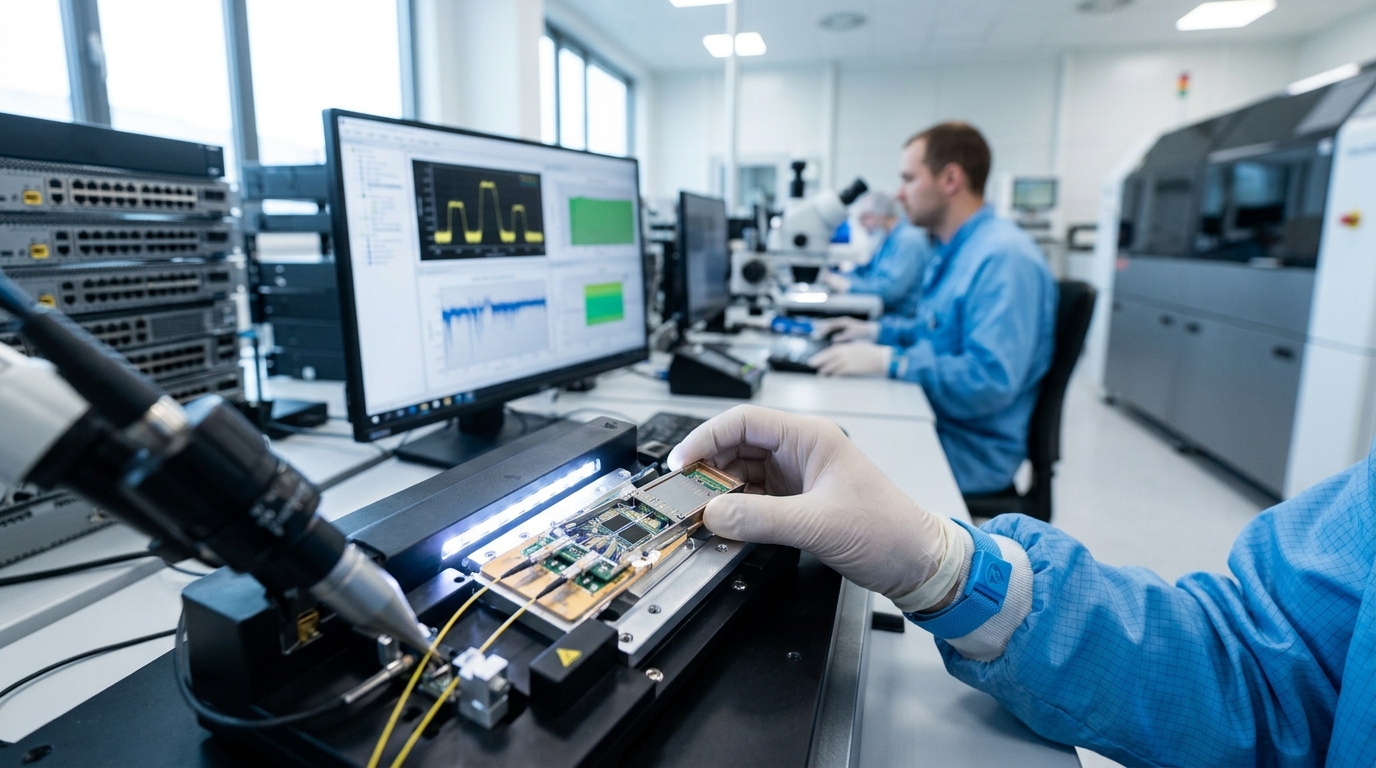
Here’s the part that gets overlooked. Credo isn’t a one-product company. Its platform spans active electrical cables (AECs), optical transceivers, retimers, SerDes chiplets, and optical digital signal processors.
AECs are the core near-term engine. These cables offer higher reliability than conventional optical links in many short-reach applications while consuming less power – a meaningful advantage as hyperscalers try to squeeze more compute into tighter physical spaces. Credo’s AEC platform has been adopted broadly across hyperscale and “neo cloud” operators as lane speeds move higher.
But the next phase is optics. The DustPhotonics acquisition, completed on May 28, 2026, added silicon photonics capabilities and a vertically integrated optical stack spanning 800G, 1.6T, and 3.2T (including near-packaged optics and co-packaged optics) targeted at hyperscale AI data centers. Management expects the combined portfolio of ZeroFlap optical transceivers, optical DSPs, and silicon photonics products to become a significant growth driver in fiscal 2027.
There’s also PCIe Gen 6. AECs are sampling now, with mass production targeted for the first half of fiscal 2027. PCIe Gen 6 retimer design wins from fiscal 2026 are expected to convert to revenue in 2027. Each product cycle creates a natural handoff, layering new revenue on top of existing volume without relying on a single connectivity type to carry the whole business.
The July Selloff and What It Actually Means
Here’s where it gets interesting. CRDO traded near $302 at its all-time high in late June. By mid-July, the stock had pulled back toward the $210–$215 range – a drop of roughly 30% in less than a month. No earnings miss. No guidance cut. No material bad news.
What actually happened was a combination of chip sector rotation and a broader China AI-driven sentiment hit (the “Kimi K3” panic) that weighed on semiconductors and AI-linked equities. There was also insider selling activity reported in the market during this period; without citing specific Form 4s and dates here, it’s best characterized as at least partly consistent with profit-taking after a sharp run-up.
The operating fundamentals didn’t change. The growth guidance didn’t change. Some analyst targets actually went higher.
That disconnect between the stock and the business is the setup worth watching.
The Risk Side Honestly
Customer concentration is the clearest risk here. Credo has disclosed that it is dependent on a limited number of customers and end customers, and that concentration can shift quickly from quarter to quarter. That means a timing shift, a budget pause, or a decision to bring connectivity in-house at any one major customer could move the numbers quickly.
Valuation is elevated. CRDO has traded at a high forward sales multiple relative to the broader semiconductor group. That premium can be justified by the growth rate, but it also means the stock is unforgiving when any data point misses.
The macro environment matters too. The fiscal 2027 outlook assumes the current AI capex cycle holds. If hyperscaler spending decelerates, Credo’s revenue trajectory bends faster than most. Management has emphasized that outlooks reflect customer demand signals and design activity, and that forward-looking statements carry risk.
The Bigger Thesis
AI clusters are moving from tens of thousands of GPUs to potentially hundreds of thousands. As that happens, the connectivity problem gets exponentially harder. More bandwidth. Lower latency. Lower power. Higher reliability. That’s not a problem that gets solved once. It creates an ongoing upgrade cycle that runs through the entire product stack Credo is building.
Analysts project revenue expanding meaningfully over the next several years, with earnings leverage along the way. That’s an aggressive path. But the company has earned the benefit of the doubt after tripling revenue in a single year with margins holding in the high 60s.
The stock is down roughly 30% from its high. The business is guided to grow from a much larger base. Something has to give – and the direction this resolves is the only real debate left.
The fiscal Q1 2027 report is the next concrete data point. Until then, the gap between price and fundamentals is loud.
Disclaimer: This editorial is for informational and educational purposes only. It does not constitute financial advice or a recommendation to buy or sell any security. All data and projections referenced are sourced from publicly available information and analyst estimates. Investing involves risk, including the potential loss of principal. Past performance is not indicative of future results.