
July 25, 2026
A Mag 7 Bargain Hiding in Plain Sight
Featured: A Mag 7 Bargain Hiding in Plain Sight
Dear Reader,
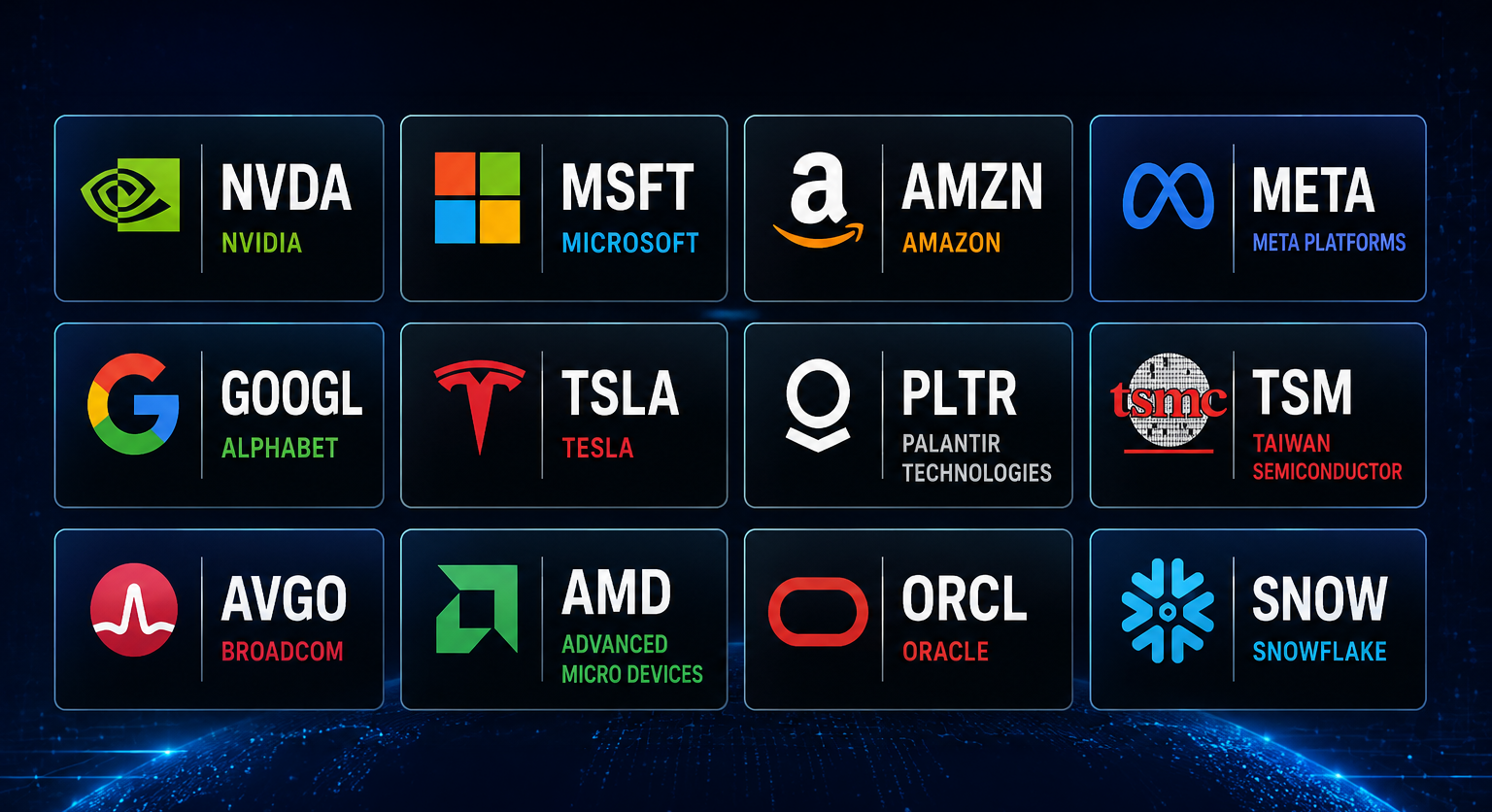
Do you hold any of these AI stocks?
Wall Street insider Jason Bodner – the man who called Nvidia at $4.50 – says today’s AI stocks are about to hit a wall.
And a completely different group of AI firms… names Wall Street is starting to ignore… are about to take off.
This has nothing to do with SpaceX…
A new chatbot…
Autonomous robots…
Or anything you’re likely hearing about.
It has to do with a brand-new “light-speed” device turning AI as we know it into “Accelerated AI”…
Making it 100 times faster…
And 100 times more energy efficient – right here, on Earth.
Already, some of the biggest tech investors like Elon Musk, Mark Zuckerberg, Cathie Wood, and Bill Gates are moving money into it.
Just to name a few…
They’re all moving money to prepare for what’s coming.
But you won’t hear anything about it in the mainstream news…
In fact, TV pundits spent most of this past year talking about AI worries and its “existential risk” to jobs…
Or arguing whether we’re in an AI bubble and when it would pop…
That’s why most Americans won’t see it coming until it’s too late.
Don’t be one of them…
Because if you’re holding the wrong AI stocks when “Accelerated AI” goes mainstream…
You could spend the next decade just trying to claw back to even…
But if you make the one move Jason reveals in this urgent video message…
The next 12 to 24 months could hand you bigger gains than the entire AI boom of the last three years.
Click here to hear the full story and get ahead of the crowd.
But hurry, because this opportunity won’t stay hidden much longer.
We have so much to look forward to,
Jeff Brown
Founder & CEO, Brownstone Research
P.S. Jason also shares details on 10 popular AI stocks he says you must dump before this shift goes mainstream. Names sitting in millions of 401(k)s, IRAs, and brokerage accounts. Click here to see if yours made the list.
A Mag 7 Bargain Hiding in Plain Sight

The Cheap Investor View: when great businesses go on sale
Hey there, bargain hunter.
Markets are funny. The same investors who demand “long-term vision” in bull markets suddenly demand immediate cash returns the moment a stock drops 7% in a day.
That whiplash is why good businesses occasionally trade like broken ones. And this week’s Magnificent Seven wipeout is a clean case study.
What happened (and why it matters)
On Thursday, July 23, the Magnificent Seven group saw about $797 billion in market value vanish in a single session, the steepest one-day decline since April 2025. The move was sparked by earnings-driven fear around AI spending and near-term cash flow pressure.
Two facts drove the mood:
- Alphabet raised its 2026 capex outlook to $195 billion to $205 billion (from $180 billion to $190 billion), and the stock fell about 7% on the day.
- Tesla reported capex of about $5.79 billion in Q2, up 142% year-over-year, with free cash flow swinging to roughly negative $1.1 billion. Shares dropped about 14.5% in the session.
The market’s message was simple: “If you want to spend like a utility building power plants, you will get valued like one too.”
One Gold Trade. Less Than an Hour.
A recent gold trade unfolded in under an hour. No overnight holding. No drawn-out waiting. What made it interesting wasn’t just the outcome… But how clearly the setup formed ahead of time. It followed a pattern tied to a specific moment in gold. One that tends to repeat more often than most realize. This report walks through the gold setup, the timing, and what to watch for.
Build the universe: who got marked down, and why
When a whole cohort sells off, I start by sorting the group into two buckets:
- Cash flow machines with a temporary headwind (often cheap for a reason, but fixable).
- Capital-hungry stories where success depends on execution, time, and financing conditions.
This week’s selloff was really about that second bucket. Capex is rising, and investors are no longer treating capex as “just a footnote.” They are treating it like an earnings item.
That is the opening for a value investor: find the business where the market is extrapolating a near-term cash flow dip into a permanent impairment.
The Cheap Test: my best bargain today
Inside the Mag 7 drawdown, the best bargain risk-reward looks like Alphabet (GOOGL).
Not because it is “down.” Because the evidence says the business is strengthening while sentiment is weakening.
Business quality: would it be great if it never traded?
Alphabet still checks the quality boxes that matter:
- Dominant distribution in Search, YouTube, and Android.
- A global advertising engine with scale advantages smaller platforms cannot match.
- A real second growth pillar in Cloud.
- A growing AI product footprint. Management said Gemini is at 950 million monthly active users, up from 750 million after Q4 2025.
You do not get 82% year-over-year growth in Cloud revenue in a “dying” platform. You get that in a business that is supply constrained.
Financial strength: the market is obsessing over one line
The bear case is not crazy. Alphabet’s capex is huge, and free cash flow turned negative. That is what investors are punishing.
But here is the key Cheap Investor distinction:
Negative free cash flow caused by discretionary growth investment is not the same thing as negative free cash flow caused by a broken model.
The market is pricing these two as if they are identical.
Valuation: cheap or just unpopular?
I am not going to throw out a P/E in this email because it moves daily, and I want the analysis to stay honest.
Instead, here is the valuation question that matters: What growth and margin outcome does the stock need to justify today’s price if capex stays elevated for 18 to 24 months?
If you assume Cloud growth cools sharply and AI monetization takes longer, Alphabet looks “fair.”
If you assume Cloud demand remains strong and capex is front-loaded to relieve capacity constraints, Alphabet starts to look “cheap.”
And this week’s Cloud number matters: $24.8 billion of Google Cloud revenue, up 82% year-over-year, is not a soft landing. It is acceleration.
The Mispricing Test: why is Alphabet discounted?
The market discount is coming from three fears:
- Capex credibility: investors do not trust that $195 to $205 billion is the “top.” They fear it is the new base.
- Timing risk: Wall Street hates multi-year payback periods.
- Second-order risk: if rates rise and energy stays expensive, long-duration cash flows get hit harder.
All fair. None automatically imply the business is impaired.
The SpaceX “xPhone” story may be bigger than people realize
Elon publicly says SpaceX isn’t building a phone.
Fair enough. But the interesting part is what recent filings and infrastructure moves may be pointing toward behind the scenes. Slight tangent, but some investors think the opportunity here has almost nothing to do with hardware.
Separate cheap from broken: my call
Alphabet looks cheap, not broken.
The business fundamentals that matter (Cloud demand, distribution, product reach) are improving. The thing that looks ugly (free cash flow) is being intentionally sacrificed for capacity and speed.
That can still go wrong. Overspending is real. Competition is real. Regulation is real.
But the market is treating “expensive year” as “permanent problem.” That is the disconnect.
The catalyst: what changes investor perception?
Perception improves if any two of these happen over the next few quarters:
- Capex stops rising, even if it stays high.
- Cloud growth stays strong while margins hold up.
- AI monetization shows up clearly in revenue lines investors can track.
- Free cash flow turns positive again, even modestly.
This is not a “tomorrow” trade. It is a patience trade. That is the point.
The Cheap Investor Scorecard
- Business Quality: Strong
- Financial Strength: Strong, but temporarily pressured by capex
- Valuation vs expectations: Improving after the selloff
- Competitive position: Strong distribution, real Cloud momentum
- Cash flow profile: Volatile near-term, watch closely
- Management execution: Solid, but capex messaging must stabilize
- Catalyst strength: Medium
- Margin of safety: Medium
- Long-term potential: High
Bottom line
If you believe AI infrastructure spending is front-loaded and Cloud demand is real, Alphabet looks like the cleanest “cheap, not broken” opportunity in this selloff.
If capex keeps ratcheting higher and free cash flow stays negative into 2027, the market’s skepticism will be justified, and the stock may stay stuck.
I am watching the next two earnings cycles for one thing: whether Alphabet can keep the growth engine hot while putting a ceiling on spending. That is when the bargain either gets recognized, or it turns into dead money.
Worth a closer look.