July 22, 2026
AMD: Expensive Stock, Cheap Thesis?
Featured:
AMD: Expensive Stock, Cheap Thesis?
Dear Reader,
This is urgent.
A new type of AI called “Accelerated AI” is about to take the world by storm…
And stocks connected to it are already breaking out.
Check this out…
One “Accelerated AI” stock just moved 133%…
A second ripped 320% in less than three months…
And a third company jumped over 210% in under four months…
All the while Tesla, Microsoft, Meta… even the king of AI – Nvidia… kept going sideways.
And it’s just getting started.
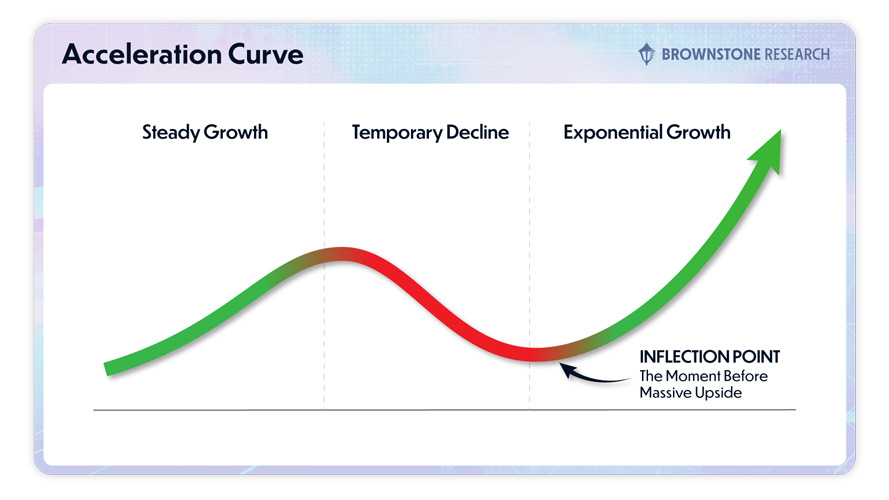
At the inflection point right before “Accelerated AI” explodes into the mainstream…
And unlocks an entire new dimension of exponential growth.
If history is any guide, we could be looking at potential gains of up to 10,000% from here.
If you want to find out more about “Accelerated AI”…
The “light-speed” device powering it…
Why it’s about to crack open the next wave of AI fortunes…
And the #1 “Accelerated AI” play everyone should buy right now – for free…
Let the money flow to you,
Jason Bodner
Founder, Inflection Point
AMD: Expensive Stock, Cheap Thesis?
Hey there, bargain hunter.
Here is the central question worth sitting with today: can a stock trading at roughly 170 times trailing earnings still represent a genuine opportunity for a patient investor? Or is AMD exactly what the skeptics say it is — a great business priced as though the next five years of growth are already in the bag?
That tension is worth taking seriously. Not dismissing, not cheerleading. Just working through the evidence honestly.
What Happened
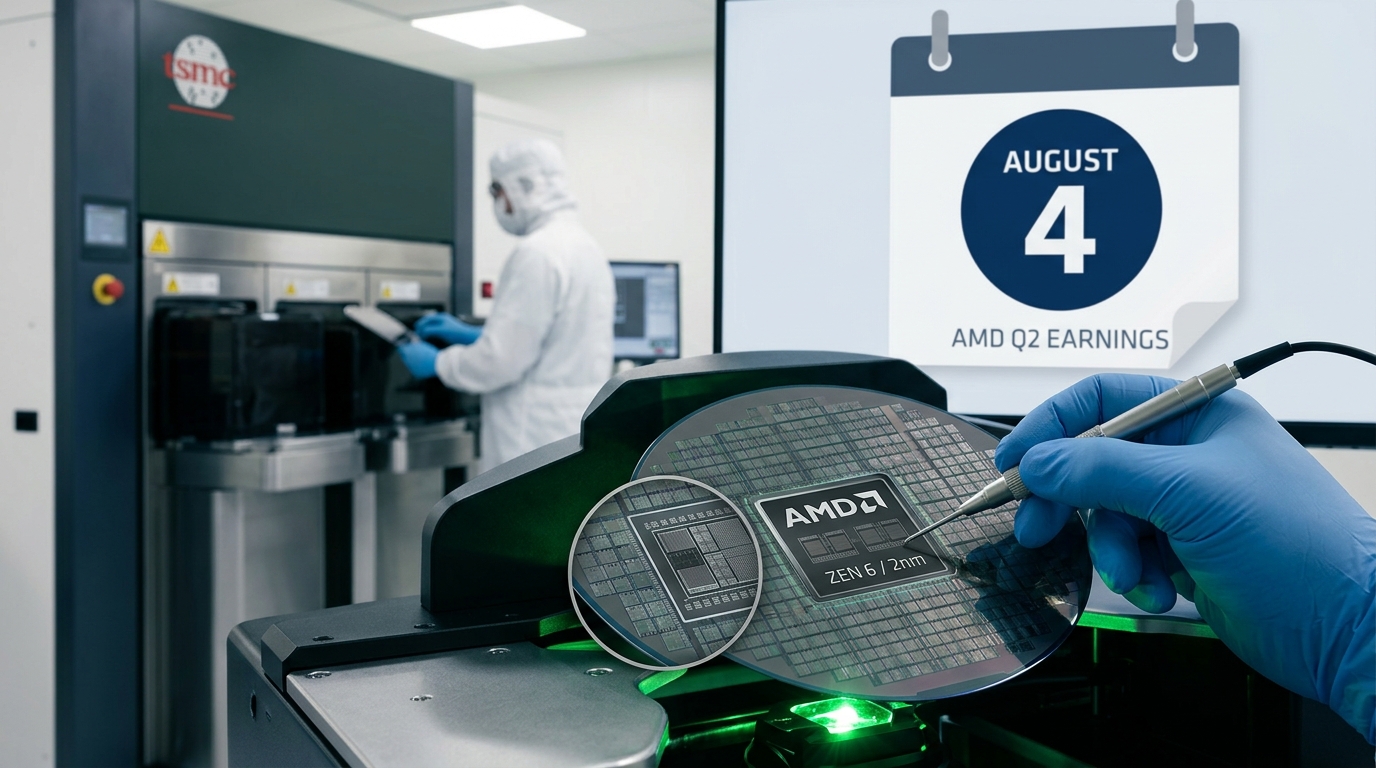
Today is not a normal Tuesday for AMD shareholders. The company officially launched its 6th Generation EPYC “Venice” processors at its Advancing AI 2026 event in San Francisco — making Venice the first high-performance computing processor to reach full production on TSMC’s 2nm process node. That is a genuine milestone, not a marketing claim.
The timing layered on top of something that happened just 48 hours ago. On July 20, Microsoft announced it would deploy AMD’s Helios rack-scale platform at scale on Azure to power frontier model inference. AMD shares jumped roughly 5% on that news alone. Helios combines the new Venice CPUs, Instinct MI455X GPUs, Pensando networking hardware, and ROCm software into a single integrated rack-scale platform — and Microsoft will use it to serve both its own AI workloads and Azure AI services for customers.
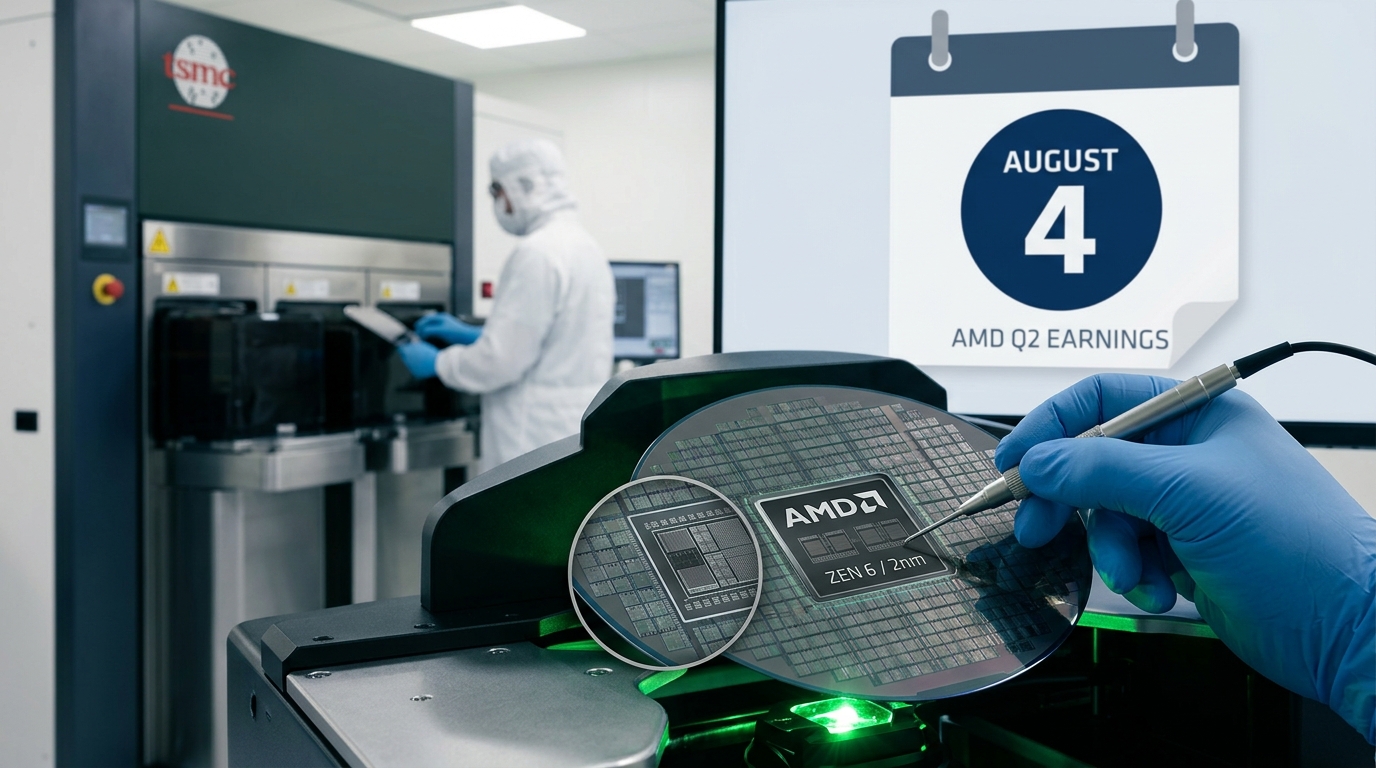
August 4 is the next checkpoint. That is when AMD reports Q2 2026 earnings after the bell. The company guided for approximately $11.2 billion in revenue, which would represent 46% year-over-year growth and a 9% sequential increase. Non-GAAP gross margin is expected at approximately 56%.
What the Business Actually Looks Like
Start with Q1 2026, which AMD reported on May 5. Revenue came in at $10.25 billion, ahead of the $9.89 billion consensus. Non-GAAP EPS of $1.37 beat estimates of $1.29. The stock ripped 16% the following day.
The driver was not hard to find. Data center revenue hit $5.8 billion in the quarter — up 57% year over year — powered by strong demand for 5th Gen EPYC processors and the Instinct MI350 Series GPUs. For context, that single segment generated more quarterly revenue than the entire company did in several quarters not long ago.
Full-year 2025 revenue was $34.6 billion, up 34%, with operating income rising 94% to $3.7 billion. That is not a slow-moving business. AMD’s free cash flow over the trailing twelve months reached $8.57 billion. The balance sheet carries $12.35 billion in cash against only $3.87 billion in debt, giving AMD a net cash position of roughly $8.48 billion. For a company in an aggressive growth phase, that financial cushion matters.
The Venice Chip: What It Actually Means
Slight tangent here, but it matters for the investment case.
Venice is not just a faster chip. The architectural leap is meaningful. It supports up to 256 Zen 6 cores — a 33% increase over the 192-core EPYC “Turin” lineup. AMD claims over 70% higher performance and efficiency versus the Zen 5-based predecessor. The chip moves to the new SP7 socket with 16-channel memory support, delivering up to 1.6 TB/s of bandwidth per socket, and adopts PCIe Gen 6. Production is already ramping at TSMC’s Taiwan facility, with future output planned at TSMC’s Arizona campus.
Venice is also the foundation of the Helios platform. It is not a standalone CPU announcement — it is the central processing component of AMD’s full-stack AI infrastructure answer to NVIDIA’s NVL72 rack solution. That positioning changes the competitive conversation from “who makes a better chip” to “who offers a better end-to-end AI system.”
The customer list for Helios now includes Microsoft, Meta, OpenAI, Oracle, and Tata Consultancy Services. Meta committed to roughly 6 gigawatts of AMD AI infrastructure in a deal reported to be worth more than $100 billion. OpenAI’s commitment covers up to 6 gigawatts of next-generation AMD Instinct GPUs across multiple product generations.
The Valuation Problem
Here is where a disciplined investor has to slow down.
AMD’s trailing P/E ratio sits near 170 times earnings as of this week. That is 66% above its 10-year median of roughly 104 times. GuruFocus rates the stock as significantly overvalued relative to its proprietary GF Value. The forward P/E is considerably more palatable — around 57 times forward earnings — which reflects the rapid earnings ramp analysts are projecting. The PEG ratio of 0.96 is actually below 1, which technically suggests the growth rate is not yet fully reflected in the price. EV/EBITDA sits near 109 times.
None of those numbers say “cheap.” Not by the standards this publication applies.
What they say is: the market is making a specific bet. That bet is that AMD’s data center revenue continues to compound aggressively over the next several years, that Venice wins meaningful server CPU share, that Helios becomes a credible alternative to NVIDIA’s rack-scale platforms, and that ROCm software matures fast enough to keep enterprise customers from defaulting back to CUDA. If all of that happens on schedule, today’s price may look reasonable in three years. If any of it slips — guidance cuts, delayed deployments, a ROCm stumble — the multiple has a long way to compress.
The NVIDIA Problem AMD Can Not Ignore
NVIDIA holds somewhere between 80% and 87% of the AI GPU market depending on the source and how it is measured. That is not going to change in the next twelve months. CUDA’s twenty-year head start is not a marketing claim — it is millions of developers, thousands of optimized libraries, and enterprise IT teams whose institutional knowledge is built around it. Porting to ROCm works, but the friction is real.
Where AMD is gaining ground is inference. As AI workloads shift from model training toward serving live requests, the workload characteristics change. Inference is more price-sensitive, less dependent on custom kernel optimization, and increasingly abstracted by frameworks like vLLM and SGLang that reduce CUDA dependency. AMD’s pricing advantage in inference — roughly 25-40% cheaper per token in some configurations — is most relevant here. The MI355X posted record MLPerf Inference 6.0 results in April 2026, placing it within single-digit percentage points of NVIDIA’s B200 on server inference workloads.
That is not nothing. But “competitive on inference benchmarks” and “winning the data center” are two very different sentences.
The Cheap Investor Scorecard
- Business Quality: Exceptional. AMD has built one of the strongest semiconductor franchises outside of NVIDIA and TSMC. Real pricing power, real competitive advantages, accelerating market position in data center.
- Financial Strength: Strong. $8.5 billion net cash, $8.57 billion trailing free cash flow, 53% gross margin. No near-term financial risk.
- Valuation: Elevated. Trailing P/E near 170x, forward P/E near 57x, EV/EBITDA near 109x. Not cheap by any traditional measure. Priced for execution, not for error.
- Competitive Position: Improving. Venice plus Helios is a credible full-stack answer to NVIDIA’s rack platforms. Customer wins at Microsoft, Meta, OpenAI, and Oracle validate the technology.
- Balance Sheet: Excellent. Net cash position of $8.48 billion. Debt/equity of 0.06. Current ratio of 2.72.
- Cash Flow: Accelerating. $8.57 billion free cash flow over the trailing twelve months. Operating cash flow of $9.73 billion.
- Management Execution: Strong track record. Lisa Su has consistently delivered on product roadmaps and financial guidance since taking over in 2014. The Zen architecture cadence has been one of the most reliable in the industry.
- Catalyst Strength: High near-term. Venice launch today plus Q2 earnings August 4 plus Helios deployment ramp in H2 2026 gives investors three near-term data points in a compressed window.
- Margin of Safety: Thin. At 170x trailing earnings, there is limited cushion if guidance disappoints. The stock has risen roughly 220% over the past 52 weeks. A lot of good news is already reflected.
- Long-Term Potential: Significant. If AMD can maintain 40-50% revenue growth into 2027, the forward earnings multiple compresses rapidly. The $30-35 billion annual data center revenue scenario being discussed by some analysts would represent a fundamentally different valuation picture.
Bull, Base, and Bear
Bull case: Venice benchmarks land materially above expectations at Advancing AI 2026. Q2 revenue beats $11.2 billion and guidance for Q3 is raised. Helios shipments to Microsoft and Meta ramp without execution issues. ROCm software continues closing the CUDA gap. AMD’s data center revenue approaches $30 billion annually by 2027, pulling forward earnings power and compressing the forward multiple. AMD’s GPU revenue forecast of $15 billion for full-year 2026 proves conservative.
Base case: AMD meets Q2 guidance at roughly $11.2 billion. Venice ramps as planned. Helios begins shipping in H2 2026 on schedule. Data center growth continues in the 40-50% range. The stock trades roughly in line with current levels as earnings catch up to the valuation over time. Patient investors are rewarded, but not quickly.
Bear case: ROCm friction limits Helios adoption at scale. NVIDIA’s Blackwell and upcoming Vera Rubin platforms extend the performance gap in training workloads. Custom silicon from Google, Amazon, and Meta reduces merchant GPU demand. Export restrictions on China sales create a revenue headwind. AMD guides Q3 revenue below current consensus. Multiple compression gets severe at 170 times earnings when growth expectations slip even modestly.
The Real Question
AMD is not a bargain in the traditional sense. The stock has tripled over the past year. There is no obvious mispricing caused by fear, neglect, or a misunderstood business. The market knows exactly what AMD is building and has priced in a generous portion of that future.
What the evidence suggests is this: AMD is a genuinely excellent business in the middle of a structural growth cycle, trading at a premium that requires continued flawless execution to justify. The margin of safety is thin. The catalyst calendar is compressed and specific — today’s launch, August 4 earnings, and H2 Helios shipments are the moments that will either validate or pressure the current price.
If you already own AMD and your time horizon is three to five years, the fundamental picture supports holding. If you are considering initiating a position today, the honest answer is that you are paying for a lot of things that have not happened yet. That is not necessarily wrong — but it is not what this publication typically calls a bargain.
Watch August 4 closely. Not because one quarter defines the thesis, but because at this valuation, every quarter is a confidence vote.
Stay patient,
The Cheap Investor