
June 30, 2026
Super Micro Got Raided. The Real Risk Is Bigger Than SMCI.
The chip export crackdown just escalated across the entire AI server sector.
This is not just a Super Micro story.
That framing misses what is actually happening.
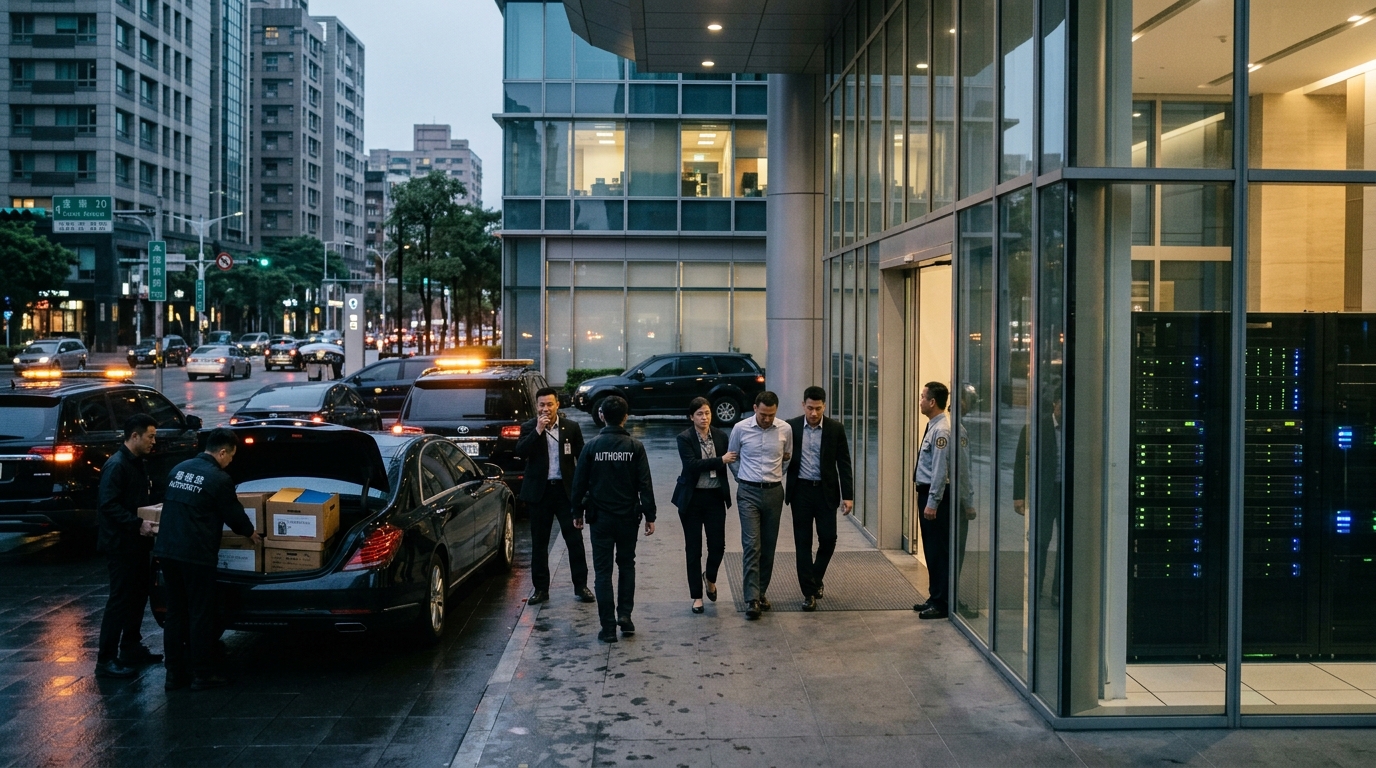
On June 29, 2026, Taiwanese government authorities raided offices of Super Micro Computer as part of an investigation into alleged smuggling of Nvidia chips to China using the company’s servers. Taiwan’s Keelung District Prosecutors Office searched Super Micro’s Taiwan office, the residences of six individuals, and the sites of three affiliated companies — including distributor Albatron Technology and data center operator Chief Telecom. SMCI shares fell as much as 9% on the news before recovering some ground, closing the session down 8.1% at $28.15.
Here is the part most people are reading wrong.
Super Micro has not been charged as a company. The probe targets alleged smuggling by third parties and individuals using Super Micro’s servers. But the question Monday sharpened for investors: are the raids a contained legacy problem, or a spreading threat to a company that still relies on its standing with suppliers, customers, and regulators?
3 Wall St. Legends Have Same Dark Prediction for June 29th
A powerful new form of AI could upend personal investing and usher in one of the biggest wealth transfers in history. If you know what’s coming, you could double your portfolio over the next two years. If you don’t, you’ll soon become “the equivalent of a man still using a fax machine to communicate.” Man who called 2025 crash airs full warning (and a free recommendation) here.
This is an expansion of an existing case, not a new one. In March 2026, the U.S. Department of Justice unsealed an indictment charging three individuals tied to Super Micro — including co-founder Yih-Shyan “Wally” Liaw — with conspiring to divert roughly $2.5 billion worth of Nvidia-equipped servers to China through shell companies in Southeast Asia. Liaw has pleaded not guilty and resigned from Super Micro’s board. His trial is set for November 2026. The Taiwan raids widen the same thread.
The second-order read is where it gets interesting.
The SMCI situation is essentially a stress test for the entire semiconductor export control regime. If prosecutors can demonstrate that billions of dollars in restricted hardware were successfully routed to China through falsified documents and dummy servers — the DOJ indictment alleges the conspirators literally swapped serial numbers with a hair dryer — it raises serious questions about enforcement gaps across the whole industry.
That means the policy response is going to get bigger. Not smaller.
Taiwan currently does not classify AI chip exports to China as a criminal offense. Authorities can warn exporters that such shipments may violate U.S. rules, but prosecutors have had to rely on other local laws — like document falsification charges — when pursuing suspected smugglers. That is now under review. As part of ongoing trade talks with the U.S., Taipei is considering broader controls that would restrict AI chip sales to all customers in China, not just blacklisted firms like Huawei. That would enable Taiwan to prosecute AI chip smuggling as a criminal violation for the first time.
If that legislation passes, the compliance burden on every server company operating in the region changes materially. That is not a small shift. Taiwan builds most of the world’s AI servers.
The Energy Stock Trump Once Called “A Big Mistake” to Mess With
When a U.S. ally tried to tax ONE American energy company…
Trump didn’t hesitate to issue a direct warning.
Now this same company is generating over $3 billion in operating income…
And partnering with the hottest AI stock on Wall Street.
Out of 23,281 publicly traded stocks, this is the ONLY one that meets all the “unicorn” criteria.
Who benefits from tighter enforcement?
American server companies with cleaner domestic supply chains. Domestic chip designers with traceable distribution. Defense-focused semiconductor firms where export compliance is already baked into the business model.
Who loses? Any company that relies on the gap between export rules and enforcement reality. That gap is shrinking fast. Nvidia shares were actually up slightly on the day of the raid — the market is not treating this as a Nvidia problem. It is treating it as a SMCI problem. And by extension, a systems-assembler problem.
Slight tangent, but it matters: SMCI had already guided full-year fiscal 2026 revenue to a range of $38.9 billion to $40.4 billion — trimming the prior floor of at least $40 billion. AI GPU platforms now make up more than 80% of sales. The growth engine is real. The compliance cloud sitting over it is also real, and the June capital raise of roughly $7 billion to fund AI server component purchases left shares more vulnerable heading into this kind of headline.
SMCI grows faster than Dell or Hewlett-Packard Enterprise on forward revenue, yet trades at a fraction of their revenue multiple. Bulls call that a discrepancy waiting to correct. Bears call it the market pricing in a risk that keeps resurfacing. Both arguments have merit right now, and that tension probably does not resolve quickly.
The real question here is not whether to buy or sell SMCI. It is identifying which parts of the AI server ecosystem earn a compliance premium as enforcement tightens — and which parts carry more legal overhang than the current price implies. That list is longer than Wall Street is currently pricing in.
Your Download Link Will Expire
If you still haven’t downloaded my free “Simple Options Trading For Beginners” guide…
…please take a few seconds and download it right now before your new temporary download link expires.
I eventually plan to charge money for this training, so do yourself a favor and download it now…
That way, no matter what it costs in the future, you’ll have a free copy on your computer.
Make sense?
Watch for Super Micro’s next earnings report on August 4. Any fresh disclosures on compliance processes, cross-border sales exposure, or changes to how the company handles high-performance server shipments into higher-risk jurisdictions will matter a lot more than usual.