June 24, 2026
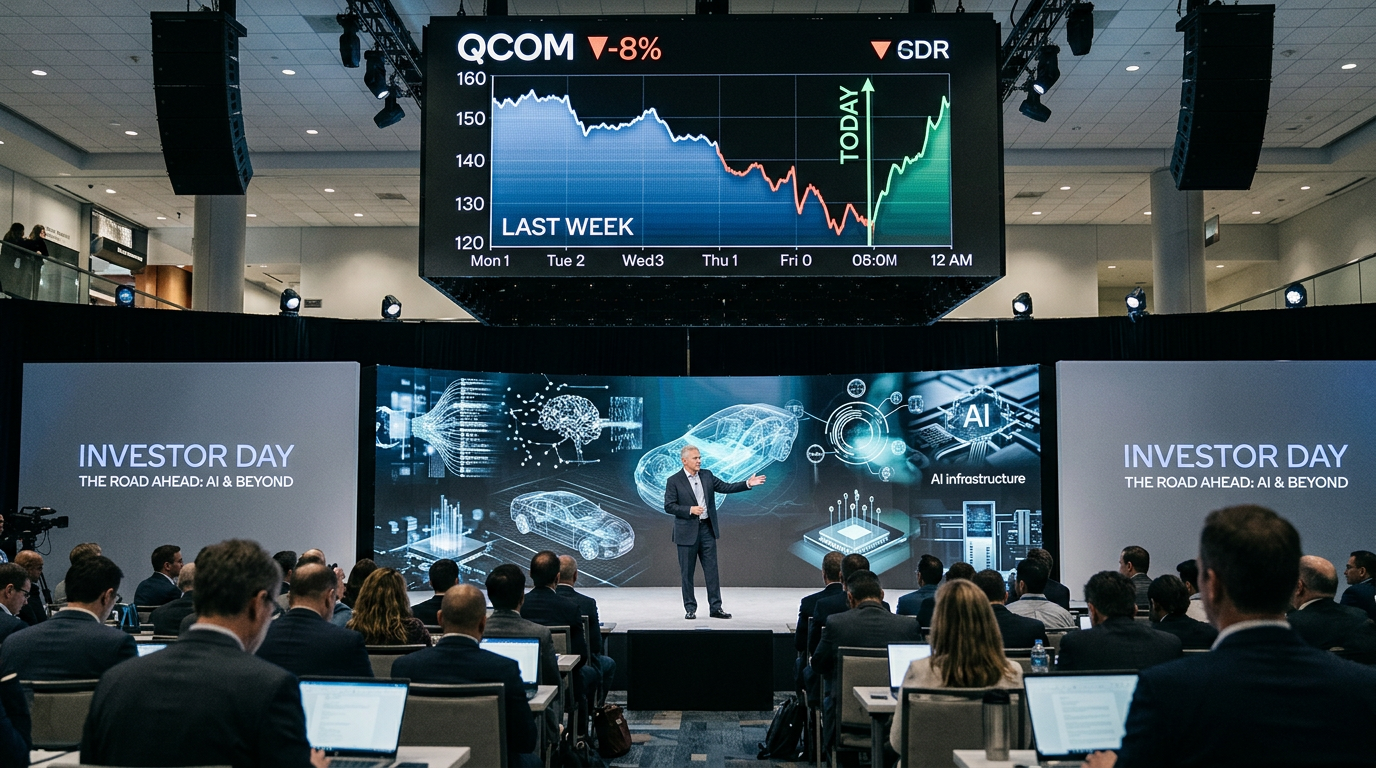
Qualcomm Investor Day: What Happens Today Matters
QCOM is sliding again this morning. Here is what the next few hours decide.
Hey there, bargain hunter. Today is a binary event for Qualcomm. Not a quarterly beat-or-miss. An actual identity question.
Qualcomm is holding its Investor Day on June 24, and the entire session is built around one core argument: this is no longer a smartphone chip company. It is an AI infrastructure platform. Data centers. Automotive. Physical AI. Agentic compute at the edge. That is the pitch. Today is where management either proves it or exposes it as a story investors have already paid for.
And the stock is not exactly going in with momentum. QCOM dropped 9.23% on Tuesday to close at $204.13, then fell another 3-4% in early Wednesday trading to around $196. The 52-week range is $121.99 to $259.92. That spread is not noise. It reflects genuine disagreement about what this business actually is — and where it is going.
Slight tangent, but it matters: Tuesday’s selloff was not entirely Qualcomm’s fault. The Philadelphia Semiconductor Index dropped 7.9% in a single session as a global AI valuation reset swept through the sector. South Korea’s KOSPI plunged nearly 10%, Samsung and SK Hynix each lost more than 12%, and circuit breakers triggered twice on the Korea Exchange. Qualcomm got hit. So did everyone else.
Pre-IPO Access to America’s Top AI Defense Startup – for $50.
No waiting lists. No special status.
Just one 4-letter ticker that gives you a seat at the table.
What Just Happened Before the Bell
This morning, Qualcomm officially confirmed the acquisition of Modular Inc., an AI software startup, for approximately $3.9 billion in an all-stock deal. Qualcomm will issue up to 19.2 million shares to fund the transaction, which is expected to close in the second half of 2026 pending regulatory approvals.
Modular builds AI-native software that enables models to run efficiently across diverse hardware architectures. The idea is to give Qualcomm a software layer that competes with Nvidia’s CUDA ecosystem — a credible alternative, built around openness and hardware portability rather than lock-in. The MAX inference framework and Mojo programming language come with it. That is not nothing.
The market initially shrugged, then sold it. The share issuance triggers dilution concerns. And reports are still circulating that Qualcomm may also be pursuing Tenstorrent, a chip startup, at a rumored $8 billion to $10 billion price tag. If both deals close, the combined outlay could approach $14 billion — more than Qualcomm’s cash and marketable securities on hand at March 29. Investors are understandably watching the balance sheet.
What the Analysts Are Expecting
JPMorgan placed QCOM on a “Positive Catalyst Watch” ahead of today and lifted its price target to $265 from $160. That is a significant move without a ratings flip to Buy. The analyst raised the target because the data center opportunity is real enough to justify higher assumptions. The Neutral rating stayed because the stock may already reflect those assumptions.
Bank of America raised its target from $165 to $195 while maintaining Underperform. BofA’s scenario analysis suggests that even if Qualcomm hits $10 billion in 2028 data center and AI revenue at 20% margins, that outcome may already be reflected in today’s share price. Their core model projects only around $2.5 billion in AI revenue by 2028 — well below what the bulls are underwriting.
JPMorgan expects Qualcomm to outline data center revenue targets above $3 billion in fiscal 2027 and as high as $35 billion by fiscal 2031. That $35 billion figure would represent a genuine transformation from a company Wall Street still mostly values as a handset chipmaker.
Wells Fargo separately raised its target to $230 from $160 and sees Amazon as a potential customer. That is a name worth watching for in today’s announcements.
Anthropic’s Project Glasswing: The AI “Too Dangerous” for the Public
Anthropic’s Project Glasswing gives a select group of companies early access to an advanced form of AI that has been deemed “too dangerous” for the public. With this in their arsenal, these companies could become the most powerful businesses in the world this year.
The Business Behind the Story
Qualcomm’s most recent quarter showed why this debate is unresolved. Q2 fiscal 2026 revenue came in at $10.6 billion with non-GAAP EPS of $2.65, beating estimates. Automotive revenue grew 38% year-over-year to a record $1.33 billion. Combined automotive and IoT revenues grew 20% year-over-year. The company completed $5.4 billion in share repurchases in the first half of fiscal 2026 and announced a fresh $20 billion buyback authorization. That is not a company in distress.
But handset revenue was down 13% year-over-year to $6.02 billion. That is still close to two-thirds of chip revenue. And Q3 guidance of $9.2 to $10 billion in revenue with EPS of $2.10 to $2.30 implies further sequential softness ahead. The Apple modem transition in 2027 remains real. Qualcomm is betting that automotive and data center revenue can fill the gap before it arrives.
On the automotive side, management guided for 50% year-over-year revenue growth in Q3. That trajectory does not get enough attention relative to the data center debate. Qualcomm has a $45 billion automotive pipeline and a driving stack co-developed with BMW. That alone is worth a conversation.
What Makes Today Different
CEO Cristiano Amon has specifically committed to sharing data center metrics at today’s event — performance comparisons for the AI200 and AI250 inference accelerators, the Dragonfly roadmap, and an update on the hyperscaler ASIC deal that includes initial shipments later in calendar 2026. At Bernstein’s conference he set a bar: “Material has to be in the multiple billions of dollars.” Today either clears it or it does not.
BofA has outlined five specific things to watch: data center market sizing for fiscal 2027 and 2028, an update on the 200-megawatt HUMAIN agreement for accelerators expected to ramp in the second half of 2026, details on the hyperscaler ASIC contract, the Dragonfly inference accelerator roadmap, and new customer announcements. If Qualcomm delivers on most of those, the stock likely moves. If it delivers vague timelines and broad market themes, the bears have their argument.
SpaceX ‘Dark Energy’ Replaces Foreign Oil
For years, we’ve been told SpaceX is a rocket company. But according to new satellite images from 300 miles above the Earth’s surface, there is something very strange going on at SpaceX right now that has nothing to do with space. It could soon replace our need for foreign oil forever and ignite a $10 trillion boom for the stocks involved.
Bull / Base / Bear
Bull: Qualcomm confirms $3 billion-plus in fiscal 2027 data center revenue with specific customer names and shipment timelines. The ASIC contract and HUMAIN deal both have concrete milestones. Amazon shows up as a named customer. Non-handset revenue gets valued at a higher multiple. Stock toward $260 to $280.
Base: Qualcomm outlines the roadmap with plausible targets but no hard new customer commitments beyond what is already known. Automotive continues growing at 40%-plus year-over-year. The Modular deal adds software credibility over time. Stock grinds toward $230 to $245 over the next two quarters as execution builds confidence.
Bear: Data center revenue stays aspirational through 2026. Handset softness worsens beyond Q3. The Modular and Tenstorrent deals raise capital allocation concerns and dilute near-term EPS. The Apple modem overhang starts weighing more heavily on estimates. Stock retests the $180 to $190 range.
The Part the Consensus Is Missing
Most of the analyst community is treating this as an event where Qualcomm justifies its current multiple. That framing is too narrow.
The more important question is whether Qualcomm has built an architecture for AI inference — edge and data center — that competes structurally with Nvidia in workloads where power efficiency and cost-per-inference matter more than raw training throughput. If Amon can make that case with real benchmarks today, the conversation changes significantly. The Modular acquisition is part of that argument. Hardware plus a portable software layer is a fundamentally different product than a chip alone.
There is also the UBS angle worth flagging. Analyst Timothy Arcuri sees data centers and agent-based computing as potentially adding roughly $20 billion to Qualcomm’s existing financial model over time. That is a much bigger number than BofA is modeling. The spread between analyst estimates here is unusually wide — which tells you the outcome today is genuinely uncertain, not already decided.
The stock went into today down roughly 9% on the week and trading around $196. JPMorgan’s target is $265. Whether that gap starts closing this afternoon depends on what gets said at 2:15 PM ET.
The Cheap Investor