
June 3, 2026
Broadcom: The Backbone of the AI Trade
AVGO Reports Tonight. The Networking Story Is Bigger Than the Chip Story.
Hey there, bargain hunter.
Everyone is watching Nvidia. But tonight, Broadcom Inc. (AVGO) reports fiscal Q2 2026 earnings after the close, and the number that matters most is not the headline revenue figure. It is how fast the ethernet switch backlog is growing.
That part gets almost no coverage. It should get all of it.
What the Scoreboard Says
Broadcom guided Q2 FY2026 revenue at approximately $22.0 billion, representing 47% year-over-year growth. Consensus EPS sits at $2.40, which would be 51.9% growth from the $1.58 per share posted in the year-ago quarter. The EPS consensus has climbed 11.1% over the past 90 days alone, rising from $2.16 to the current $2.40 target. That upward revision trajectory is not noise. It reflects genuine demand acceleration.
Broadcom has beaten the consensus estimate in every one of its trailing four quarters, with an average earnings surprise of 1.93%. The bar is high. The question is whether AI semiconductor revenue guidance for Q3 moves the stock.
Live demo of Elon Musk’s AI-powered profit machine
Have you tried Elon Musk’s new AI agent?
It’s the most powerful AI ever created.
Musk himself thinks it could make investors 70 times their money.
In a few short years…
I expect an announcement from Musk by the end of this month…that will make this AI agent available to every American.
But you can get in right now…
When you click here, I’ll give you a live demo of this amazing AI agent – for free.
What Broadcom Actually Does
Most people think of Broadcom as a chip company. That is accurate but incomplete. The business runs two engines: a semiconductor solutions segment and an infrastructure software business powered largely by VMware.
On the semiconductor side, Broadcom designs custom AI accelerators (XPUs and ASICs) for hyperscalers including Google, Meta, and ByteDance, plus the ethernet networking silicon that links those accelerators together inside and across data centers. On the software side, VMware Cloud Foundation has been migrating enterprise customers to subscription licensing, generating high-margin recurring revenue.
In Q1 FY2026 (ended February 1, 2026), semiconductor revenue hit a record $12.5 billion, up 52% year-over-year. Infrastructure software came in at $6.8 billion, up just 1% year-over-year. The growth story, at least right now, belongs entirely to silicon.
The Number Driving Volume Today
AI semiconductor revenue in Q1 FY2026 grew 106% year-over-year to $8.4 billion, above management’s own forecast, driven by custom AI accelerators and AI networking demand. For Q2, Broadcom guided AI semiconductor revenue to $10.7 billion – roughly 140% year-over-year growth. That is the key figure analysts are watching into tonight’s report.
A slight tangent, but it matters: Alphabet recently announced plans to raise $80 billion for AI compute infrastructure. That kind of capital commitment from a company at that scale reinforces the depth of demand for custom silicon and networking capacity across the hyperscaler ecosystem. Broadcom does not need to win every dollar. It just needs to be the default infrastructure layer, which is largely what it already is.
Custom accelerator business grew 140% year-over-year in Q1. Broadcom currently has five hyperscaler customers in volume production for custom AI chips, with a sixth customer expected to deploy more than one gigawatt of capacity in 2027. Management has stated line-of-sight to AI chip revenue in excess of $100 billion in 2027.
The Real Edge: Ethernet Switches
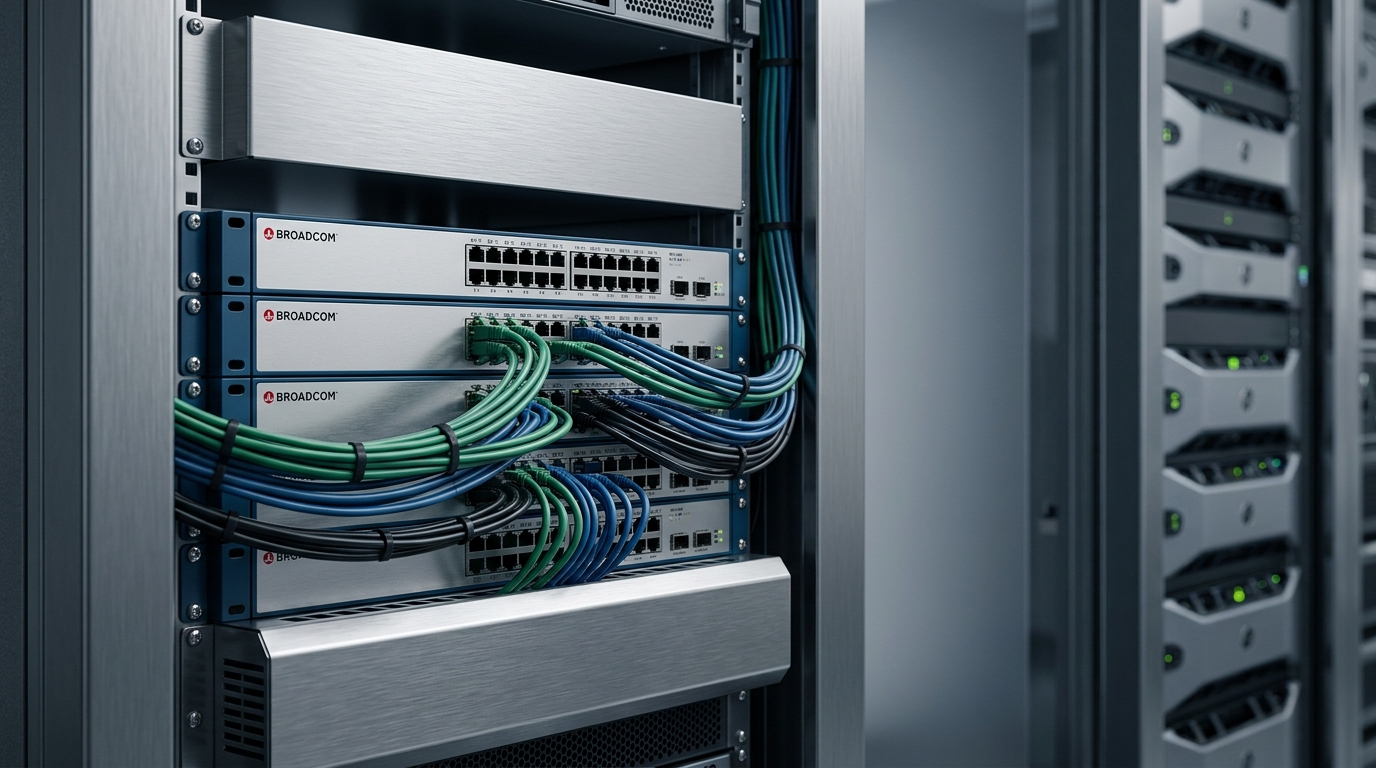
Here is where it gets interesting. AI networking revenue is expected to account for roughly 40% of total AI revenue in Q2. That means somewhere around $4.3 billion of this quarter’s AI revenue comes not from accelerator chips but from ethernet switches and interconnect silicon alone.
Broadcom’s current order backlog for AI switches exceeds $10 billion. The company now offers what it calls the only complete ethernet portfolio for AI scale-up, scale-out, and scale-across networking. Three chips. Three distinct problems solved.
- Tomahawk 6: The world’s first 102.4 terabit-per-second ethernet switch chip, now shipping in production volume. It doubles the bandwidth of any competing switch currently on the market and enables two-tier networks supporting up to 131,000 processors, eliminating a costly third tier. Multiple deployments are already planned with more than 100,000 XPUs using Tomahawk 6 for both scale-out and scale-up interconnect.
- Tomahawk Ultra: Purpose-built for in-cluster, ultra-low latency at sub-250 nanosecond ball-to-ball. Designed for scale-up environments where GPU and XPU memories need to communicate with each other at speeds that eliminate job completion bottlenecks.
- Jericho4: The inter-data-center router. Designed to interconnect over one million XPUs across multiple facilities, with a single system scaling to 36,000 HyperPorts, each operating at 3.2 terabits per second with RoCE transport over distances exceeding 100 kilometers. Built on TSMC’s 3-nanometer process. Already shipping to customers.
This three-chip architecture is not incidental. It is a deliberate bet that ethernet – not InfiniBand, not proprietary fabrics – becomes the universal standard for AI cluster networking from rack scale all the way to gigawatt-scale distributed clusters that span multiple cities. The multi-vendor ethernet ecosystem drives costs down. It avoids lock-in. And Broadcom sits at the center of it.
Iran War TRUTH: What Two Congressmen Led Me To
There’s a strategy behind the Iran war.
I know because two private meetings with U.S. Congressmen on March 2nd – three days after the first missiles fell – sent me down a research path I wasn’t expecting.
What I found at the end of it: a coordinated operation, a shadow group running it, and one company at the dead center of all of it.
The Data That Matters
- Q2 FY2026 revenue guidance: ~$22.0 billion (+47% YoY)
- Q2 AI semiconductor revenue guidance: ~$10.7 billion (+140% YoY)
- Q2 semiconductor segment guidance: ~$14.8 billion (+76% YoY)
- Q2 infrastructure software guidance: ~$7.2 billion (+9% YoY)
- Q1 FY2026 free cash flow: $8.0 billion (41% of revenue)
- Q1 FY2026 adjusted EBITDA: $13.1 billion (68% of revenue)
- Q1 consolidated gross margin: 77%; semiconductor gross margin ~68%
- AI switch backlog: exceeds $10 billion
- AI-related long-term backlog: $73 billion
- Long-term AI chip revenue target: $100+ billion by 2027
- Shareholder returns in Q1: $10.9 billion ($3.1B dividends, $7.8B buybacks)
- Cash on hand end of Q1: $14.2 billion
Is It Cheap?
Not on a trailing basis. But that is not the right frame here. With AI semiconductor revenue guided to grow 140% year-over-year in Q2, and analyst EPS estimates implying roughly 52% earnings growth this quarter, the traditional PE multiple tells you almost nothing useful. What matters is the PEG ratio, and at 0.88x, Broadcom looks undervalued relative to its growth rate.
Full-year FY2025 results confirmed what compounding at scale looks like: revenue of $63.9 billion, up 24% year-over-year; net income of $23.1 billion, up 275% from the prior year; and profit margins expanding from 12% to 36%. Analysts have raised fair value estimates from approximately $274 to $345 per share. The stock has returned roughly 29% year-to-date heading into tonight’s report.
The honest question is whether the $100 billion AI chip revenue target for 2027 is credible. Long-term custom AI chip agreements with Google and Anthropic, alongside multi-year deals with Meta and others, form the visible backlog supporting that figure. It is a real number grounded in real contracts, not aspirational math.
Bull, Base, and Bear
- Bull: AI semiconductor revenue guidance for Q3 comes in above $12 billion. Networking backlog expands. A sixth hyperscaler customer accelerates its deployment timeline. The market re-evaluates the $100 billion FY2027 target as conservative rather than ambitious.
- Base: Q2 beats on revenue and EPS modestly. Q3 guidance in line with current analyst expectations. Networking and custom ASIC ramps proceed on schedule. Stock moves 5-8% higher and holds.
- Bear: Any softness in AI revenue guidance, customer deployment delays, or rising inventory days (currently at 68, already elevated) could trigger a sharp pullback. Options traders are pricing a 10.65% move in either direction around tonight’s report. Non-AI semiconductor revenue growth remains nearly flat, and customer concentration risk – a small number of very large hyperscaler accounts generating the majority of AI revenue – is a structural vulnerability that will not go away.
The Best Time Of Day To Trade For A Better Retirement
This little known trading window is turning even novices into consistently profitable investors, and now, you can learn to take advantage of it for free!
With expert Dave Aquino’s latest free guide, “How To Master The Retirement Guide”, you’ll get step-by-step instructions to one of the most powerful market plays around today.
Action Plan
For those already holding AVGO: the quarter itself is less important than the forward guidance on AI networking and the trajectory of the switch backlog. If the backlog number expands materially beyond the $10 billion AI switch figure already disclosed, that is the signal worth acting on.
For those on the sidelines: given the 10.65% options-implied move and meaningful customer concentration risk, initiating a full position into tonight is aggressive. A scale-in approach – one-third now, one-third on any post-earnings pullback, one-third after the next quarter confirms trajectory – is the more measured path for a conservative posture. Aggressive posture: build into the report and add on strength if the Q3 AI semiconductor guide comes in above $12.5 billion.
The Cheap Investor Scorecard
- Q2 AI semiconductor revenue vs. $10.7B guidance: Beat or miss?
- Q3 AI semiconductor revenue guidance: Above or below $12.5B?
- AI switch backlog: Expanding beyond $10B or holding flat?
- Gross margin: Flat sequentially at 77% or compressing?
- Free cash flow conversion: Holding near 41% of revenue?
- Infrastructure software (VMware): ARR growth sustaining at 19% YoY?
- Customer count for custom AI chips: Any sixth customer detail confirmed?
- Inventory days: Trending down from current 68-day level?
- Non-AI semiconductor revenue: Any sign of a recovery beyond 4% growth?
- Forward commentary on gigawatt-scale cluster deployments: Specific or vague?
The bottom line: Broadcom is not just an AI chip company. It is the plumbing that holds large-scale AI infrastructure together. If the AI spending cycle stays intact – and right now, nothing in the capital allocation behavior of the major hyperscalers suggests otherwise – the ethernet switch and custom ASIC business compounds at rates that most semiconductor companies will not see for a decade. The risk is concentration. The reward is duration.
Watch the backlog number tonight. Everything else is secondary.
– The Cheap Investor