May 10, 2026
Oil Above $100, No Cuts in Sight, and a New Fed Chair
Energy, inflation, and where money is moving
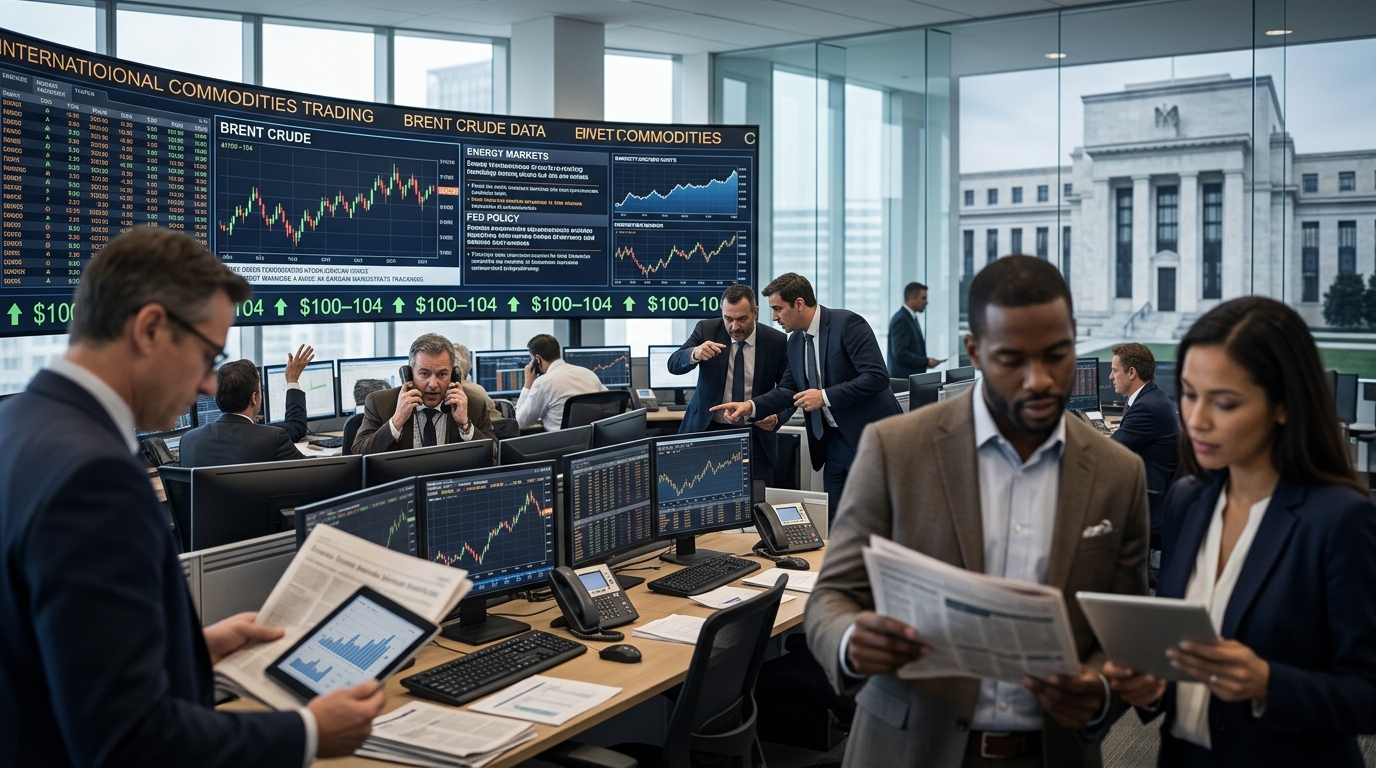
Let’s just start with where things actually stand. Brent crude closed Friday May 8 at $101.29 a barrel — recouping some ground after a rough week that saw crude post a weekly loss of about 6%. That dip came after a fragile U.S.-Iran ceasefire briefly pulled some heat out of the market. Then fresh skirmishes near the Strait of Hormuz pushed it right back above $100. The conflict that began in late February has not resolved. The strait has remained largely closed since then. And oil is trading every single headline like it’s the last one it’ll ever read.
Here’s the part that doesn’t get enough attention: the March CPI report confirmed what anyone filling up their tank already knew. Headline inflation jumped to 3.3% annually, the highest since May 2024, driven almost entirely by a 21.2% single-month surge in gasoline — the largest monthly gasoline spike on record since that data series began in 1967. Core inflation — the number the Fed actually watches — was far more contained at 2.6% year-over-year, with a modest 0.2% monthly move. That gap between headline and core is the entire story of this macro environment right now.
He went 11-for-11 during the last Fed shock. Another one is about to hit.
In 2022, when the Federal Reserve made its most dramatic pivot in history and the S&P lost nearly 20%, Larry Benedict didn’t lose a single trade.
He knew where the money was going and positioned his readers to profit.
Trump is now installing his own Fed Chair, something Wall Street is already calling a generational shift.
Larry says his readers will be ready for it.
Click here to find out the one ticker he’s positioning in, completely free.
The Fed’s Uncomfortable Position
The Federal Reserve held rates at 3.5–3.75% for the third straight meeting at its April 28–29 session — Powell’s last as chair. The vote wasn’t clean. Governor Miran voted to cut 25 basis points immediately. Three other members objected to any language suggesting future cuts were coming. The resulting 8-4 split was the first time since October 1992 that four officials dissented at a single FOMC meeting. That’s not a policy signal. That’s a committee that fundamentally disagrees about what comes next.
The dilemma is real. Labor market softening — the kind that would normally argue for cuts — is happening at exactly the same moment that headline inflation is running hot because of an oil shock. You can’t cut into a gasoline fire. But you also can’t ignore employment data that’s deteriorating. The IEA has estimated that the conflict is removing around 14 million barrels per day from global supply — describing it as the largest disruption in the history of the global oil market. That’s not background noise. That is the entire macro context.
Slight tangent, but it matters a lot: the April CPI report drops Tuesday morning, May 12. CME FedWatch futures have now priced out every single rate cut in 2026 — not just the back-half cuts the market was hanging onto earlier in the year. All of them. Gone. Economists at Wells Fargo are forecasting headline inflation at 3.8% year-over-year for April, with BofA estimating 3.7–3.8% headline and core rising to 2.7–2.9%. If those numbers land at the high end, the Fed’s room to maneuver gets even tighter. Watch food, shelter, and airline fares within that report. Those are the early signals of whether energy is seeping into broader services prices.
Elon’s $480 Trillion Currency Masterplan
He’s waited 27 years for this moment. Elon Musk just launched his biggest disruption ever, which could totally reset how millions of people access their money and even pay tax.
A New Face at the Fed — With New Rules
Powell’s term as chair ends May 15. Kevin Warsh — Trump’s nominee, a former Fed governor from 2006 to 2011 — cleared the Senate Banking Committee 13–11 along strict party lines on April 29, the first fully partisan committee vote on a Fed chair nominee in history. The full Senate vote is expected the week of May 11. Warsh is widely expected to be confirmed in time to preside over the June 16–17 FOMC meeting as chair.
What he actually does once confirmed is a genuine unknown. During his confirmation hearing, Warsh said he believes Fed officials should speak less frequently, pull back on forward guidance, and he did not commit to holding a press conference after every policy meeting — a practice Powell put in place that markets have come to rely on. That last point alone introduces a new layer of uncertainty for anyone trying to read near-term rate signals. Former Fed economist Claudia Sahm noted that Warsh’s confirmation process itself was already breaking with historical norms. The pressure from the White House to cut rates doesn’t disappear when he takes the chair — it just changes address.
What’s Actually Working Right Now
The S&P 500 is up roughly 8% year-to-date as of early May — its fourth straight year of gains — and closed Friday at 7,398.93. April alone was a strong month driven by a Q1 earnings season running well ahead of expectations. As of the latest FactSet data, 84% of S&P 500 companies that have reported Q1 results beat EPS estimates, with blended Information Technology earnings growth running above 50% year-over-year. That’s not a broad recovery. That’s a very specific kind of strength concentrated in a very specific place.
Energy stocks had their moment early in the conflict when oil prices spiked, but the trade has gotten complicated since. Technology led equity gains in April while energy lagged — a reversal worth noting. The early energy-war trade has played out to a significant degree. What matters from here is whether crude holds above $90–100 through Q3, or whether a credible ceasefire resolution sends Brent back toward $75–80 and the entire sector rotation reverses again.
The part people skip: the 8% YTD gain in the S&P 500 is built almost entirely on mega-cap technology earnings and AI capital expenditure spending. Concentration at the top of the index is significant. If you’re not watching it actively, that’s a risk that doesn’t announce itself until it moves.
Three Scenarios Worth Mapping
If the ceasefire holds and the Strait reopens: Brent retreats toward $75–85. Headline inflation cools sharply by Q3. Rate cut expectations get rebuilt into the back half of 2026 or early 2027. Rate-sensitive sectors — utilities, REITs, small caps — get a second look. The equity rally broadens beyond tech. This is the scenario the market wants to price but hasn’t been able to yet.
If the conflict stays frozen but contained through Q3: Oil holds in the $90–105 range. The Fed stays on hold through at least year-end under Warsh, with no cuts priced in for 2026 — consistent with where CME FedWatch already sits. Markets remain volatile. AI infrastructure leadership continues. Consumer discretionary and retail underperform as gas prices and elevated borrowing costs squeeze household budgets. The forward P/E on the S&P 500 — above 21x, higher than both the five-year and ten-year averages — stays under pressure.
If escalation resumes and the strait stays closed into year-end: Brent pushes back above $120. The April CPI number looks optimistic in retrospect. The Fed is forced into a hawkish hold through 2027. High-multiple technology stocks face valuation pressure as the earnings anchor — AI CapEx — gets reassessed against a stagflationary backdrop. Credit spreads widen. The IEA has already described the current disruption as the largest in the history of the global oil market. A prolonged extension would stress that language further.
In by 9:35 AM. Out by 10.
What if one simple pattern at the market open could hand you gains like 240% on META and 139% on GLD? The Opening Bell Trade Guide reveals the exact setup, the timing, and why this window keeps producing outsized wins. Download it free before we start charging for it.
What to Track From Here
In sequence, these are the variables that determine how Q3 develops:
- Strait of Hormuz status — the single most consequential variable. The IEA estimates the combined pipeline bypass capacity at only 9 million barrels per day against normal strait throughput of 20 million. A credible reopening changes everything from oil to LNG to fertilizer to inflation expectations.
- April CPI — Tuesday, May 12 — headline forecasts cluster around 3.7–3.8% annually. Watch whether core starts moving above 2.7% on a sustained basis. That’s when the Fed’s patience gets genuinely tested — even under a new chair.
- Kevin Warsh’s first FOMC press conference — June 16–17 — or lack thereof. Whether he holds one at all will be an immediate signal about how he intends to communicate policy. Markets have been conditioned on post-meeting press conferences for years. Any change to that cadence moves rates and equities.
- CME FedWatch pricing for 2026 — futures have already priced out all cuts. Watch whether any cut gets rebuilt into late 2026 pricing after the May 12 CPI, or whether the market extends the no-cut view into 2027.
- Q1 earnings revisions through May — if analysts start cutting Q2 estimates ahead of the June reports, that’s an early signal that energy cost pressures are hitting margins outside oil-dependent sectors.
Position sizing in this environment isn’t about conviction — it’s about probability-weighting scenarios you can’t fully handicap. A ceasefire headline can move crude 8–10% in a session. Discipline on where you’re sized relative to those moves matters more than having the right directional call.
What’s interesting is that the market has held up far better than the 1970s oil shock playbook would suggest. Historically, oil disruptions of this magnitude triggered recessions and bear markets. The S&P 500’s maximum drawdown in response to the Iran conflict has been less than 10% — and the index is now pushing toward all-time highs. That resilience is real, and it’s mostly explained by AI capital expenditure providing an earnings anchor that prior inflationary cycles simply didn’t have. But resilience isn’t immunity. At a forward P/E above 21x, with the Fed frozen and a new chair who may say less rather than more, the margin for error is thinner than the headline numbers suggest.
The Strait of Hormuz is the economic clock of this war. Every week it stays restricted is another week of supply destruction, inflation pressure, and policy paralysis in Washington. If it reopens credibly — even partially — the entire macro picture shifts. Not a prediction. Just where all the leverage is sitting.
The Cheap Investor