
May 4, 2026
The Humanoid Trade Is No Longer a 2030 Story
Optimus V3 production starts this summer. The picks-and-shovels play might be smarter than the headline names.
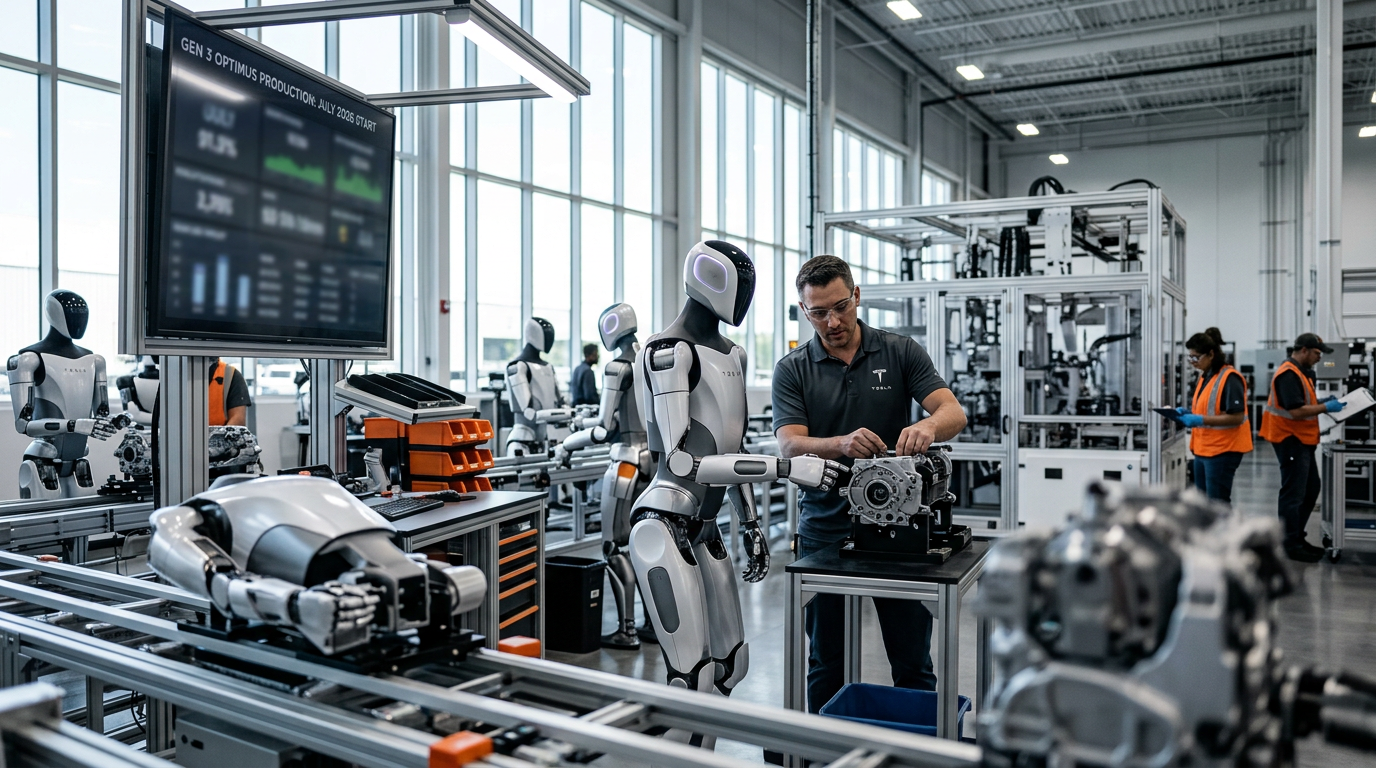
This one moved fast — faster than most people expected.
On April 22, Tesla confirmed on its Q1 2026 earnings call that Optimus V3 production will begin at Fremont in late July or August 2026 — using the freed-up floor space from the Model S and X lines, which roll their final vehicles off in early May after 14 years of production. The conversion timeline is aggressive. Musk’s own word for it: “insane.” He declined to give any production volume target for 2026, saying initial output will be “quite slow” and that predicting rates is “literally impossible” given Optimus has 10,000 unique components across an entirely new line.
That’s worth sitting with for a second. In January 2025, Musk said Tesla would build roughly 10,000 Optimus robots that year. By January 2026, he admitted none were doing “useful work” in Tesla’s factories. Now the target is simply “start production” — no volume commitment attached. Tesla is also constructing a second dedicated Optimus factory at Giga Texas, targeting production start around summer 2027 and an eventual run-rate of 10 million units annually. The steep part of the ramp is probably 2027, not 2026.
At CES 2026 in January, Boston Dynamics unveiled the production-ready version of its Atlas humanoid robot during Hyundai’s global media day — and won the show’s Best Robot award from CNET Group. Production began immediately at Boston Dynamics’ headquarters. All 2026 Atlas units are already fully committed to Hyundai’s Robotics Metaplant Application Center and Google DeepMind, with additional customers onboarded starting in early 2027. The full-scale Hyundai factory deployment — targeting 30,000 robots per year — is planned for 2028, initially focused on parts sequencing and material handling.
TrendForce projects global humanoid shipments will exceed 50,000 units in 2026 — a 700% surge over the prior year. That’s not a forecast range. That’s an order of magnitude shift. Meanwhile, Nvidia has iterated its Isaac GR00T robotics foundation model to N1.7 — now with commercial licensing for production deployments — and its broader Physical AI Dataset has been downloaded over 4.8 million times on Hugging Face. Every serious robot program in production today trains in Nvidia’s simulation environment before a single real step is taken.
2026: The Year of the Robot
A revolutionary new robot is beginning to emerge.
Elon Musk says it will “change civilization as we know it.”
Microsoft’s Bill Gates said, “it will be as revolutionary as the PC.”
Nvidia’s Jensen Huang says it could be “the largest technology industry the world has ever seen.”
Creating a $24 trillion opportunity for investors.
And one $7 stock could be the biggest winner of all.
The Part Most Investors Are Skipping
The obvious plays are Tesla (TSLA) and Nvidia (NVDA). But Tesla is trading at a forward P/E of roughly 180-193x right now — depending on the source — and a trailing P/E north of 300x. That leaves zero room for missed timelines. And Musk’s production schedules, as the Optimus record now clearly shows, have a well-documented history of slipping. Tesla is the bet you make if you believe the entire robotics vision executes flawlessly on the first try. The market has already priced in a lot of success that hasn’t shown up on a factory floor yet.
The more interesting angle, frankly, is the supply chain.
- Nvidia (NVDA) – Platform-agnostic. Sells simulation infrastructure, training tools, and chips to Tesla, Boston Dynamics, Agility Robotics, Franka Robotics, LG, and dozens more. Wins regardless of who “wins” the humanoid race. GR00T N1.7 just added commercial licensing, opening the production deployment market.
- Qualcomm (QCOM) – Its Dragonwing chips are designed for robots requiring 5G connectivity plus on-device AI inference. The fleet communication layer nobody talks about.
- Ambarella (AMBA) – Low-power edge AI chips for machine vision. When a robot needs to catch something mid-motion, it can’t wait for a cloud round-trip. That latency problem is Ambarella’s opportunity.
- MP Materials (MP) – Rare earth magnets sit inside every electric actuator in every humanoid robot. Supply is constrained. MP runs the only operational rare earth mine of scale in the Western hemisphere.
- Roundhill Humanoid Robotics ETF (HUMN) – Holds Tesla, Nvidia, Harmonic Drive Systems, and the broader supply chain in a single ticker. A reasonable way to get diversified exposure without picking a single winner.
Harmonic Drive Systems deserves its own mention. Each high-spec two-armed humanoid unit uses as many as 44 harmonic drives — the precision gear systems that control joint movement at every joint. There is no real substitute at this quality level. Japan controls this component moat, and TrendForce’s own on-the-ground reporting from iREX 2025 confirmed Harmonic Drive is already optimizing reducer designs specifically for humanoid joints — flat, high-torque designs for the neck and arms, ultra-compact for fingers. The component fortress is being built right now.
Public Law 63-43: Trump’s Secret Weapon to Win the Midterms?
Most pundits are predicting the coming midterm elections will be a disaster for Republicans.
But the 112-year-old little-known law you see below could save Trump from this disaster.
Because Public Law 63-43 could also have a huge impact on your wealth in 2026 – starting on May 15th.
The Risks Are Real
Musk’s timelines are notoriously optimistic — the Optimus track record proves it. The supply chain for 10,000+ unique Optimus components largely doesn’t exist yet at the scale Tesla needs; it has to be built vertically from scratch. Regulatory pushback from labor-displacement concerns is already emerging in Washington. And at 180x+ forward earnings, Tesla has already priced in a version of the future that hasn’t materialized on a factory floor.
There’s also the China angle — and it’s not small. TrendForce estimates Chinese humanoid robot output will surge 94% in 2026, led by Unitree and AgiBot, who together could capture nearly 80% of Chinese shipments. Chinese suppliers account for roughly 60-70% of Optimus’s core component value already. The price competition that’s coming — from companies with lower cost structures and government backing — is going to compress margins across the board.
That said: 2026 is structurally different from 2024’s hype cycle. The demos are done. Boston Dynamics’ Atlas is in production and shipping to real customers. Tesla’s Fremont lines are physically being torn down right now to make room. The shareholder meeting in June will likely be the next major signal — expect a full Gen 3 reveal and production update there.
Whether the headline stocks justify their valuations is a separate question from whether humanoid robotics is happening. It is. The question for a bargain hunter is where to find the value inside a theme that’s already been partially discovered — and the picks-and-shovels layer still looks less crowded than the front-page names. The component moat is real. Start there.
Futurist Eric Fry says it will be a “Season of Surge” for these three stocks
One company to replace Amazon… another to rival Tesla… and a third to upset Nvidia. These little-known stocks are poised to overtake the three reigning tech darlings in a move that could completely reorder the top dogs of the stock market. Eric Fry gives away names, tickers and full analysis in this first-ever free broadcast.