
April 25, 2026
Tesla Just Announced Optimus V3 Production for This Summer.
The humanoid robotics trade is getting real. Here’s how to think about TSLA versus the quieter supply chain plays.
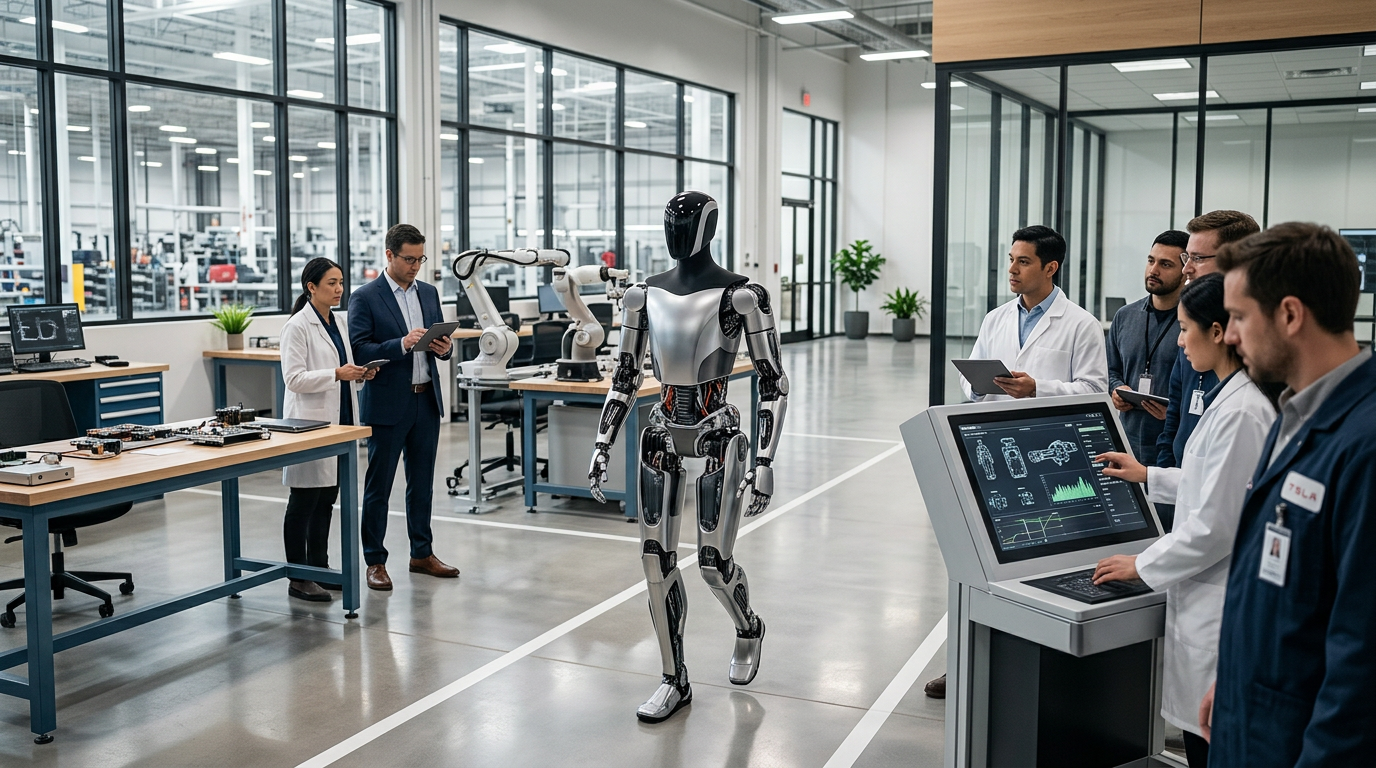
Hey there, bargain hunter. On April 23 – two days ago – Tesla officially announced via its Weibo account that Optimus V3, its third-generation humanoid robot, is expected to debut mid-year, with large-scale production slated to begin between July and August 2026. That’s not a rumor. That’s a production timeline.
This is the moment a lot of retail investors have been waiting for. The problem is most of them are going to express it the wrong way. And the Q1 2026 earnings call two days earlier gave us a lot more to work with than the headline beat suggested.
What the Earnings Call Actually Said
Tesla reported Q1 2026 earnings that beat Wall Street expectations, with revenue rising 15.8% year-over-year to $22.39 billion and EPS of $0.41. Gross margin jumped to 21.1% – that’s up 478 basis points year-over-year from 16.3%. Good quarter on paper. But the reaction was muted for a reason.
Shares initially rose about 4% in extended trading but gave up their gains after the company said spending this year will be $5 billion above prior guidance. Tesla plans over $25 billion in capital expenditures for 2026 to support growth. That’s a 67% jump in capex year-over-year and it includes the Optimus production lines, Cybercab, new factories, and a chip fab in Texas. The company anticipates negative free cash flow for the remainder of the year due to these investments.
The part people are focused on: when asked about plans to demo a forthcoming version of Optimus, Musk said “competitors literally do a frame-by-frame analysis and copy everything we’re doing,” so he’d rather “unveil” the humanoid closer to the start of production, which he said would be “somewhere around the late July, August time frame.” So the Weibo announcement and the earnings call are telling the same story. July is the marker.
2026: The Year of the Robot
A revolutionary new robot is beginning to emerge.
Elon Musk says it will “change civilization as we know it.”
Microsoft’s Bill Gates said, “it will be as revolutionary as the PC.”
Nvidia’s Jensen Huang says it could be “the largest technology industry the world has ever seen.”
Creating a $24 trillion opportunity for investors.
And one $7 stock could be the biggest winner of all.
What’s Actually Happening at Tesla
Optimus V3 is a meaningful hardware upgrade. The new design features 37 joints – nine more than the prior generation – improved hand dexterity, and a walking speed of 1.2 meters per second with the ability to stabilize on 15-degree slopes. Gen 3 hands now feature 25 actuators per forearm and hand, totaling 50 per robot – a 4.5x increase from Gen 2. Tesla is ending production of the Model S and Model X and repurposing those lines at its Fremont, California factory to build Optimus humanoid robots.
Tesla is utilizing a “Pilot Factory” strategy at the Fremont plant to refine the S-curve production ramp, starting with a few hundred units to identify assembly defects before hitting a target of 1 million units annually by late 2026. To support that ramp, Tesla broke ground on a massive new Optimus manufacturing facility at Gigafactory Texas in late 2025, with ambitions to eventually reach 10 million units per year.
Tesla’s vehicle business, for what it’s worth, lost its position as the world’s top-selling EV company last year. The company’s core automotive business continues to struggle against competitors across the globe like China’s BYD and Xiaomi. Tesla delivered 358,023 vehicles in Q1 2026, missing expectations by roughly 7,600 units, and the company also built over 50,000 more vehicles than it sold, signaling significant inventory buildup. Musk seems fine with that tradeoff. The pivot is real.
Wedbush’s Dan Ives has called Tesla the best physical AI company in the world and projects a $2 trillion market cap by year-end, growing to $3 trillion by end of 2027 on the back of FSD and robotics momentum. That’s the bull case in full, and it’s not crazy. It’s also priced in.
Here’s the Thing About TSLA’s Valuation
The electric vehicle maker, valued at a market capitalization of $1.46 trillion, trades at a P/E ratio of 360, reflecting premium investor expectations. Analysts estimate $2.12 in non-GAAP EPS for 2026, growing to $3.00 in 2027. Even on 2027 numbers, you’re paying well over 100x earnings. The humanoid robotics market could reach $5 trillion by 2050 – experts have put that number out there – but that’s a 24-year runway. The stock’s forward multiple assumes flawless execution with no regulatory delays, no supply chain stumbles, and no competition intensification.
That’s a lot of assumptions for a product that hasn’t shipped at scale yet. As of February 2026, Optimus robots are operating within Tesla’s own factories, though CEO Elon Musk acknowledged on the Q4 2025 earnings call that they are primarily for learning and data collection rather than performing productive tasks. Musk told the World Economic Forum in January that Tesla plans to sell Optimus to the public by end of 2027 at a price between $20,000 and $30,000. The gap between “robots in learning mode” and “robots sold to the public at scale” is wide. That gap is the risk.
The Supply Chain Problem Nobody Is Pricing In
Here’s where it gets complicated. Each Optimus requires approximately 3.5 kg of NdFeB magnets, sourced entirely from China – the single biggest production risk in 2026. China controls 90% of the rare earth materials needed for Optimus’s specialized magnets and actuators, and the Chinese government is demanding that companies share technical specifications and secure permits to use these materials.
In April 2025, China imposed export restrictions on rare earth magnets used in Optimus actuators – a response to U.S. tariff escalation. Tesla sought export licenses, and as of March 2026, this constraint has not been publicly resolved. It remains a material risk for 2026 production targets.
Slight tangent, but it matters: moving production to America to circumvent the China dependency could raise the estimated cost of an Optimus unit from $46,000 to $133,000. That $20,000–$30,000 target price depends almost entirely on Chinese supply staying intact. Tesla Optimus is one of the most geopolitically exposed supply chains in American technology – the robot designed to demonstrate U.S. AI and manufacturing leadership depends on Chinese suppliers for its most critical mechanical components. The bulls know this. They’re betting the license gets resolved. Maybe it does. But that’s a geopolitical bet, not a technology bet.
The 2026 production goal was set at 50,000 units. By July 2025, actual production was approximately a few hundred units – less than 10% of the 5,000 unit target for all of 2025. History of missed targets matters here. The Model 3 “production hell” of 2017–2018 delayed timelines by 18 months. There’s a reasonable base case that a similar dynamic plays out for Optimus. Not a disaster – just slower than the stock currently prices.
The Stock Signal That Called 2008 Just Flashed Red
What does a 100-year-old algorithm know that Wall Street doesn’t? This proprietary signal predicted the Dot-Com bust, the 2008 financial crisis, and the 2020 crash. Now, as Middle East tensions threaten to trigger America’s $38T debt crisis, it just issued its biggest warning yet. Get the 10 popular stocks to avoid – and 3 overlooked stocks you need to buy now.
The Quieter Plays Worth Thinking About
What’s interesting is the real money in humanoid robotics may not be in betting on which robot wins. It may be in owning the picks-and-shovels layer – the components, actuators, sensors, and AI chips that every humanoid robot manufacturer will need regardless of who dominates the market.
Nvidia is making money from the humanoid market, whereas the companies developing humanoids are spending big money. And it should make much more money from this market once humanoid robots are manufactured at large scale. The company already has a widely adopted platform for humanoid robot development and is generating revenue from the nascent market today.
On the competitor front, the field is more crowded than TSLA bulls want to admit. Figure 03 is Figure AI’s most advanced humanoid yet – capable of fully autonomous 24/7 operation without human supervision, built on the Helix 02 full-body AI system, running 5 hours on a single charge, and handling 20 kg payloads. With $675M in funding and a production facility targeting 12,000+ units annually, Figure AI is one of the fastest-moving companies in the industry.
Robotics is increasingly being positioned as an AI infrastructure play rather than a hardware play. Boston Dynamics formalized this pivot through a strategic partnership with Google DeepMind, announced at CES 2026, whose Gemini Robotics models will underpin Atlas’s AI capabilities. Unlike pure-play startups, Boston Dynamics inherits the structural advantages of an automotive OEM parent: automotive-grade supply chains, actuator and component integration via Hyundai Mobis, and a built-in enterprise customer in Hyundai Motor Group itself. That’s a meaningful moat, and it’s one Tesla doesn’t have a direct equivalent to.
Then there’s the Chinese competition angle. Unitree delivers shockingly capable humanoid robots at a fraction of Western competitors’ prices – the G1 starts at $16,000. That’s below Tesla’s own target price. However, there are legitimate security concerns – researchers have found data collection issues and potential backdoors in some Chinese robot platforms, and U.S. government scrutiny is increasing. The Chinese price competition is real. The policy response to it is unpredictable.
On the software side, every robot in this wave will need some version of physical AI training infrastructure – which cycles back to the GPU and data center buildout. Symbotic is already automating Walmart’s supply chain with non-humanoid bots and is positioned to integrate humanoid tech as it matures. The deployment infrastructure story is arguably more durable than any single hardware bet right now.
At CES 2026 in January, humanoid robots shifted visibly from demo mode to deployment mode. Boston Dynamics unveiled its all-new electric Atlas, and deployments for 2026 are already fully allocated, with initial fleets set to ship to Hyundai’s Robotics Metaplant Application Center and Google DeepMind in the coming months. 1X has opened preorders for NEO, with first customer deliveries planned for 2026, marking a major step toward real-world consumer deployment. The psychological barrier has been crossed. These machines are now pre-orderable, not just conceptual.
Bull / Base / Bear
- Bull: The Q2–Q3 2026 factory deployment is the make-or-break moment for Tesla’s production credibility. If Gen 3 performs reliable, autonomous productive work on the Fremont floor – that changes everything. TSLA toward $500+, supply chain names re-rate higher, and the rare earth license gets resolved quietly.
- Base: Production ramps slowly through 2027, regulatory friction and the China magnet issue slow commercial deployment, but the narrative holds. TSLA trades sideways to modestly higher on execution milestones. Supply chain names generate steady alpha as deployment broadens across multiple OEMs.
- Bear: If Optimus remains in “learning mode,” the 2026 targets will be the next in a long line of optimistic projections. Supply chain complexity delays V3 mass production – there are approximately 10,000 unique components with no established supply chain – the rare earth situation drags into 2027, and the 360x P/E multiple compresses hard. With analyst target prices showing a five-fold discrepancy ranging from $119 to $600, the distribution of outcomes is genuinely wide. TSLA tests $300.
The Cheap Investor Scorecard
Watch these before making a move:
- July–August production data: Did the first-generation Fremont line actually start volume output? Any concrete unit number changes the thesis.
- Rare earth license resolution: Musk confirmed production faces delays stemming from China’s export restrictions on rare earth mineral exports. The core problem, as Musk described it, is a “magnet issue” – certain rare earth elements are essential components in high-performance magnets used in robotic actuators and motors. Watch for any update on export license approval.
- Autonomous vs. teleoperated: Are the factory-deployed units working autonomously or still leaning on human remote operation? This is the line between hype and product.
- Gross margin trajectory: Automotive gross margin hit 21.1% in Q1 2026. Can Tesla maintain that while absorbing $25B+ in capex? The answer funds – or starves – the Optimus ramp.
- Competitor deployment data: If Figure AI or Agility Robotics posts real commercial deployment metrics before Tesla does, the robotics narrative partially shifts away from TSLA.
- Nvidia robotics revenue disclosure: Any breakdown of humanoid-specific revenue from NVDA is a leading indicator for the whole ecosystem.
- China supply chain alternatives: Niron Magnetics is scaling alternative materials and MP Materials is building domestic magnet capacity with support from the U.S. Department of Defense. A credible domestic supply announcement could remove the biggest single production risk.
- Capex vs. free cash flow: Tesla anticipates negative free cash flow for the remainder of 2026 due to these investments. Monitor whether the narrative holds under the financial pressure of a prolonged burn.
Musk’s 106X AI Breakthrough Will Shock the World
Google, OpenAI and Bezos say this AI breakthrough is a decade away…
Jeff Brown says Musk could announce it as soon as April 24, and kickstart a massive 106X market boom.
The Bottom Line
The humanoid robotics trade is now investable – that’s not speculation, that’s production timelines being publicly announced and confirmed on an earnings call two days ago. The question is where you want to take your exposure.
TSLA gives you maximum upside and maximum valuation risk in a single name. High P/E valuation, execution risks, and delayed revenue timelines mean investors must weigh long-term potential against near-term volatility. The supply chain layer – Nvidia, Symbotic, and the industrial automation names – gives you robotics exposure without betting the farm on Musk’s delivery record. And that delivery record has a pattern worth acknowledging: Musk initially targeted Optimus production by 2023, then 5,000–10,000 units by end of 2025. Actual 2025 production fell short.
If you’re a bargain hunter, the supply chain is where the margin of safety lives. The narrative around TSLA is loud. The price already reflects a lot of the good news – and then some.
Watch July. That’s when the first real production data arrives. If the units are autonomous and volume is measurable, the bull case gets real traction. If the line is still “learning,” the multiple has a problem.
– The Cheap Investor