
April 24, 2026
The $500 Billion Club: The Revenge of the Atom
Intel breaks a 26-year curse. AMD joins the elite. Software gets crushed. Welcome to the Hard-Asset Supercycle.
Hey there, bargain hunter.
The ghost of the dot-com bubble was finally laid to rest this afternoon. While the software sector is still nursing a hangover, Intel just broke a 26-year curse and AMD joined the $500 billion elite. In April 2026, the “cloud” has officially been grounded — and investors are loving the dirt.
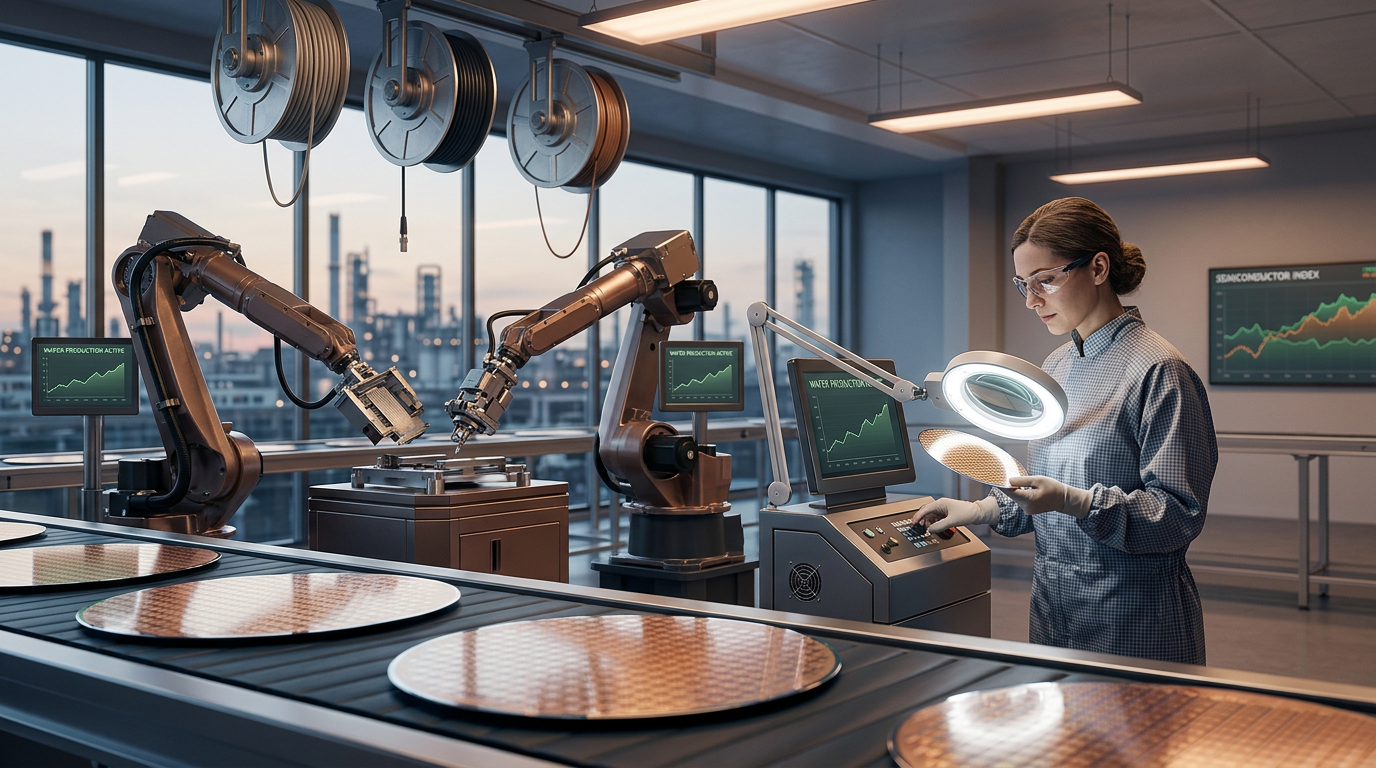
What happened on April 23–24 wasn’t a routine earnings pop. It was a market saying something out loud that it has been whispering for months: the atoms are worth more than the algorithms right now. The fabs, the turbines, the excavators — they are the new real estate.
The Scoreboard
Let’s run the numbers, because this tape deserves to be documented.
- Intel (INTC): Soared as much as 31% in premarket Friday — setting up the stock to surpass its all-time dot-com peak from 26 years ago. Q1 revenue came in at $13.6 billion, up ~7% year over year, crushing the $12.43 billion consensus. Non-GAAP EPS of $0.29 obliterated estimates. The Data Center and AI segment grew 22% year over year to $5.05 billion. Intel Foundry revenue climbed 16% to $5.42 billion.
- AMD (AMD): Surged 13.29% on no company-specific news — purely riding Intel’s coattails as investors repriced the entire CPU ecosystem. AMD crossed the $500 billion market cap threshold in after-hours Thursday for the first time in its history.
- United Rentals (URI): Jumped 18–19% after posting Q1 2026 record revenue of $3.985 billion (up 7.2% YoY), adjusted EPS of $9.71 (beating estimates of $9.06), and raising full-year guidance to $16.9–$17.4 billion in total revenue.
- Software sector: ServiceNow crashed nearly 18%. IBM fell nearly 9%. Salesforce dropped ~9%. Adobe lost 7%. Workday slid ~10% — and is now down over 45% for the year. The iShares Expanded Tech-Software ETF (IGV) shed roughly 5% on the session.
One day. Two worlds. The market drew a very sharp line.
Buffett, Gates and Bezos Quietly Dumping Stocks—Here’s Why
The world’s wealthiest individuals are making huge moves with their money.
Warren Buffett just liquidated billions of shares. Bill Gates sold 500,000 shares of Microsoft. Jeff Bezos filed to sell Amazon shares worth $4.8 billion.
What is going on? One multi-millionaire believes they are preparing for a catastrophic event. But not a crash, bank run, or recession. It’s something we haven’t see in America for more than a century.
What Actually Happened — And Why It Matters
Here’s where it gets interesting. Neither IBM nor ServiceNow actually had bad quarters. IBM beat Wall Street’s adjusted EPS expectations by $0.10 and came in $300 million above revenue estimates. ServiceNow reported first-quarter revenue of $3.77 billion, topping the $3.74 billion consensus. Both companies did their jobs.
But the market punished them anyway. IBM didn’t raise full-year guidance. ServiceNow flagged a 75 basis point headwind to subscription revenue growth from deal slippage in the Middle East — roughly $23 million, which one Truist analyst described as a “contained instance.” Didn’t matter. The stocks got torched.
The takeaway on the floor: in this tape, anything that hints at deceleration is getting punished — AI narrative or not. Fund managers are drawing a sharper line between AI infrastructure winners, where spending on chips and physical capacity is boosting revenue, and traditional SaaS vendors that must now prove they can monetize AI without gutting the subscription economics that made them attractive in the first place.
The fear is structural, not cyclical: if low-cost AI agents can automate more workflows, a lot of the functionality that enterprise vendors charge for today could get squeezed out of existence. Investors aren’t waiting around to find out.
Meanwhile, Intel posted its sixth consecutive quarter of beating financial expectations.
The Revenge of the Atom — A Deep Dive
Let me back up for a second, because the Intel story is more than an earnings pop. It is a multi-year structural reset that has been hiding in plain sight.
Intel was dead money — worse than dead — for most of 2023 and 2024. The stock hit a 52-week low of $18.97. The company posted an $18.8 billion loss in 2024, largely from write-downs and restructuring. Most of Wall Street had written the obituary. Then something shifted.
CEO Lip-Bu Tan spent his first year doing the unglamorous work: workforce discipline, new manufacturing leadership (including a Samsung veteran for foundry operations), and a relentless focus on executing the 18A process node — a 1.8nm-class technology that Intel claims delivers up to 15% better performance per watt and 30% better chip density versus its prior generation. On April 1, 2026, Intel announced a $14.2 billion deal to repurchase the 49% stake in its Fab 34 facility in Leixlip, Ireland from Apollo Global Management — the same stake it sold for $11.2 billion in 2024 when it was capital-constrained. Buying it back at a higher price sent a clear message: the balance sheet is healed, and Intel is transitioning from defensive survival to aggressive expansion.
Then came the Terafab partnership with Elon Musk’s AI chip initiative, hyperscaler partnerships with Tesla and Google, and the launch of Core Series 3 AI PCs. Northland came out with a $92 Outperform rating. The stock made its biggest nine-day run ever — from multi-year lows to near 26-year highs — before the earnings confirmed what the tape already suspected.
Slight tangent, but it matters: one analyst at Great Hill Capital described the move as going “from despondency to euphoria in a very short period of time.” That kind of language is worth noting. It cuts both ways.
AMD’s story is complementary, not derivative. The company now operates across three segments — Data Center, Client, Gaming, and Embedded — and its data center business has effectively quadrupled in recent years. Revenue has roughly doubled. Meta and OpenAI are signed to multi-year, multi-billion-dollar contracts. The MI450 chip on a 2nm process is expected to leapfrog Nvidia’s current generation on process node for the first time. A PEG ratio below 1.0 on a stock growing earnings at 35%+ CAGR is not a common sight anywhere in large-cap tech.
And then there’s the steel side of this story.
The Dirt Economy
United Rentals rents bulldozers, cranes, power systems, and specialty equipment to the companies building data centers, upgrading the grid, and constructing the physical infrastructure that the digital economy runs on. It is about as un-glamorous as investing gets. And it just posted record first-quarter revenue, record EBITDA, record EPS, and raised full-year guidance — all in the same report.
Specialty revenue grew 14% year over year. Fleet productivity came in at 2.3%, exceeding the company’s internal 1.5% inflation benchmark. Adjusted EBITDA hit $1.76 billion with a 44.1% margin. The company returned $500 million to shareholders in Q1 alone — $375 million in buybacks and $125 million in dividends. Net leverage sits at a comfortable 1.9x.
For 2026, United Rentals now expects $16.9–$17.4 billion in total revenue, $7.625–$7.875 billion in adjusted EBITDA, and free cash flow of $2.15–$2.45 billion. That is not a software multiple. That is a cash machine with a construction helmet on.
The broader theme: GE Vernova is electrifying the grid. Caterpillar is moving the earth. Micron is building the memory that AI servers depend on. These are not speculative plays on a vague AI future — they are the picks-and-shovels beneficiaries of a capex supercycle that is only in its second or third inning.
As one market analysis put it, the industrials sector is now led by companies at the intersection of automation and infrastructure. The “Old Economy” is outpacing the “New Economy” — at least this quarter, and arguably for the rest of this cycle.
Public Law 63-43: Trump’s Secret Weapon to Win the Midterms?
Most pundits are predicting the coming midterm elections will be a disaster for Republicans.
But the 112-year-old little-known law you see below could save Trump from this disaster.
Because Public Law 63-43 could also have a huge impact on your wealth in 2026 – starting on May 15th.
The Data That Matters
- Intel Q1 2026: Revenue $13.6B (+7% YoY) | Data Center & AI +22% to $5.05B | Foundry Revenue +16% to $5.42B | Non-GAAP gross margin 41% | Non-GAAP EPS $0.29 vs. $0.05 consensus
- AMD market cap: ~$497–$566B as of April 23–24, 2026 — first time ever above $500B | 12-month market cap growth: ~238–347% depending on data source | Revenue growth 34% in 2025; projected 34% in 2026
- United Rentals Q1 2026: Total revenue $3.985B | Rental revenue $3.4B (+8.7% YoY) | Adj. EBITDA $1.76B (44.1% margin) | Adj. EPS $9.71 | Full-year guidance raised to $16.9–$17.4B
- Micron (MU): Analysts project Q3 2026 revenue of $33.5B — a 260% increase over Q3 2025. Forward P/E of ~12 on fiscal 2026 estimates. PEG ratio: 0.46 per Morningstar.
- Software sector (IGV ETF): Down ~5% on April 23 alone. Workday down 45%+ YTD. ServiceNow off nearly 18% in a single session.
Is It Cheap? The Valuation Frame
This is the part where I pump the brakes slightly, because the Cheap Investor doesn’t chase.
Intel at $83–$85 post-earnings is a different animal than Intel at $19 a year ago. The stock is up roughly 100% year-to-date as of today’s session. The rally has compressed the margin of safety. That said, a sum-of-the-parts argument still holds water: the foundry business alone, if it scales to serve external customers at TSMC-comparable margins, could be worth more than the entire company’s current enterprise value. The $15 billion foundry backlog is real. The 18A node is shipping. Microsoft is a customer. The question is execution timeline, not direction.
AMD at ~$300 per share with a PEG below 1.0 on 35%+ earnings growth is, by the numbers, not expensive. It never is when growth is accelerating. The risk is Nvidia’s CUDA ecosystem moat, China export controls (a $1.5 billion headache), and semiconductor cyclicality — which has historically punished AMD with drops of 65–83% in down cycles. Worth keeping that in your back pocket.
United Rentals at ~$960 per share trades at roughly 14–15x forward earnings with a 44% EBITDA margin and a 15% North American market share. That is not cheap on a price-per-share basis. But on fundamentals relative to cash flow generation? It is reasonable for a company raising guidance into its busiest season of the year.
Micron is the most compelling valuation setup in this entire cohort. A forward P/E of 12 on a company projecting revenue to more than double year-over-year — and a PEG of 0.46 — is the kind of number that makes you squint and read it twice. The risk is cyclicality. The reward, if AI server memory demand sustains, is substantial.
Bull / Base / Bear
Bull case: Intel wins external foundry customers at scale, 18A yields prove out, and the AI capex cycle extends into 2028. AMD captures 20%+ of the data center GPU market. United Rentals benefits from a multi-year infrastructure construction wave. Micron’s memory supercycle runs hotter than 2021. The Hard-Asset Supercycle becomes the defining equity theme for the next three to five years. Rotational flows out of software continue re-rating industrials and hardware higher.
Base case: Intel executes the foundry build-out but faces margin compression. AMD grinds forward on data center CPU share. United Rentals delivers 6–7% revenue growth in line with guidance. Micron’s PEG expands but the stock pauses as the market prices in 2027 risks. Software stabilizes at lower multiples and begins recovering late 2026.
Bear case: Intel’s 18A yields disappoint. A recessionary shock dries up data center capex. AMD gets squeezed by both Nvidia (high end) and custom silicon from hyperscalers (mid market). Micron faces an oversupply event if Samsung and SK Hynix dump capacity in 2027. United Rentals sees project deferrals as financing costs rise. The blow-off top narrative wins.
5 Cheap Plays for the Hard-Asset Supercycle
Here is where the bargain hunting actually happens. These are not the obvious names everyone is already talking about.
-
Micron Technology (MU) — The Memory Floor Play
Forward P/E of ~12. PEG of 0.46. Q3 2026 revenue projected at $33.5 billion — a 260% increase over Q3 2025. The company is building a $100 billion fab in New York, mass-producing HBM4 chips ahead of rivals, and is deeply embedded in Nvidia’s Vera Rubin platform. Yes, it’s cyclical. But at 12x earnings on a company growing at this rate? That’s a Cheap Investor number. Scale in on weakness; the memory cycle has not peaked. -
Intel (INTC) — The Foundry Option Play
This one requires honesty. Intel at $83+ is not the Intel at $19 that we wish we had bought. But the 18A node is shipping, the Terafab partnership is real, and the foundry backlog is $15 billion and growing. If you missed the first move, the trade now is to wait for a post-earnings consolidation — likely in the $68–$75 range — and treat any pullback as a scale-in opportunity on the foundry thesis, not the PC business. The long-term target is the all-time high at $74.88 as a first stop, with the real prize being a full foundry re-rating beyond $90 if external customer wins materialize. -
United Rentals (URI) — The Invisible Infrastructure Play
Nobody talks about URI at cocktail parties. That’s usually a good sign. Specialty revenue growing at 14% with a 44% EBITDA margin is not a slow business — it just doesn’t have a ChatGPT moment to generate headlines. The setup: data centers need construction equipment to be built. Grid modernization requires heavy machinery. URI is the toll road for all of it. At ~$960 per share, it’s not historically cheap, but the guidance raise and record Q1 results make it a hold-and-add-on-dips name for the infrastructure cycle. Free cash flow of $2.15–$2.45 billion for 2026 supports the shareholder return story. -
GE Vernova (GEV) — The Grid Electrification Play
The AI supercycle runs on electricity. Every data center being built today requires turbines, transformers, and power management systems — and GE Vernova is one of the few companies in the world that can supply them at scale. This one is for investors who believe the energy infrastructure buildout is a 10-year story, not a 10-month trade. The “Old Economy” has become a growth sector precisely because AI demands unprecedented physical power. GEV is the cleanest way to own that theme without taking on process-node execution risk. -
Applied Materials (AMAT) — The Equipment Supercycle Play
If Intel, TSMC, and Micron are all building or upgrading fabs simultaneously, someone has to sell them the machines. Applied Materials is the largest semiconductor equipment company in the world, and it benefits from every dollar of capex spent across the entire industry — regardless of which chipmaker wins the process race. Bank of America has flagged an evolving supercycle as a strong tailwind for semiconductor equipment stocks. AMAT trades at a more modest multiple than the chipmakers themselves, with a direct line to every major fab investment globally. It’s a quieter way to play the Hard-Asset Supercycle without betting on a single technology node.
Your Free Options Book Is About to Vanish
In case you missed it… make sure you get your free “Simple Options Trading For Beginners” book before your link expires.
I eventually plan to charge money for this training, so do yourself a favor and download it now…
That way, no matter what it costs in the future, you’ll have a free copy.
Sound good?
The Cheap Investor Scorecard
- [ ] Intel 18A external customer wins — track quarterly foundry revenue vs. internal-only baseline
- [ ] AMD data center revenue as % of total — watch for 60%+ mix shift signaling full rerating
- [ ] United Rentals fleet productivity metric — must stay above the 1.5% internal “bogey” to confirm demand durability
- [ ] Micron HBM4 yield rates and Q3 2026 actual revenue vs. $33.5B projection
- [ ] IGV (software ETF) vs. SMH (semiconductor ETF) relative performance — widening gap confirms the rotation thesis
- [ ] Intel Foundry gross margin trajectory — moving from negative to breakeven is the key inflection trigger
- [ ] AMD EPYC Venice launch (H2 2026) — server CPU share gains against Intel’s recovery narrative
- [ ] GE Vernova order backlog growth — proxy for power infrastructure capex commitment
- [ ] Applied Materials booking momentum — leading indicator for fab investment 12–18 months forward
- [ ] ServiceNow and Workday stabilization — if software bottoms, it may signal the rotation is maturing
Bottom Line
The Hard-Asset Supercycle is not a prediction anymore. It is a Q1 2026 earnings report.
Intel breaking a 26-year curse, AMD crossing $500 billion, and United Rentals posting record numbers — all on the same day that ServiceNow crashed 18% and Workday quietly buried itself deeper in a 45% year-to-date hole — is not a coincidence. It is a market delivering a verdict on two competing visions of where value lives in the AI era.
The atoms are winning. For now.
The risk is that “for now” is doing a lot of heavy lifting in that sentence. Intel at $85 is not Intel at $19. The blow-off top is a real scenario, and anyone who tells you they know for certain which way this resolves from here is selling something. What I do know is this: the companies building and supplying the physical substrate of the digital world — fabs, turbines, cranes, memory — are generating real cash, beating real estimates, and raising real guidance. That’s the kind of dirt a bargain hunter can work with.
Watch the 18A yield rates. Watch the Micron revenue print. Watch whether United Rentals’ guidance holds into the busy construction season. Those three data points will tell you more about the durability of this supercycle than anything else on the tape.
Stop Overcomplicating Your Trades
Stop staring at charts until your eyes melt. I found one repeatable morning setup that works so well, I’m usually done trading by 10 AM. No drama, no 14-hour sessions. Just real income.
Is This a New Cycle or a Blow-Off Top?
Intel just broke a 26-year technical resistance level. AMD joined the $500 billion club. The question on every trader’s desk right now is simple — and there is no consensus answer.
We want to know where you stand:
- The Intel breakout is the start of a new 5-year semiconductor supercycle
- It’s a blow-off top — this rally gets faded hard within 6 months
- Real-world assets will keep outperforming software for the rest of 2026, but I’d take profits on Intel specifically
- I’m rotating out of software and into hardware/industrials right now
- Too early to call — I’m watching the 18A yield data before committing
Stay cheap,
The Cheap Investor