
Tesla Is Building the Humanoid. These Companies Are Taking Robotics Somewhere Else.
Tesla has spent years trying to change how people think about cars.
Its next major technology bet could change how people think about labor.
Optimus is Tesla’s general-purpose humanoid robot project.
The goal is ambitious: build an autonomous, bipedal machine capable of performing repetitive, unsafe or otherwise undesirable tasks.
Tesla’s Gen 3 design was developed as its first Optimus version intended for mass production.
Whether Tesla ultimately reaches the scale it envisions remains an open question.
But Optimus represents something much larger than one company’s robot.
Artificial intelligence is beginning to move off the screen.
Into machines.
Onto sidewalks.
Across factory floors.
Inside hospitals.
Through restaurants.
Into the sky.
And even beneath the ocean.
This transition is sometimes described as physical AI.
Instead of using artificial intelligence only to generate information, physical AI attempts to give machines the ability to perceive their surroundings, make decisions and act in the real world.
And that creates an investment story that extends far beyond Tesla.
Because the robotics boom may not produce one dominant type of robot.
A humanoid makes sense when the environment was designed for humans.
But why build legs when wheels work better?
Why build hands when a specialized tool can perform the job more efficiently?
Why build one expensive general-purpose robot when a fleet of simpler machines can solve a specific problem?
Those questions lead us away from the biggest technology companies and toward a much more speculative corner of the market.
This report examines four smaller public companies pursuing four very different versions of the robotics opportunity:
Serve Robotics | NASDAQ: SERV
THE SIDEWALK
Autonomous robots designed to move goods through human environments.
Palladyne AI | NASDAQ: PDYN
THE BRAIN
Embodied AI software designed to give different types of machines greater autonomy.
Richtech Robotics | NASDAQ: RR
THE SERVICE ECONOMY
Robots designed for restaurants, hospitality, healthcare and other commercial environments.
Nauticus Robotics | NASDAQ: KITT
THE OCEAN FLOOR
Autonomous machines designed to perform difficult work beneath the water.
These are not four miniature versions of Tesla.
They are four different answers to a much bigger question:
Where might robots actually become useful enough for businesses to pay for them?
That is the question worth researching.
BEFORE WE GO ANY FURTHER
Small Robotics Companies Come With Big Risks
This report is deliberately different from a list built around large, established technology companies.
SERV, PDYN, RR and KITT are smaller and more speculative businesses.
Several remain in early stages of commercialization.
Some generate relatively modest revenue.
Some depend on outside financing.
Some have meaningful customer concentration.
And some are trying to commercialize technologies that may take considerably longer to scale than investors expect.
That makes the opportunity interesting.
It also makes the risk impossible to ignore.
So every company in this report gets two boxes:
THE ROBOTICS CASE
Why the technology deserves further research.
THE REALITY CHECK
What could go wrong.
Both matter.
Let’s start on the sidewalk.
DESTINATION #1
THE SIDEWALK
Serve Robotics | NASDAQ: SERV
The Robot That Doesn’t Need a Driver
Think about the last mile of a delivery.
A restaurant prepares an order.
A customer may live only a mile or two away.
Yet completing that final portion of the trip can require putting a human being inside a car and moving thousands of pounds of metal through traffic just to transport a relatively small package.
Serve Robotics is built around a different idea.
What if the package moved itself?
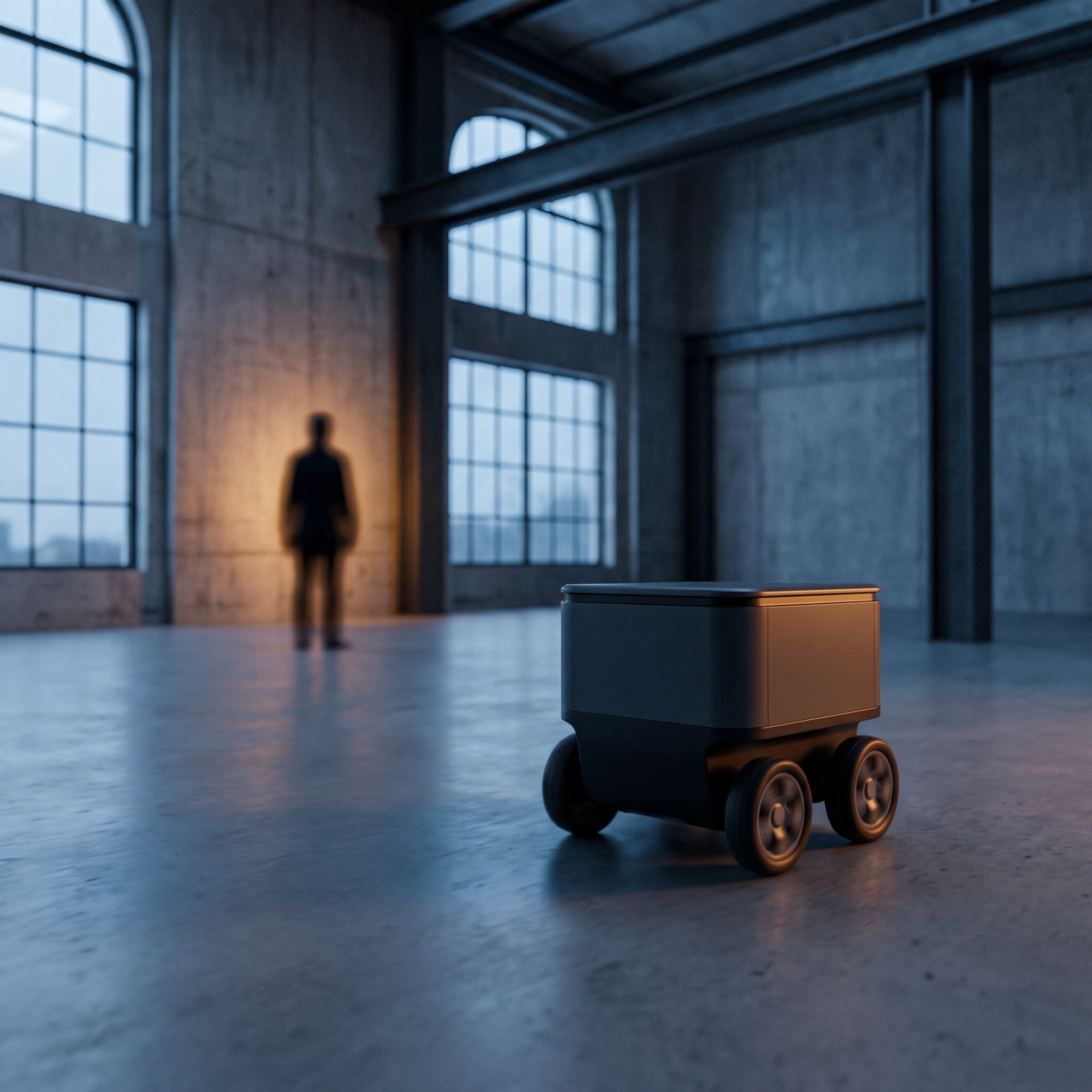
Serve develops autonomous robots designed to navigate sidewalks and other human-centered environments.
Its machines use artificial intelligence, computer vision, sensors and fleet-management software to travel through real-world environments while transporting goods.
The robot does not look like Optimus.
It doesn’t need to.
Its job is much narrower.
Move something from one location to another.
And that simplicity makes Serve an interesting place to begin our search.
THE TECHNOLOGY
Autonomous sidewalk delivery sounds straightforward until you think about what a robot actually encounters.
Pedestrians.
Dogs.
Bicycles.
Crosswalks.
Curbs.
Construction.
Unexpected obstacles.
Weather.
Changing lighting.
People behaving unpredictably.
A delivery robot has to perceive those conditions and respond appropriately.
Serve’s platform combines proprietary hardware, artificial intelligence, computer vision and cloud-based fleet-management software.
This is physical AI in a very literal sense.
The software does not simply need to identify an object.
The machine needs to determine what that object means for its next movement.
THE NUMBER TO KNOW
792
Serve reported an average of 792 daily active robots for the three months ended June 30, 2026, compared with 160 during the comparable 2025 period.
The company defines daily active robots as the average number of robots performing deliveries during the reporting period.
That provides a more useful metric than simply counting how many robots have been manufactured.
A robot sitting in storage does not demonstrate commercial adoption.
A robot performing work does.
THE STORY JUST GOT BIGGER
Serve began primarily as a sidewalk-delivery robotics company.
Its ambitions have expanded.
Through acquisitions, Serve has added capabilities in other areas of robotics, including healthcare.
The company’s acquisition of Diligent Robotics added indoor robots used in hospital environments.
That changes the research question.
Serve is no longer simply asking whether sidewalk delivery robots can work.
It is attempting to build a broader autonomy platform that can operate across multiple physical environments.
Outdoor robots can move food and other goods.
Indoor robots can help move supplies through hospitals.
Different machines.
Different customers.
But potentially overlapping autonomy technology.
FOLLOW THE REVENUE, NOT JUST THE ROBOTS
Serve reported $6.2 million of revenue for the six months ended June 30, 2026, compared with $1.1 million during the comparable 2025 period.
Fleet-services revenue accounted for approximately $4.3 million of the first-half total, while software-services revenue contributed approximately $2.0 million.
The growth is notable.
So is the scale.
Serve remains a small business relative to the size of the opportunity investors may imagine for autonomous delivery.
That gap between potential and commercial scale is exactly what researchers need to monitor.
THE ROBOTICS CASE
If autonomous delivery works economically, the addressable opportunity could extend beyond restaurants.
Groceries.
Pharmacy.
Retail.
Laundry.
Healthcare.
Local commerce.
The important question is not whether a robot can successfully complete a demonstration.
It is whether fleets can operate with sufficient utilization, reliability and economics to make autonomous delivery attractive to customers.
Serve provides a public-company laboratory for that question.
THE REALITY CHECK
Expansion is expensive.
Serve reported $24.0 million in cost of revenues during the first six months of 2026 against $6.2 million of revenue.
Research and development expense was approximately $39.3 million during the same period.
The company also disclosed lower-than-expected delivery volume through its Uber Eats partnership during the second quarter of 2026.
That matters.
A larger robot fleet does not automatically produce attractive economics.
Utilization matters.
Customer demand matters.
Operating cost matters.
And the company needs to prove that its physical infrastructure can eventually support a sustainable business model.
RESEARCH FILE: SERV
Watch: Robot utilization Watch: Revenue per deployed robot Watch: Fleet-service economics Watch: Customer diversification Watch: Healthcare expansion Watch: Cash usage
Core Question: Can autonomous robots become economical enough to replace cars for certain short-distance tasks?
DESTINATION #2
THE BRAIN
Palladyne AI | NASDAQ: PDYN
What If the Valuable Part Isn’t the Robot?
A robot needs hardware.
Motors.
Sensors.
Cameras.
Actuators.
Processors.
But those components do not automatically create intelligence.
The machine also needs to understand what is happening around it.
It needs to distinguish useful information from irrelevant information.
It needs to decide.
Then it needs to act.
Palladyne AI is trying to build that intelligence layer.
Rather than focusing only on one robot, Palladyne develops embodied AI and autonomy software intended to work across multiple types of machines.
That makes PDYN one of the more unusual names in this report.
The thesis isn’t:
Which robot wins?
It is:
Could software become valuable across many different robots?
THE TECHNOLOGY
Palladyne’s core AI offerings include Palladyne IQ and its collaborative autonomy technologies.
The company’s software is designed to be hardware agnostic.
In plain English:
The objective is to create intelligence that can potentially operate across different machines rather than being locked to one specific robot.
Those machines can include:
Industrial robots.
Collaborative robots.
Drones.
Unmanned ground vehicles.
Remotely operated vehicles.
That could matter if robotics develops the way computing did.
Computers came in many forms.
Software created a layer of value that could operate across hardware.
Smartphones came from many manufacturers.
Operating systems and applications became enormously important.
Robotics could potentially develop its own version of that separation.
The machine may matter.
The intelligence running it may matter just as much.
EDGE INTELLIGENCE
Palladyne’s approach also highlights an important robotics problem.
A machine operating in the physical world cannot always send every decision back to a distant data center.
Imagine a drone flying through a contested environment.
Or an industrial robot reacting to a moving object.
Or an autonomous vehicle losing connectivity.
The machine may need to make decisions locally.
Palladyne describes its technology around decentralized embodied autonomy, where machines can perceive information, make decisions and act at the edge.
That is fundamentally different from asking a cloud-based AI model a question and waiting for a response.
Physical machines often need answers in fractions of a second.
THE NUMBER TO KNOW
$5.8 million
Palladyne reported approximately $5.8 million in revenue for the second quarter of 2026, compared with approximately $1.0 million in the comparable 2025 period.
The increase included contributions from acquisitions as well as organic activity.
The company also reported approximately $24.6 million in backlog as of June 30, 2026.
Backlog does not guarantee future revenue.
But the numbers give researchers something tangible to follow as Palladyne attempts to move from technology development toward broader commercialization.
WHY DEFENSE MATTERS HERE
Palladyne is not purely an industrial robotics story.
Its autonomy technology also applies to drones and defense systems.
That may be important because military applications can create unusually demanding environments for autonomous machines.
Communication may be unreliable.
GPS may be disrupted.
Several machines may need to coordinate.
Decisions may need to happen quickly.
Systems may have to operate without constant cloud connectivity.
Those requirements overlap with many of the technical problems embodied AI developers are trying to solve.
Defense therefore may serve as both a market and a proving ground for autonomous technology.
THE ROBOTICS CASE
Palladyne becomes interesting if robotics develops into a fragmented hardware market.
Imagine dozens of companies building different types of autonomous machines.
If a software platform can improve intelligence across several of them, the opportunity could become broader than selling one specific robot.
The company does not need every robotics manufacturer to use its technology.
But it does need to demonstrate that its AI software creates enough value for customers to pay for it.
That distinction is critical.
THE REALITY CHECK
Palladyne’s own filings make the commercialization risk clear.
Its foundational AI technology remains relatively new.
Customer trials and discussions do not guarantee purchases.
The company disclosed in its second-quarter 2026 filing that it had secured one paying customer specifically for its foundational AI-related products, while other revenue-generating contracts involved areas such as UAV engineering, avionics and precision manufacturing.
That is an important reality check.
The robotics software vision is potentially large.
The commercial evidence remains much smaller.
Investors need to distinguish the two.
RESEARCH FILE: PDYN
Watch: AI software customers Watch: Backlog conversion Watch: Government contracts Watch: Palladyne IQ adoption Watch: Drone and swarm applications Watch: Revenue mix
Core Question: Can embodied AI become a valuable software layer across different types of robots?
DESTINATION #3
THE SERVICE ECONOMY
Richtech Robotics | NASDAQ: RR
Your First Robot Coworker Might Make Coffee
When people imagine robots entering the workforce, they often picture a humanoid walking into a factory.
The transition may be less dramatic.
A robot might make a drink.
Carry a tray.
Deliver supplies.
Clean a floor.
Transport items through a building.
Perform one repetitive task over and over.
Richtech Robotics is focused on that part of the market.
The company develops robotic systems for commercial and service environments, including hospitality, food service and healthcare applications.
And its approach gives us another useful lesson about the robotics boom:
A robot does not have to do everything to be economically useful.
Sometimes one task is enough.
MEET ADAM
One of Richtech’s more recognizable systems is ADAM.
ADAM is a robotic beverage system designed to prepare and serve drinks.
The machine has been used for applications involving coffee and other beverages.
That might sound like a novelty.
But it illustrates an important commercialization strategy.
Instead of trying to build a general-purpose robot capable of learning hundreds of unrelated tasks, a company can focus on a narrow workflow.
The environment can be controlled.
The actions can be repeated.
Performance can be measured.
The customer can evaluate whether the economics work.
That makes specialized service robots an interesting contrast with Tesla’s humanoid approach.
ROBOTS-AS-A-SERVICE
Richtech has also been developing a Robots-as-a-Service model.
The idea resembles the shift that occurred in enterprise software.
Instead of requiring a customer to make a large upfront technology purchase, robotics can potentially be offered through recurring service arrangements.
That may reduce the barrier to adoption.
It can also change the manufacturer’s economics.
A one-time robot sale generates revenue once.
A recurring service model may create an ongoing relationship.
But it also means the robotics provider may retain more responsibility for deployment, maintenance and performance.
THE NUMBER TO KNOW
$3.95 million
Richtech reported approximately $3.95 million in revenue for the nine months ended June 30, 2026, compared with approximately $3.60 million during the comparable 2025 period.
That number tells us two things at once.
Richtech is generating commercial revenue.
And it remains an extremely small business.
This is exactly why the company belongs in the discovery category rather than being treated like an established robotics leader.
The question is whether its technology can scale beyond early deployments.
WHY SERVICE ROBOTS COULD MATTER
Labor-intensive industries face a different automation problem than factories.
Restaurants and hotels were designed around people.
The environment changes constantly.
Customers move unpredictably.
Products vary.
Workers perform many different tasks.
That makes full automation difficult.
But individual workflows may still be automated.
A robot might not replace a restaurant employee.
It could potentially remove one repetitive task from that employee’s day.
This incremental approach could be an important path for robotics adoption.
Businesses do not need to automate everything at once.
They can automate one process at a time.
THE ROBOTICS CASE
Service industries represent an enormous part of the economy.
If robots become easier to deploy and operate, restaurants, hotels, hospitals and retail environments could represent meaningful markets.
Richtech gives investors exposure to that experiment from a very early stage.
Its opportunity depends less on creating science-fiction-level intelligence and more on proving that specialized machines can generate acceptable economics for customers.
That may be a more achievable problem.
It may also create a more competitive market.
THE REALITY CHECK
Richtech’s size creates substantial risk.
Revenue remains measured in millions rather than hundreds of millions or billions.
Scaling a hardware business requires capital.
Machines need to be built.
Installed.
Maintained.
Supported.
And replaced when necessary.
Richtech is also experimenting with operating robot-enabled food and beverage locations through its Alphamax subsidiary.
That could provide valuable operating data.
It also adds another layer of execution complexity.
Investors need to determine whether Richtech is primarily becoming a robotics manufacturer, a robotics service provider, an operator of automated locations, or some combination of all three.
RESEARCH FILE: RR
Watch: Robots-as-a-Service growth Watch: Customer deployments Watch: Revenue growth Watch: Gross margins Watch: Cash requirements Watch: Expansion beyond food service
Core Question: Can specialized service robots become useful enough to move from novelty to everyday commercial equipment?
DESTINATION #4
THE OCEAN FLOOR
Nauticus Robotics | NASDAQ: KITT
Some Jobs Were Made for Robots
The ocean changes the robotics equation.
Human beings are poorly designed for underwater work.
We need air.
Pressure becomes dangerous.
Visibility can be limited.
Conditions can be unpredictable.
Operating offshore can require specialized vessels, crews and equipment.
That creates a very different economic argument for robotics.
Instead of asking whether a robot can perform a task more cheaply than a person standing nearby, the question becomes:
Can the robot go somewhere that is expensive, difficult or dangerous for humans to work in the first place?
That is the market Nauticus Robotics is pursuing.
THE TECHNOLOGY
Nauticus develops ocean robots, software and intelligent services for offshore applications.
Its portfolio includes:
Autonomous underwater vehicles.
Remotely operated vehicles.
Electric robotic manipulators.
Autonomy software.
Its Aquanaut platform represents the company’s push toward more autonomous subsea operations.
Traditional remotely operated vehicles often depend on cables connecting the machine to a surface vessel.
Greater autonomy could potentially change that operating model.
A subsea robot capable of performing more work without constant direct control could reduce some of the infrastructure required for offshore operations.
That is the thesis.
Proving it commercially is the challenge.
WHY THE OCEAN IS AN INTERESTING ROBOTICS MARKET
Many of the physical tasks performed offshore are expensive.
Inspection.
Maintenance.
Monitoring.
Manipulation.
Infrastructure work.
Energy companies need to inspect subsea assets.
Governments care about underwater infrastructure and security.
Telecommunications cables cross the ocean floor.
Offshore energy projects require inspection and maintenance.
Environmental monitoring requires data collection.
These applications can make autonomy valuable for a different reason than factory automation.
The objective is not simply replacing labor.
It can be reducing the complexity of sending people and equipment into difficult environments.
THE NUMBER TO KNOW
500+ HOURS
As of its first-quarter 2026 update, Nauticus reported that one Aquanaut vehicle had completed more than 500 hours of in-water testing on client-driven workflows and more than 200 successful vertical inspection behaviors involving mooring lines.
In its second-quarter update, the company said Aquanaut had completed the planned freshwater phase of that same mooring-line and riser inspection workflow at its Florida test location, with the next phase awaiting access to an appropriate offshore test environment.
Testing is not the same as commercial deployment.
But those figures provide something concrete for researchers to follow as Nauticus attempts to move its autonomous technology into offshore work.
THE SOFTWARE LAYER
Nauticus also develops ToolKITT, its robotics software platform.
This matters because the long-term opportunity may not depend entirely on selling proprietary vehicles.
Software capable of adding greater autonomy to robotic systems could potentially become another commercial path.
That gives Nauticus an interesting combination:
Build the robot.
Develop the software.
Operate robotic services.
The strategy could create several revenue opportunities.
It also creates several things that need to go right.
THE ROBOTICS CASE
Underwater environments provide a compelling argument for autonomy.
The work can be expensive.
The environment can be dangerous.
The infrastructure is valuable.
And there are tasks that machines may be better suited to perform.
If autonomous underwater systems can reduce vessel time, crew requirements or operating complexity, customers could have a direct economic reason to adopt them.
That makes subsea robotics one of the more intuitive use cases in this report.
THE REALITY CHECK
Nauticus may also carry the greatest financial risk of our four companies.
The company reported recurring losses and disclosed that revenue has not been sufficient to cover operating expenses, working capital and capital expenditures.
Revenue for the three and six months ended June 30, 2026 also declined sharply compared with the comparable 2025 periods, with second-quarter revenue of approximately $0.9 million versus $2.1 million a year earlier.
Management attributed much of that decrease to weaker ROV market activity during the first half of the year.
The Aquanaut program’s own timeline is also a reminder that promising test results do not automatically lead to the next milestone on schedule: the further offshore testing needed to advance the mooring-line inspection workflow beyond its freshwater phase now depends on site availability and customer budget cycles rather than a date the company controls.
Those issues matter enormously.
Promising technology does not eliminate financing risk.
If a company requires additional capital, shareholders can face dilution.
Commercial timelines can also take longer than anticipated.
For KITT, researchers should spend as much time studying the balance sheet and cash requirements as they spend studying Aquanaut.
RESEARCH FILE: KITT
Watch: Aquanaut commercial deployments Watch: ToolKITT commercialization Watch: Service revenue Watch: Offshore customer activity Watch: Cash requirements Watch: Financing and dilution risk
Core Question: Can autonomous underwater robots reduce enough cost and complexity to become commercially important offshore tools?
FOUR ROBOTS
FOUR COMPLETELY DIFFERENT JOBS
This is where the robotics boom becomes more interesting.
None of these companies is trying to solve exactly the same problem.
SERV
MOVE THE PACKAGE
The robot navigates human environments to transport goods.
PDYN
MAKE THE MACHINE THINK
The software attempts to provide autonomy across multiple robotic platforms.
RR
AUTOMATE THE TASK
The robot handles specific repetitive jobs inside service businesses.
KITT
GO WHERE PEOPLE DON’T WANT TO GO
The robot performs work in difficult underwater environments.
And then there is Tesla.
TSLA
BUILD THE GENERALIST
Optimus represents the attempt to build a machine capable of eventually performing many different types of physical work.
That gives us two competing visions of the robotics economy.
THE SPECIALIST VS. THE GENERALIST
Imagine two possible futures.
FUTURE A: THE HUMANOID WINS
General-purpose robots become capable enough and inexpensive enough to perform many tasks.
Instead of buying separate machines for separate jobs, businesses buy flexible humanoids that can learn new workflows.
Tesla’s strategy looks particularly powerful in that world.
FUTURE B: SPECIALISTS WIN
Businesses discover that purpose-built robots are cheaper, more reliable and easier to deploy.
Sidewalk robots deliver food.
Mobile robots move material.
Robotic arms handle repetitive production.
Underwater robots inspect infrastructure.
Service robots automate narrow workflows.
Humanoids still exist.
They simply become one category among many.
Reality could fall somewhere between the two.
And that is precisely why smaller robotics companies deserve attention.
They allow investors to study which use cases are actually moving from laboratory demonstrations into commercial environments.
DON’T ASK WHETHER THE ROBOT IS COOL
Ask Whether the Economics Work
Robotics attracts attention because the technology is visually impressive.
That can be dangerous for investors.
A compelling demonstration does not necessarily create a compelling business.
For every robotics company, five questions matter more.
1. DOES THE ROBOT SOLVE AN EXPENSIVE PROBLEM?
Businesses rarely automate something simply because they can.
There needs to be a reason.
Labor cost.
Safety.
Speed.
Availability.
Precision.
Throughput.
Or the ability to operate somewhere humans cannot easily work.
2. HOW OFTEN DOES THE ROBOT ACTUALLY WORK?
Utilization matters.
A machine operating ten hours per day has very different economics from one operating ten hours per month.
3. HOW MUCH HUMAN SUPPORT DOES AUTONOMY REQUIRE?
A robot can be described as autonomous while still requiring meaningful remote supervision.
The less intervention required, the more interesting the economics may become.
4. CAN THE COMPANY BUILD ENOUGH OF THEM?
Successful prototypes do not guarantee successful manufacturing.
Scaling hardware requires supply chains, working capital, quality control and service infrastructure.
5. CAN THE COMPANY SURVIVE LONG ENOUGH TO SCALE?
This is particularly important for smaller public companies.
Cash matters.
Losses matter.
Share issuance matters.
Debt matters.
Dilution matters.
A technology can eventually succeed even if an early company developing it does not.
Investors need to research both.
THE SPECULATION METER
These four companies do not carry identical risks.
SERV | Serve Robotics
Commercial Evidence: ●●●○○ Technology Risk: ●●●○○ Financial Risk: ●●●●○ Scale Risk: ●●●●○
Research Profile: Early commercialization with a growing physical fleet.
PDYN | Palladyne AI
Commercial Evidence: ●●○○○ Technology Risk: ●●●●○ Financial Risk: ●●●○○ Scale Risk: ●●●●○
Research Profile: Embodied AI opportunity with limited commercial proof for its foundational AI products.
RR | Richtech Robotics
Commercial Evidence: ●●○○○ Technology Risk: ●●●○○ Financial Risk: ●●●●○ Scale Risk: ●●●●○
Research Profile: Very early-stage service robotics with several potential commercialization models.
KITT | Nauticus Robotics
Commercial Evidence: ●●○○○ Technology Risk: ●●●●○ Financial Risk: ●●●●● Scale Risk: ●●●●○
Research Profile: Compelling subsea use case paired with significant financial and commercialization risk.
These are research classifications only. They are not investment ratings.
THE BIGGER ROBOTICS MAP
The four companies in this report represent only part of the ecosystem.
If physical AI continues developing, investors may eventually need to follow several layers:
AI SOFTWARE
The intelligence allowing machines to perceive, reason and act.
PROCESSORS
Computing hardware running AI models inside machines.
SENSORS
Cameras, lidar, radar, force sensors and other technology allowing machines to understand their environment.
ACTUATORS
The motors and mechanical systems that create movement.
BATTERIES
Energy storage allowing mobile machines to operate for longer periods.
ROBOT MANUFACTURERS
Companies designing the physical machines.
AUTOMATION SOFTWARE
Systems coordinating many machines across factories and warehouses.
SERVICE PROVIDERS
Businesses operating robotic fleets for customers.
This is why Tesla’s Optimus project matters even to investors who never buy Tesla shares.
A successful humanoid robot could increase attention across an entire supply chain.
But even if humanoids take longer than expected, many of these technologies can still find markets elsewhere.
TESLA OPENED THE DOOR
Tesla’s robotics ambitions have made the humanoid easy to understand.
A robot shaped like a person can potentially operate in a world built for people.
Doors.
Stairs.
Tools.
Factories.
Warehouses.
Homes.
That is the appeal.
But specialized robots do not need to solve every problem.
Serve only needs its machines to become effective at moving things.
Palladyne needs its software to make autonomous machines more capable.
Richtech needs customers to find economic value in automating specific service tasks.
Nauticus needs its underwater systems to make offshore work safer, simpler or less expensive.
Four smaller companies.
Four very different commercialization paths.
And four very different levels of risk.
That makes them useful research subjects.
Because the robotics boom will not be determined by which machine looks the most futuristic.
It will be determined by something far less exciting:
Which machines can actually earn their keep?
THE DISCOVERY BOARD
| Company | Ticker | Robotics Market | The Question |
|---|---|---|---|
| Serve Robotics | SERV | Delivery & Healthcare | Can autonomous fleets become economical at scale? |
| Palladyne AI | PDYN | Embodied AI | Can autonomy software work across many machines? |
| Richtech Robotics | RR | Service Robotics | Can specialized robots become everyday commercial equipment? |
| Nauticus Robotics | KITT | Subsea Robotics | Can autonomy change the economics of offshore work? |
FINAL PERSPECTIVE
The Robot Doesn’t Have to Look Like Us
Tesla’s Optimus is designed around one powerful assumption:
The world was built for humans.
Therefore, a robot shaped like a human could potentially work almost anywhere humans work.
There is logic to that idea.
But there is another possibility.
The robot of the future may not be one robot at all.
It could be thousands of specialized machines designed around individual problems.
A box on wheels moving dinner down a sidewalk.
Software giving a drone the ability to make decisions without the cloud.
A robotic system preparing drinks.
An autonomous machine inspecting infrastructure beneath the ocean.
Some will succeed.
Many probably will not.
And even promising technologies can struggle if the companies developing them run out of capital before reaching meaningful scale.
That is particularly important with the four smaller businesses examined in this report.
They should not be researched like established blue-chip companies.
They belong in the speculative portion of a research file.
But that is also what makes them interesting.
Tesla has already helped turn robotics into a mainstream technology conversation.
The next phase could be about discovering where robots make economic sense.
Not in theory.
Not in a demonstration.
In the real world.
And that search is only beginning.
Disclaimer
This report is for informational and educational purposes only and does not constitute financial, investment, legal or trading advice. The companies discussed are presented solely as examples for further independent research and should not be interpreted as recommendations to buy, sell or hold any security.
The companies discussed in this report are smaller, speculative businesses that may face significant risks, including operating losses, limited revenue, customer concentration, financing requirements, share dilution, technological uncertainty and commercialization risk.
References to Tesla and Optimus are provided solely as context for the broader robotics industry. Inclusion in this report does not imply that Serve Robotics, Palladyne AI, Richtech Robotics or Nauticus Robotics supplies, partners with or otherwise participates in Tesla’s Optimus program.
Company plans, testing milestones, backlog, contracts, robot deployments and other operating metrics do not guarantee future revenue or financial performance. Historical operating results should not be interpreted as predictions of future results.
Investors should conduct independent research, review SEC filings and other primary-source information, consider their financial circumstances and consult with a qualified financial professional before making investment decisions.