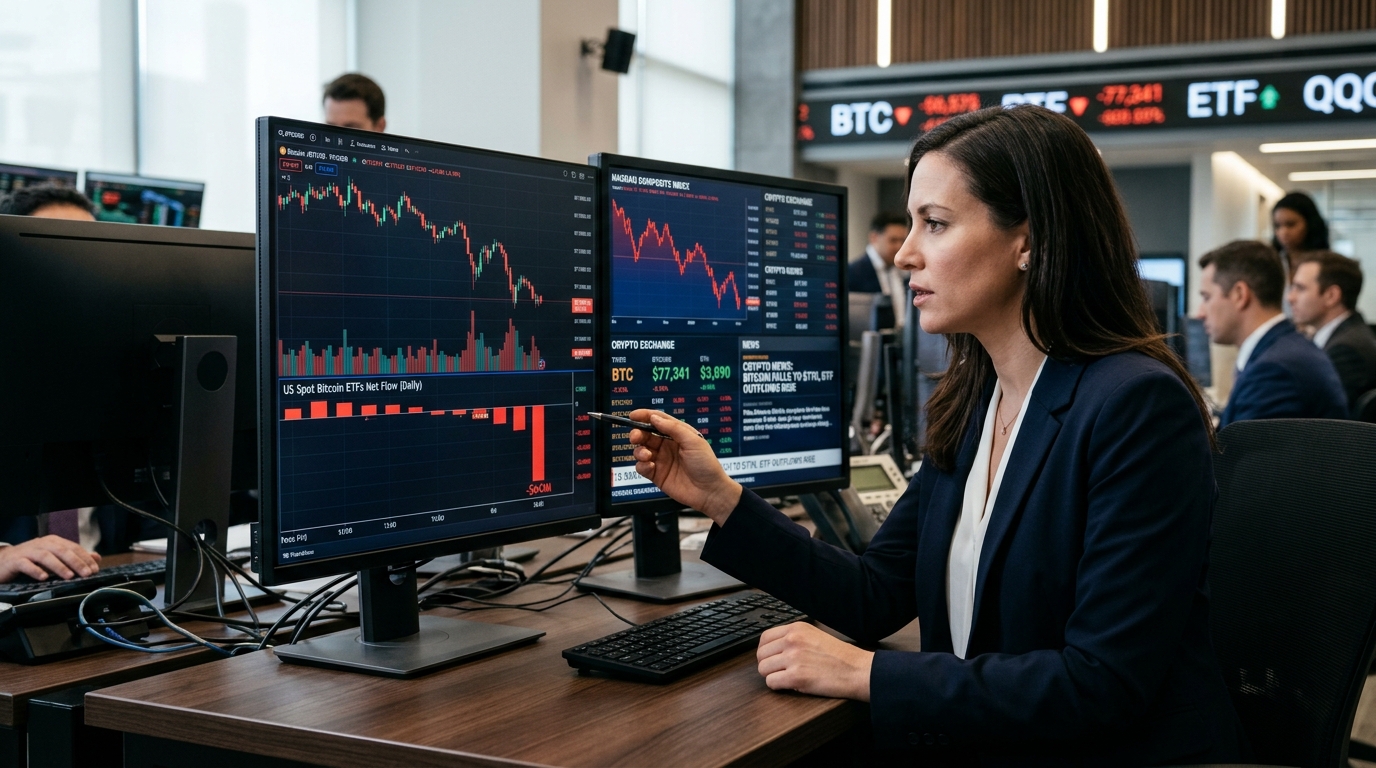
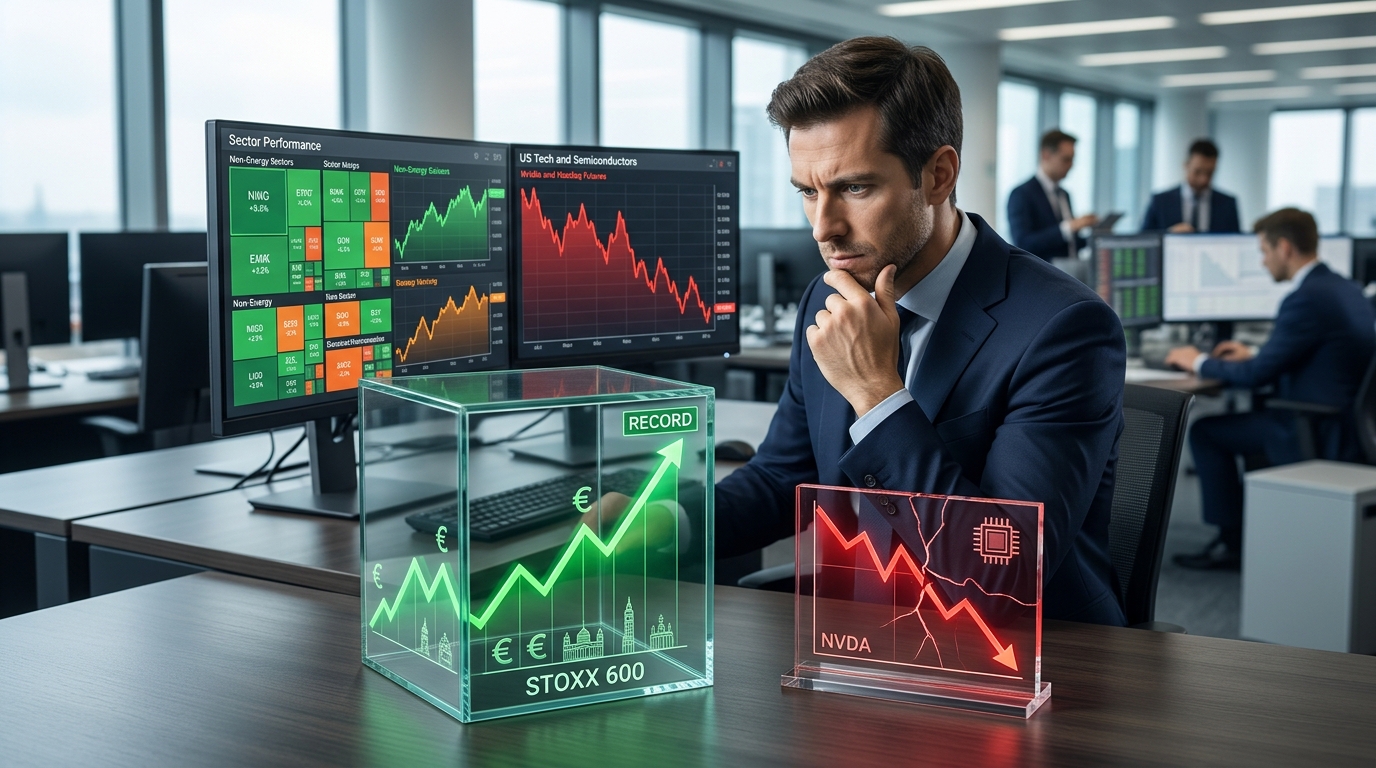
The cleanest picture of 2026’s dominant rotation showed up Thursday morning in a single split screen: the pan-European STOXX 600 pushing through its prior peak to a fresh record, building on a record close the previous session, while Nasdaq 100 futures fell about 1% and S&P 500 contracts slipped roughly 0.2% to 0.4% after Nvidia tumbled about 9% to 10% in late trading. The two moves share a cause. Capital rotating out of AI-linked names had to land somewhere, and it landed in Frankfurt and Paris.
The question worth asking before you act on that is a simple one: is Europe’s rally a genuine re-rating, or is it just what happens when the room empties out next door?
What Actually Moved
The STOXX 600 rose about 0.3% by around 08:04 GMT to surpass its previous record, after closing Wednesday at a record 663.05. Germany’s DAX gained about 1% and traded at an all-time high.
On the US side, Nvidia’s board was expected to meet to discuss Jensen Huang’s future after revelations that he had an affair with a business executive that U.S. intelligence has identified as a Chinese spy, and after reports of another extramarital relationship with Nvidia healthcare vice president Kimberly Powell. Nvidia’s central role in the AI boom has tied much of the industry’s fortunes to the chipmaker, leaving investors wary of the potential fallout from any leadership change.
Why It Happened
STOXX 600 companies are on track to report quarterly earnings growth of 25% in aggregate, up from 23.6% a week earlier, based on results from 212 companies and estimates for those yet to report. That is the strongest in four years, and two individual results today gave it momentum. Siemens rose about 3% to 4% after the industrial technology group lifted its outlook, while Merck gained about 1% to 2% after the drugmaker raised its 2026 profit guidance for a third time this year.
Allianz added to the tone: operating profit rose 7.8% to a record 14.1 billion euros for the first nine months of 2026, and the insurer raised the upper end of its full-year target range to around 18.6 billion euros.
Lower oil helped too. Investors have been relieved by oil prices easing back below $100 a barrel as the White House signaled fresh Iran attacks looked unlikely. For an energy-importing region, that is a margin story as much as a sentiment story.
What the Market May Be Missing
The 25% headline number is real, but it rests on a narrow pillar. Energy sector profits are expected to surge 153.4%, up from 139% the prior week, helped by strong refining margins and higher energy prices amid Iran-related supply disruptions. Strip energy out and the growth rate for the broader index falls to roughly high single digits, respectable but not extraordinary. The same oil price easing that lifted sentiment today also implies that this energy tailwind fades from here.
The region’s smaller exposure to AI-linked stocks has also helped it outperform Asian and US peers at a time when traders scrutinize the AI trade. That is not a durable competitive advantage. It is an absence. When AI sentiment recovers, the STOXX 600 will not capture the upside the way a Nasdaq-heavy portfolio will. Today’s outperformance owes something to what Europe does not own.
EUR/USD has been hovering near 1.11 as the dollar firmed on hotter US inflation data. A softer euro is a tailwind for European exporters’ reported earnings in domestic currency terms, which partly flatters the numbers. Investors benchmarking in dollars are getting less of that gain than the index level suggests.
Risks and Counterpoints
The bull case is straightforward: easing Iran-escalation risk has been a key driver of improving risk sentiment, particularly in Europe, and earnings resilience has been a surprise to many. Banks and insurers are compounding capital at high single-digit rates, industrials like Siemens are raising forward guidance, and the geopolitical discount that weighed on European equities for much of 2024-25 is narrowing.
The bear case is that the record is thin. Investors have taken a liking to defensives, with European healthcare and consumer-related sectors such as food and beverage, travel and leisure, and retail reporting double-digit gains this quarter, while real estate remains a drag. And markets continue to assess higher-than-expected US inflation data, which has increased expectations of a Federal Reserve rate increase in December, a move that could strengthen the dollar further and pressure capital flows back toward US assets.
What to Watch Next
Three things will determine whether today’s record holds. First, any confirmed decision on Jensen Huang’s future at Nvidia: a clean resolution stabilizes AI sentiment and reduces the rotation pressure that has benefited Europe. Second, the next LSEG earnings update on STOXX 600 ex-energy growth, which will show whether the breadth of this season is real or concentrated. Third, the December Fed meeting outlook, particularly any shift in rate expectations following this week’s US inflation data. If the dollar strengthens materially from current levels near 1.11, some of this quarter’s European outperformance will reverse in currency-adjusted terms before a single share changes hands.