

For a while now, I’ve been showing regular traders like you how to take advantage of a specific 60-minute window…
One that lets us go after 50% returns every morning – whether the market opens higher… or lower.
Here’s what I mean…
If you had spotted this 60-minute opportunity yesterday morning… all you would’ve had to do was place a quick trade before 10 am…
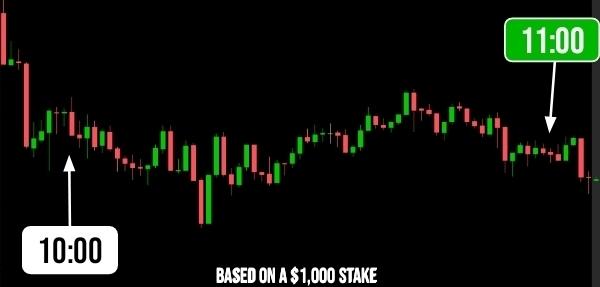
Went ahead with your morning plans and when you return a couple of minutes later, there’s a good chance you’d find $500 in extra income sitting in your account (on a 1k stake)
It wouldn’t have mattered what happened with the overall market… this 60-minute window would have been all you needed to target cash.
Today? Same story.
Place a quick trade, grab your coffee… and let the setup do the heavy lifting.
And just 60 minutes later… come back to what could be a nice $500 in extra income sitting in the brokerage account.
I designed the setup to be that straightforward.
Granted, there will be trades that won’t work out
But if you want in?
Green Energy Stocks Popped 10%. Now Comes the Hard Part.

Hey there, bargain hunter. Democrats swept both chambers last week and clean energy stocks threw a party. Plug Power surged 10.6%, Sunrun jumped 8.6%, First Solar gained about 8%, and Bloom Energy added 5.8% in a single session. Beautiful numbers. Now let’s figure out what they actually mean.
The Scoreboard
Renewable energy stocks rallied around the world after Democrats won control of both chambers of Congress, an outcome seen as supporting more favorable policy for the industry. Renewable stocks also benefited from a rotation away from stocks tied to artificial intelligence. So some of this move is policy optimism. Some of it is just money looking for a new home.
What the Market Is Pricing In
Barclays analysts wrote that the midterm result eases political risk on U.S. renewables, noting it “potentially reduces the risk of further political interference with renewable energy incentives and provides greater protection for the long-term economics of U.S. wind, solar and battery storage investments.”
That framing is correct but incomplete. The political risk has been reduced. It has not been eliminated, and the structural damage already done is worth pricing carefully.
The Real Problem
Here is what a Democratic Congress cannot undo with a midterm win alone. The One Big Beautiful Bill, signed July 4, 2025, rolled back and accelerated deadlines for multiple clean energy tax incentives that had been expanded under the Inflation Reduction Act. Rhodium Group’s Clean Investment Monitor has identified $522 billion of announced clean energy investments that were still outstanding as of Q1 2025, and it has warned that a meaningful portion of that pipeline could be at risk without stable policy support.
The policy damage to wind and solar has also reshuffled which clean energy sources attract capital. Nuclear is drawing renewed investor attention precisely because its economics do not depend on the same tax-credit windows now under threat.
On wind and solar in particular, the law created an accelerated eligibility window for the technology-neutral credits: for projects that begin construction after July 4, 2026, the credits generally require the project to be placed in service by December 31, 2027 to qualify. Congress would need a majority willing to broaden that window and a president who would sign the bill. Democrats have the first part. They do not have the second.
What they do have is blocking power. Even with the Trump administration’s concerted efforts to unwind much of the roughly $1.6 trillion in spending and tax breaks associated with the Bipartisan Infrastructure Law and the IRA, Politico reported that about $600 billion in direct federal outlays remained available. A Democratic Congress can protect that pipeline.
Is It Cheap?
A Morningstar analyst noted that the gains had more to do with sentiment than with any concrete proposals. That is the honest read. Sentiment trades can run further than logic suggests, but they also reverse faster.
First Solar trades at roughly 8x forward earnings after the spike. That is not expensive, but the key question is whether a tax-credit backstop that markets once treated as durable is now permanently more fragile. Plug Power still burns cash. The sentiment pop has not changed either balance sheet.
The Action Plan
- First Solar (FSLR): Domestic manufacturing moat is real. Wait for a pullback toward $200 before adding.
- Enphase (ENPH): Residential solar demand is the swing factor; watch Q4 installer commentary before sizing up.
- Clean energy ETFs (ICLN, QCLN): Better diversification across a policy-dependent theme than single-name concentration.
Bottom Line
The midterms could improve the outlook for investors focused on clean energy. Could. The move you already missed was priced on hope. The next move will be priced on what a divided government can actually legislate. That is a slower, messier story than a one-day 10% pop suggests. Scale in on weakness; do not chase the news cycle.