November 4, 2026
Bonus Content: First Solar Has the Balance Sheet. Enphase and Sunrun Have the Hype.
For a while now, I’ve been showing regular traders like you how to take advantage of a specific 60-minute window…
One that lets us pursue asymmetric setups each morning – whether the market opens higher… or lower.
Here’s what I mean…
If you had spotted this 60-minute opportunity yesterday morning… all you would’ve had to do was place a quick trade before 10 am…
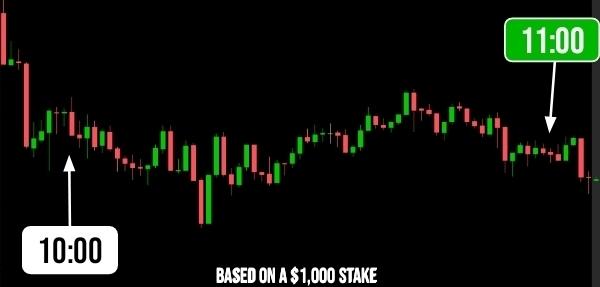
Went ahead with your morning plans and when you return a short while later, there’s a chance you’d find a target payout sitting in your account (on a 1k stake)
It wouldn’t have mattered what happened with the overall market… this 60-minute window would have been all you needed to target that outcome.
Today? Same story.
Place a quick trade, grab your coffee… and let the setup do the heavy lifting.
And just 60 minutes later… come back to what could be a meaningful return sitting in the brokerage account.
I designed the setup to be that straightforward.
Granted, there will be trades that won’t work out.
But if you want in?
First Solar Has the Balance Sheet. Enphase and Sunrun Have the Hype.
Scoreboard
Hey there, bargain hunter. Democrats swept both chambers of Congress on November 3, and the solar trade did not wait for the opening bell to react. First Solar and Sunrun climbed 11% and 8.7% on the Blue Ocean overnight platform, while Enphase and SolarEdge both advanced as much as 12%. The Stoxx Europe 600 was 0.5% higher, with Orsted rising as much as 7% and Vestas gaining as much as 5% as the Democratic wave was read as protective of the entire clean-energy supply chain. The TAN ETF followed. This was not a subtle sector rotation.
What Actually Happened
The Democrats securing control of both chambers renewed investor optimism about enhanced renewable energy policies. The specific fear being unwound: a Republican Congress clawing back or phasing out the Inflation Reduction Act’s manufacturing and production credits. That Democratic-controlled Congress passed the IRA in 2022, devoting hundreds of billions to climate and energy-security measures. Those credits are now safer. What matters for a bargain hunter is figuring out which stocks actually deserved the bid and which just caught beta.
Deep Dive: What These Businesses Are
Four names, four different risk profiles. First Solar makes CdTe thin-film utility-scale modules at U.S. factories. Its earnings are structurally tied to Section 45X manufacturing credits. Enphase and SolarEdge sell inverters and energy management hardware into the residential and commercial rooftop market. Sunrun installs residential solar and storage systems under long-term subscriber contracts.
The Numbers That Separate the Field
Start with First Solar. Q3 2026 net sales were $1.23 billion, diluted EPS was $5.30, and the board authorized a $500 million share repurchase program. The contracted sales backlog stood at 44.0 GW as of September 30, and net cash was $1.5 billion, supported by Section 45X cash receipts and IEEPA tariff refunds. The valuation is not demanding: FSLR’s trailing P/E is about 10.7.
The honest asterisk on that earnings quality: First Solar’s 2026 guidance assumes approximately $2.10 to $2.19 billion in Section 45X manufacturing credits against guided gross profit of $2.4 to $2.6 billion, meaning those credits represent roughly 81% to 91% of guided gross profit. Policy continuity is not a tailwind for FSLR. It is the product.
Now Enphase. Revenue tells the other story. Revenue fell 29% year-over-year to $293 million in Q3 as U.S. residential demand remained soft. The balance sheet is clean, though: Enphase has said it retired $633 million in 2026 notes, and ended Q3 with about $932 million in cash and marketable securities. Free cash flow was barely positive. Management said Q4 2026 sell-through was expected to be down 10% versus Q3, which is not a demand recovery call.
SolarEdge is a turnaround in progress. Q2 2026 revenue grew 20% year-over-year to $346.2 million, and the company returned to non-GAAP operating profitability for the first time since Q2 2023. Net cash and investments grew by $20.4 million to $264.6 million as of June 30. Real improvement, but free cash flow in Q2 was just $3.1 million. The runway to self-funded growth is narrow.
Sunrun carries the heaviest structural load. Non-recourse debt stood at about $1.4 billion as of June 30, 2026. That is asset-backed by its subscriber fleet, so it is not an apples-to-apples compare with the others, but rate sensitivity is real. Full-year 2026 Cash Generation guidance started at $250 to $450 million, but the company reduced it to $200 to $375 million in its Q2 2026 update. The business model works; the balance sheet does not forgive rising financing costs.
Rate sensitivity is not unique to U.S. residential solar. European offshore wind developers have been selling equity stakes in major projects to manage balance-sheet pressure from rising financing costs.
Is It Cheap?
First Solar trades at roughly 10x trailing earnings with $1.5 billion in net cash, a 44 GW backlog, and policy risk now materially reduced. The 45X dependency is a known risk, not a hidden one. Among the four, FSLR offers the best combination of valuation, liquidity, and confirmed revenue visibility.
Enphase has a clean balance sheet and negative revenue momentum. At today’s pop, you are paying for a recovery that the company has not guided for in 2026. SolarEdge is improving but thinly capitalized. Sunrun’s leverage makes it a high-octane policy play, not a balance-sheet story.
Bull / Base / Bear
- Bull: Democratic Congress extends and expands 45X credits; residential demand recovers in 2027 as rates ease; FSLR converts backlog at higher ASPs; ENPH battery launch drives a volume inflection.
- Base: Credits survive intact; U.S. residential solar demand stays flat through mid-2027; First Solar ships into contracted backlog without meaningful pricing upside; SEDG’s turnaround continues slowly.
- Bear: A Trump veto blocks any new legislation; 45X phase-down timeline accelerates under budget pressure; Chinese module oversupply compresses U.S. pricing; Sunrun’s financing costs rise faster than subscriber value.
Action Plan
Do not chase the whole basket. FSLR is the one name where today’s policy bid reduces a known overhang on a business with real cash, real backlog, and a P/E below its own history. That is a clear buy on a pullback, not a gap-open chase. The combination of a clear political catalyst and a sector-wide re-rating has converged to push First Solar sharply higher. Scale in if it gives back half the day’s move.
Policy catalysts can mask the difference between a re-rating and a real business inflection. Bloom Energy’s stock fell even after doubling revenue, showing how a gap between results and market reaction is where the valuation question actually lives.
Enphase and SolarEdge are holds for existing positions; both have defensible balance sheets but no demand catalyst confirmed for 2026. Sunrun is a speculative position only, sized for the leverage risk it carries.
Cheap Investor Checklist
- FSLR net cash balance: target $1.5B or above through year-end
- Section 45X credits: watch for any 2027 legislative amendment language
- FSLR backlog conversion: does 44 GW turn into shipments and cash, or does it slip?
- ENPH U.S. residential sell-through: any sequential improvement in Q4 is the trigger
- SEDG free cash flow: needs to clear $10M per quarter consistently to justify the rally
- Sunrun Cash Generation: holds the $200M floor in 2026 guidance; a miss re-opens the leverage question
- Vestas and Orsted: European sentiment proxy; fades here signal the U.S. policy bid cooling
- TAN ETF relative strength vs. QQQ: policy premium persisting or eroding
Bottom Line
If Section 45X credits remain intact, First Solar at a sub-11x P/E with $1.5 billion in net cash and 44 GW under contract is the only solar name in this group where the balance sheet independently funds the recovery. Enphase, SolarEdge, and Sunrun all rallied today on the same policy catalyst, but none of the three can point to the same combination of liquidity, contracted revenue, and valuation discount. Buy the fortress; rent the rest conditionally.