
October 3, 2026
Bonus Content: Idle Delivery Vans Can Earn Thousands Selling Power Back
Editor’s Note: Jeff Brown is the former tech executive who picked Nvidia in 2016 before it jumped 37,000% higher. He’s now recommending another AI stock that’s the same size Nvidia was 10 years ago. He calls it “Elon Musk’s One Stock Retirement Plan” because he believes Elon Musk is about to create massive demand for this company’s patented technology. Click here to see the details or read more below.
Dear Reader,
Sometimes you come across an opportunity so explosive…
That it has the potential to turn a small stake…
Into a six figure and in some rare cases even a seven-figure nest egg…
Like it happened when I picked Nvidia in 2016.
It jumped high enough to turn $5,000 into an entire retirement nest egg of $1,895,000.
And while I can’t guarantee you’ll become a millionaire…
I think this little-known AI stock is one of those opportunities…
Which is why I call it “Elon Musk’s One Stock Retirement Plan.”
Now, if this idea of retiring with a single stock sounds crazy to you…
You should know that some of the best investors in the world believe that the idea of diversification is a little overrated.
Stanley Druckenmiller said…
“You don’t get rich by diversifying into 50 mediocre assets. You get rich by finding two or three asymmetric home runs.”
I believe this stock is an asymmetric home run.
Or listen to legendary investor Peter Lynch. He said…
“I would own one stock if I can find one great stock.”
Even Warren Buffett said…
“Diversification is protection against ignorance. It makes little sense if you know what you are doing.”
Click here now and I’ll show you why I believe this stock might be the only one you need to retire.
Jeff Brown,
Founder & CEO, Brownstone Research
P.S. If I could buy only one stock, this would be it… it might just be the perfect tech stock.
It’s a leader in an AI breakthrough that’s protected by 150 patents…
It’s a small company, unknown to most people… still in the initial phase of exponential growth…
Plus, it has a near term catalyst that could send shares skyrocketing… starting November 11.
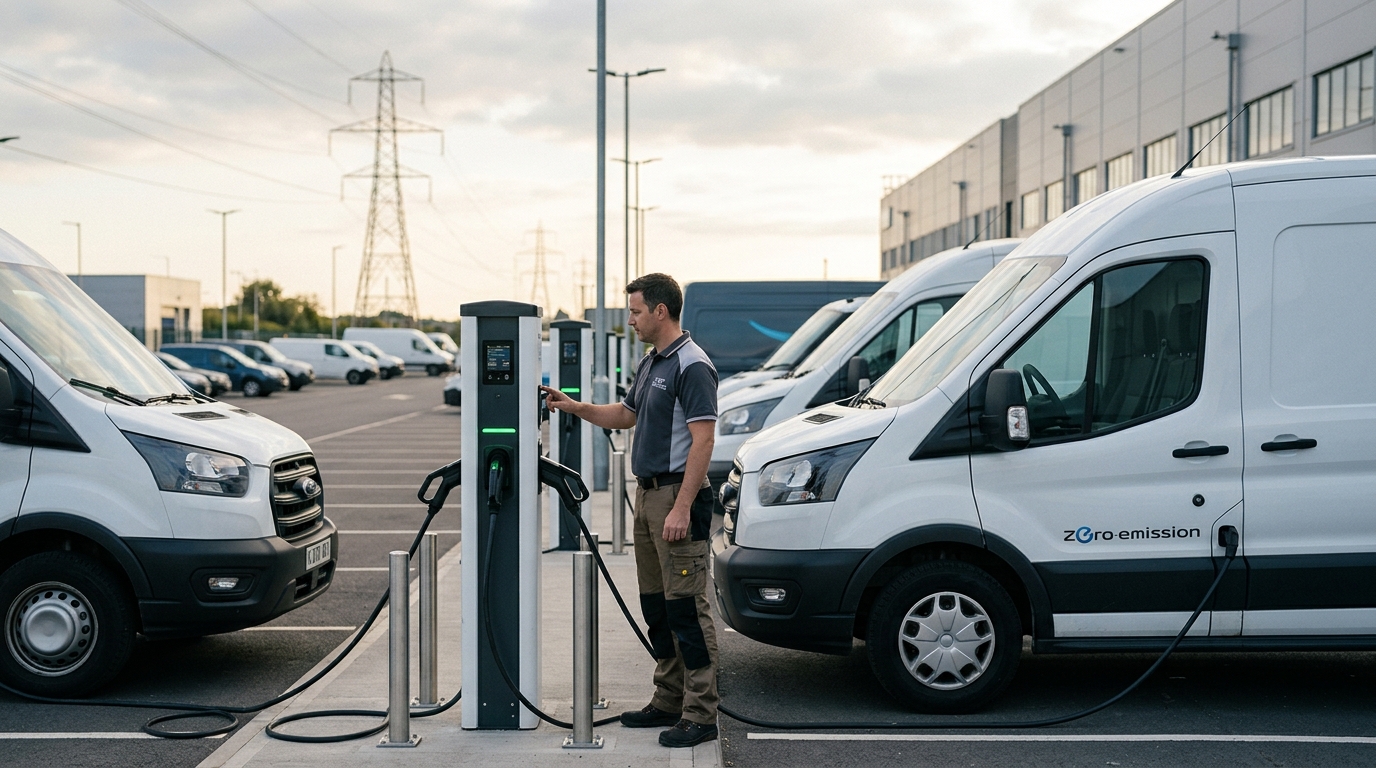
Idle Delivery Vans Can Earn Thousands Selling Power Back
Hey there, bargain hunter. The story everyone tells about vehicle-to-grid is simple: park the van, sell the electrons, collect a check. The honest version is messier, and that gap is where the real opportunity hides.
Scoreboard
Fleet and commercial V2G is scaling faster than residential, driven by predictable schedules, larger batteries (roughly 100 to 250 kWh for many medium and heavy-duty use cases), and higher utilization rates. Nuvve has publicly tied real-world school bus deployments to Thomas Built Buses, but the widely repeated claim that these programs are already earning $2,000 to $5,000 per bus per year is not consistently documented in primary sources. Treat “low-thousands per vehicle per year” as plausible in the right markets, but not universal and not guaranteed.
What Actually Happened
Heavier fleet vehicles could earn over $9,000 per year per vehicle under research best-case conditions, based on analyses using recent market prices and optimistic operational assumptions. The key word is best-case. The bigger, more reliable point is operational: company fleet vehicles spend a large share of their time parked, and that idle time is the feedstock for the entire revenue model.
Commercial fleets can represent one of the highest-density concentrations of bidirectional-capable assets. A single electrified logistics depot with 100 bidirectional-ready vehicles can aggregate several megawatt-hours of dispatchable capacity, which in some markets may be enough to bid into utility and ISO/RTO programs for ancillary services and peak demand reduction. Whether it can actually participate depends on interconnection, program rules, and whether an aggregator has an approved pathway for that service.
The Three Revenue Lines
- Frequency regulation: Fast response to grid frequency changes. This can be a high-value V2G service, but the “$2,000 to $5,000 per vehicle per year” figure varies sharply by market design, rules, and saturation. Treat it as a scenario range, not a baseline.
- Energy arbitrage: Buying electricity at low overnight rates, storing it, and reselling when prices rise. European day-ahead and retail time-of-use spreads can sometimes reach the rough ballpark of €0.15 to €0.30 per kWh in volatile periods, but those spreads are not steady, and round-trip efficiency plus fees can eat much of it.
- Peak demand reduction: A logistics depot can use fleet battery banks to reduce facility peak load and potentially avoid demand charges. In some regions, it can also sell grid services, but the tariff and program plumbing is the deciding factor.
The Catch Nobody Leads With
Battery wear costs are often modeled around roughly $0.05 to $0.10 per kWh of throughput, depending on chemistry, temperature, depth of discharge, and the replacement cost you assume. Many research models also find calendar aging can be the dominant driver of degradation for lightly used batteries, with V2G cycling adding a smaller increment under constrained operating windows. Net that out and the economics can still work, but they are thinner than the headline numbers imply.
Geography matters enormously. A McKinsey fleet V2X analysis shows outcomes can swing widely by utility territory and use case, but it does not support the specific claim that school bus revenue is $1,000 to $2,000 annually in Georgia versus $15,000 to $16,000 in Virginia. The actionable takeaway stands: same vehicle, radically different return depending on the local market rules and prices it plugs into.
Who Owns the Infrastructure Play
Nuvve (Nasdaq: NVVE) announced in April 2025 that it acquired substantially all of the net assets of Fermata Energy. The combined platform adds more deployed know-how and IP, but the financial reality still matters. For example, in the company’s third quarter of 2025, total revenue was $1.60 million, and the company has historically reported multi-million-dollar quarterly operating losses and ongoing funding needs. Vision is real. The income statement is not there yet.
Cheap Investor Scorecard
- Revenue per vehicle per year (target: above $2,000 to justify hardware)
- State utility tariff framework: does your market have one?
- Battery degradation cost offset vs. gross V2G receipts
- Aggregator contract terms: minimum state-of-charge buffer protecting dispatch availability
- NVVE cash burn vs. revenue trajectory (watch quarterly)
Bottom Line
If you operate a depot fleet in a state with an active ancillary service market and a clear participation pathway, V2G can be a real, spreadsheet-defensible revenue line today. If you are buying NVVE as a pure V2G play, the technology is credible but the business model is still losing money and regularly needs financing. Wait for the revenue-to-burn ratio to close before sizing up.