The question worth asking this week is not whether nuclear power matters to artificial intelligence. It clearly does. The question is which businesses actually collect money from that connection, and when.
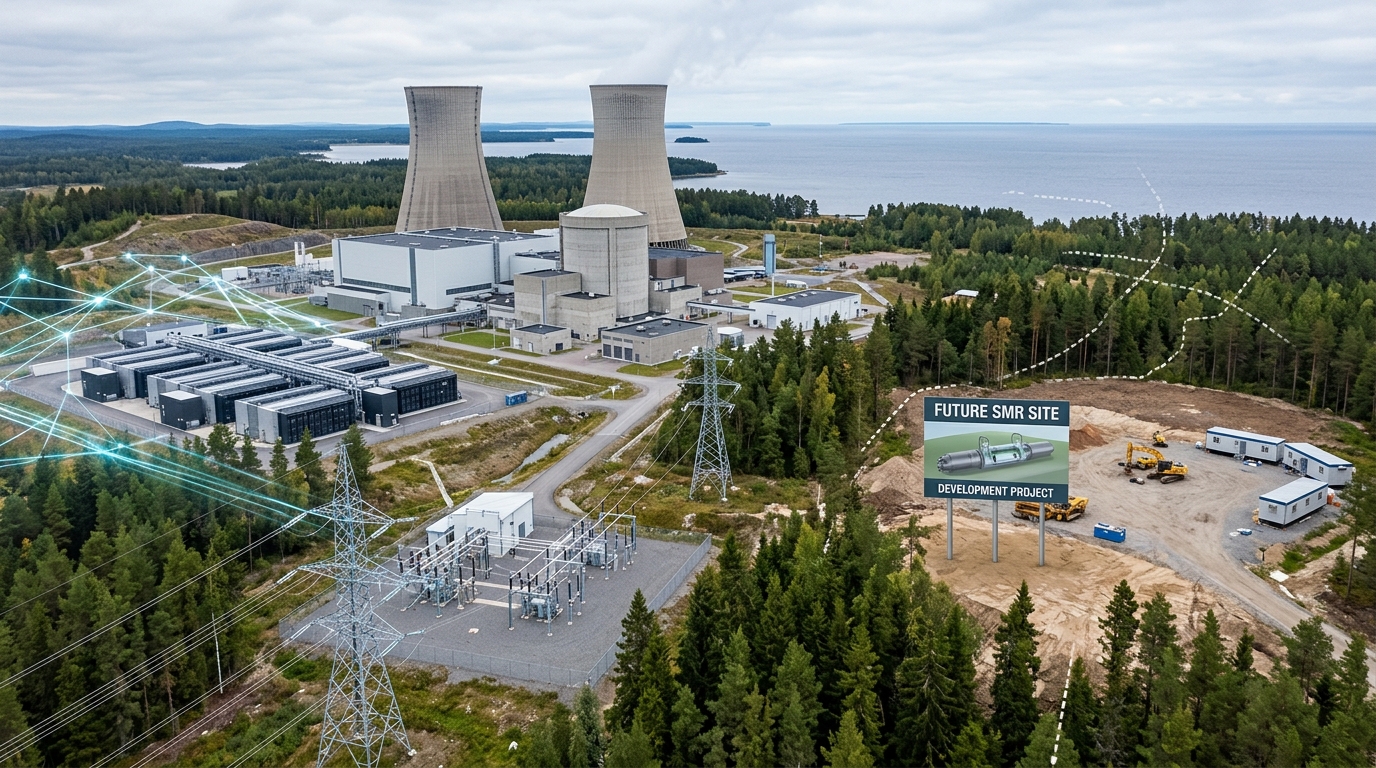
Tuesday’s answer came from Helsinki. A deal between Alphabet’s Google and Nordic utility Fortum, described by Fortum as a landmark 22-year partnership, will help unlock roughly €1 billion of investment needed to keep a nuclear power plant in Finland running for decades to come. As part of a €13 billion investment plan on AI infrastructure in Finland, Google agreed to buy up to 50% of the capacity from the Loviisa nuclear power plant, paving the way for the plant to keep running through the end of its operating license in 2050.
The structure is worth studying. Fortum said the plant could not continue operating beyond 2030 without this investment. The Google agreement provides revenue certainty for that work, intended to keep the plant running through 2050. Fortum said the deal is expected to lift its group comparable return on net assets by approximately 1.4 percentage points over time once half of the plant’s output is contracted. Fortum’s shares rose about 10% on the news. A creditworthy buyer with a 22-year commitment changed the economics of a €1 billion spending program overnight.
This is the model that is actually working. Constellation Energy and Vistra are two major players in U.S. nuclear power, and both are running the same playbook: leaning on nuclear as the crown-jewel asset for the AI data center build-out, while simultaneously bulking up on natural gas to add flexible capacity faster than new nuclear could ever be built. In the second quarter alone, Constellation signed roughly 920 megawatts of long-term nuclear contracts with corporate customers, averaging 18.5 years, locking up about 30% of its clean baseload output. These are operating plants, contracted today, generating revenue.
Friday told the other side of the story. NuScale Power stock crashed 13.5% through 2 p.m. ET. UBS analyst Jon Windham downgraded NuScale from neutral to sell and slapped a $6 price target on the stock. UBS grounded its bearish thesis in three interlocking failures: a construction timeline extending more than five years, the complete absence of firm customer commitments, and projected cash consumption of approximately $700 million from 2026 through 2028.
The bank now models only one NuScale project breaking ground in 2028. Stalled progress on the RoPower joint venture in Romania and limited movement on a nonbinding collaborative agreement with the Tennessee Valley Authority amplified the bear case. UBS calculates that the market is currently embedding $124 million in 2028 EBITDA expectations, while the firm’s own estimate sits at merely $29 million. This substantial disconnect forms the foundation of the Sell rating.
Oklo slipped in sympathy but held its ground better. UBS’s relative argument is that competing small modular reactor developers reach the construction stage sooner than NuScale, which concentrates the pressure at the NuScale name inside a group otherwise close to unchanged. Oklo ended its second quarter with about $3.0 billion in cash and marketable securities, giving it a meaningful cushion. That is a more defensible position, though Oklo too has no operating megawatts and no signed power offtake agreements with a hyperscaler.
The discipline worth applying here is the same one the Google-Fortum deal illustrates: a long-duration power purchase agreement is what converts nuclear’s promise into investable cash flow. A two-decade purchase commitment from a creditworthy buyer changes the calculation on capital spending. Fortum knew that. Constellation and Vistra have structured their businesses around exactly that principle. NuScale, as UBS argues, has not yet found the buyer who signs that paper.
Investors drawn to nuclear as an AI theme should be precise about what they are buying. Existing fleet operators with contracted capacity and rising earnings are a different proposition from pre-revenue developers burning through cash while timelines extend. The Finland deal is a reminder that in the power build-out behind artificial intelligence, the businesses getting paid today are the ones who already own the electrons.