
September 7, 2026
Bonus Content: Macy’s Land Is Worth More Than Wall Street Thinks. RH Needs a Housing Thaw to Prove Its Price.
Dear reader,
Most investors wait for the government press conference.
I follow the money before the cameras show up.
And the money trail now leads straight to one tiny nickel stock.
Its U.S. platform has already been selected for $135.4 million in disclosed federal grants: $114.8 million tied to a domestic processing facility and another $20.6 million supporting exploration in Minnesota and Michigan.
That is not a prediction. That’s money already disclosed.
The next step is my forecast: I believe Washington could eventually go further and take an equity stake.
It may never happen. But the U.S. has already shown it is willing to put taxpayer capital directly into strategic mineral companies. And this company now controls the only primary nickel mine operating in America.
Meanwhile, Tesla has locked in a six-year supply agreement, and America remains dangerously exposed to foreign nickel supply.
Russia, China, and Indonesia have leverage because the United States allowed its domestic pipeline to wither.
This little company is one of the few credible ways to fight back.
That’s why I bought 10,000 shares before any equity announcement.
I am not promising Washington will buy in. I am saying the grants, the operating mine, the Tesla agreement, and the strategic pressure form a setup I refuse to ignore.
Click here to learn more about the $5 nickel stock I believe Washington could target next.
Yours for peace, prosperity, and liberty, AEIOU,
Dr. Mark Skousen
Macroeconomic Strategist, The Oxford Club
P.S. Washington has already backed this platform with $135.4 million in disclosed grants.
If an equity stake comes next, I believe a stock this small could move violently.
I refuse to wait for the press conference.
Click here to reveal details on what I bought before Washington makes its next move.
Macy’s Land Is Worth More Than Wall Street Thinks. RH Needs a Housing Thaw to Prove Its Price.
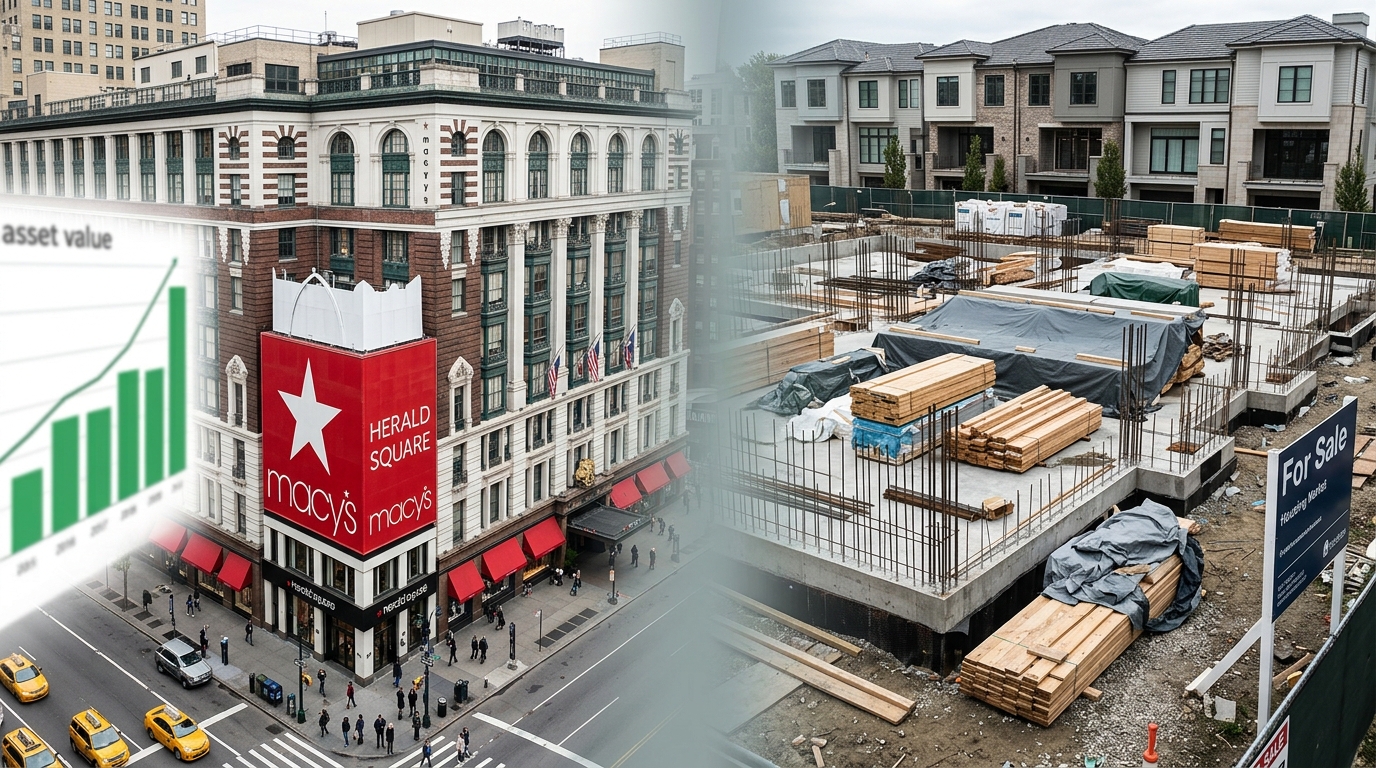
Hey there, bargain hunter. Thursday morning, September 10, two very different retailers report into the same broken backdrop: Macy’s before the bell, RH after the close. One owns prime real estate that Wall Street perpetually undervalues. The other is a bet on a housing market that, by most honest counts, is still frozen solid. Neither is a gimme. Both deserve your attention.
Scoreboard
Consumer discretionary has been among the S&P 500’s worst-performing sectors in 2026. Nike has shed 38% year-to-date, and it hit a 12-year closing low of $39.09 on August 17, 2026. It has since traded even lower, with a $38.50 close on September 4. Lululemon just guided Q3 EPS to $0.93 to $0.98 against a $2.41 consensus and cut full-year revenue to a range implying a 5% to 7% decline. The sector’s problems are not subtle. And into that rubble walk Macy’s (M) and RH, both printing quarterly numbers on the same Thursday.
What Actually Happened Before Thursday
Macy’s Q1 was genuinely good. Macy’s, Inc. comparable sales rose 3.0%, the strongest first quarter in four years. Macy’s nameplate comparable sales rose 1.6%. Bloomingdale’s delivered 10.2% comp growth. The company ended the quarter with $1.3 billion in cash. Management then guided full-year adjusted EPS of $2.00 to $2.20.
RH guided Q2 revenue to $903 million to $922 million, a reset from prior annual guidance that ran as high as $3.71 billion. The company’s full-year fiscal 2026 outlook calls for revenue growth of 4.5% to 8%, adjusted EBITDA margin of 14.2% to 16%, and free cash flow of $300 million to $400 million. That is the target on Thursday’s page.
The Real Reason This Week Matters
August was brutally expensive at the U.S. pump. AAA had the national average at $4.08 a gallon on August 31, and Labor Day weekend pricing has been described as record-high in nominal terms. Consumers paying around $4 a gallon are not shopping for $6,000 sofas or impulse-buying fashion at the mall. The macro context for both Thursday reports is as hostile as it gets for discretionary spending.
Yet here is the distinction that matters to a bargain hunter: Macy’s is not purely a retail bet. It is a real estate play wearing a department store’s name tag.
Deep Dive
Macy’s: The company owns significant real estate across roughly 350 go-forward stores, and analysts have pegged the full portfolio at $5 billion to $11 billion depending on timing and market conditions. The Herald Square flagship alone has been valued by various analysts at $1 billion or more. CEO Tony Spring has explicitly said the frame for every store is “value to operate versus value to close.” The company has already closed 64 locations and has roughly 65 still to address, with the plan extended to 2028 so management can wait for better real estate market conditions rather than fire-sale assets. That optionality has cash value that the stock price rarely fully reflects.
RH: RH sells high-end furniture and home furnishings through design galleries, sourcebooks, and integrated hospitality. Its business is structurally tethered to home sales because people who move buy furniture. The NAR reported existing-home sales at a seasonally adjusted annual rate of 4.06 million in July. Mortgage rates remain around 6.5%, and Raymond James called the market “frozen between sellers unwilling to give up low rates and buyers struggling to absorb today’s financing costs.”
Data to Watch Thursday
- Macy’s Q2 comp sales: Guidance was flat to +1%. A beat matters more than the number itself given Q1’s 3.0% company-wide surprise.
- Macy’s gross margin: Guided at 6.9% to 7.2% EBITDA margin, with 20 to 40 basis points of tariff drag.
- Macy’s real estate proceeds: Any update on asset sales toward the 2028 timeline.
- RH Q2 revenue: Guided at $903 million to $922 million. Demand growth (which leads revenue) is the number Gary Friedman will lead with.
- RH adjusted EBITDA margin: Full-year target is 14.2% to 16%, but international pre-opening costs pressure Q2 by as much as 380 basis points.
- RH guidance tone: Any language on housing inflection or second-half acceleration is the real tell.
Is It Cheap?
Macy’s trades at a low single-digit forward earnings multiple, which sounds compelling until you remember the retail business itself is barely growing. The compelling argument is the one that does not show up in the income statement: the land and buildings. If the company eventually surfaces even half the conservative $5 billion estimate for its real estate against a market cap that has traded well below that figure, buyers at today’s price get a meaningful margin of safety.
RH is harder. Its fiscal 2025 revenues were $3.44 billion with about $125 million in net income. At a still-elevated multiple, the stock is pricing in a housing recovery that the data does not yet support. Zillow’s own forecast has existing-home sales at just 3.73 million for 2026, barely up from last year. If that freeze persists, RH is not cheap by any traditional metric.
Bull / Base / Bear
Macy’s Bull: Comps beat again, real estate monetization accelerates, and the market begins pricing the asset base rather than just the retail income stream.
Macy’s Base: Comps land inside guidance, margins hold, and the stock treads water while management patiently unlocks property value toward 2028.
Macy’s Bear: Consumer spending cracks further under $4 gas and tariff pressure, comps go negative, and real estate sales stall in a weak transaction market.
RH Bull: Mortgage rates break below 6.5%, home sales volumes tick toward 4.5 million, and RH’s European gallery expansion provides a second revenue engine.
RH Base: Housing stays stuck, RH grows modestly via new galleries, and the stock goes nowhere for another year while management waits for the thaw.
RH Bear: Housing volumes soften further, tariff costs compound, and RH’s high fixed-cost gallery model produces margin compression at a valuation that leaves no room for error.
Action Plan
On Macy’s: watch Thursday’s comp line first. If it beats flat-to-1% guidance, consider a starter position sized for the real estate optionality, not for the department store business. Scale in on any post-earnings weakness toward the lower end of its 52-week range. The real estate floor makes the downside case harder to make than the stock’s multiple suggests.
On RH: do not chase ahead of the print. The report lands after the close Thursday. If Gary Friedman’s letter includes concrete language about second-half demand acceleration and margin recovery, reassess. Until mortgage rates show a clear directional move below 6.5%, a full position is a bet on a macro catalyst that does not exist yet. A small, patient starter is fine. A full position is not.
Cheap Investor Checklist
- Macy’s Q2 comps: beat, meet, or miss the flat-to-1% guide?
- Macy’s gross margin: does tariff drag stay within the guided 20 to 40 basis points?
- Macy’s real estate: any update on sale proceeds or 2028 timeline?
- Macy’s cash: stays above $1 billion with buybacks continuing?
- RH Q2 revenue: does it land inside $903 million to $922 million?
- RH demand growth: does Friedman’s letter show demand outpacing revenues, as it did in prior quarters?
- RH EBITDA margin: does international drag stay within guided range?
- RH second-half guidance: any concrete signal of housing or demand inflection?
- Housing data: watch August existing-home sales (due later in September) as the confirming or denying data point for RH’s thesis.
- Sector sentiment: does Lululemon’s 17% post-earnings crash infect the rest of XLY into Thursday’s opens?
Bottom Line
If Macy’s comps hold at or above guidance, the real estate story does the rest of the work for patient holders. If RH’s Friedman signals demand is building faster than revenues, the housing thaw may be closer than the macro data implies, and the stock gets interesting. If both reports disappoint, you have your answer: the sector’s problems are not company-specific. They are the $4-a-gallon, 6.5%-mortgage-rate, frozen-consumer world every bargain hunter is navigating right now.