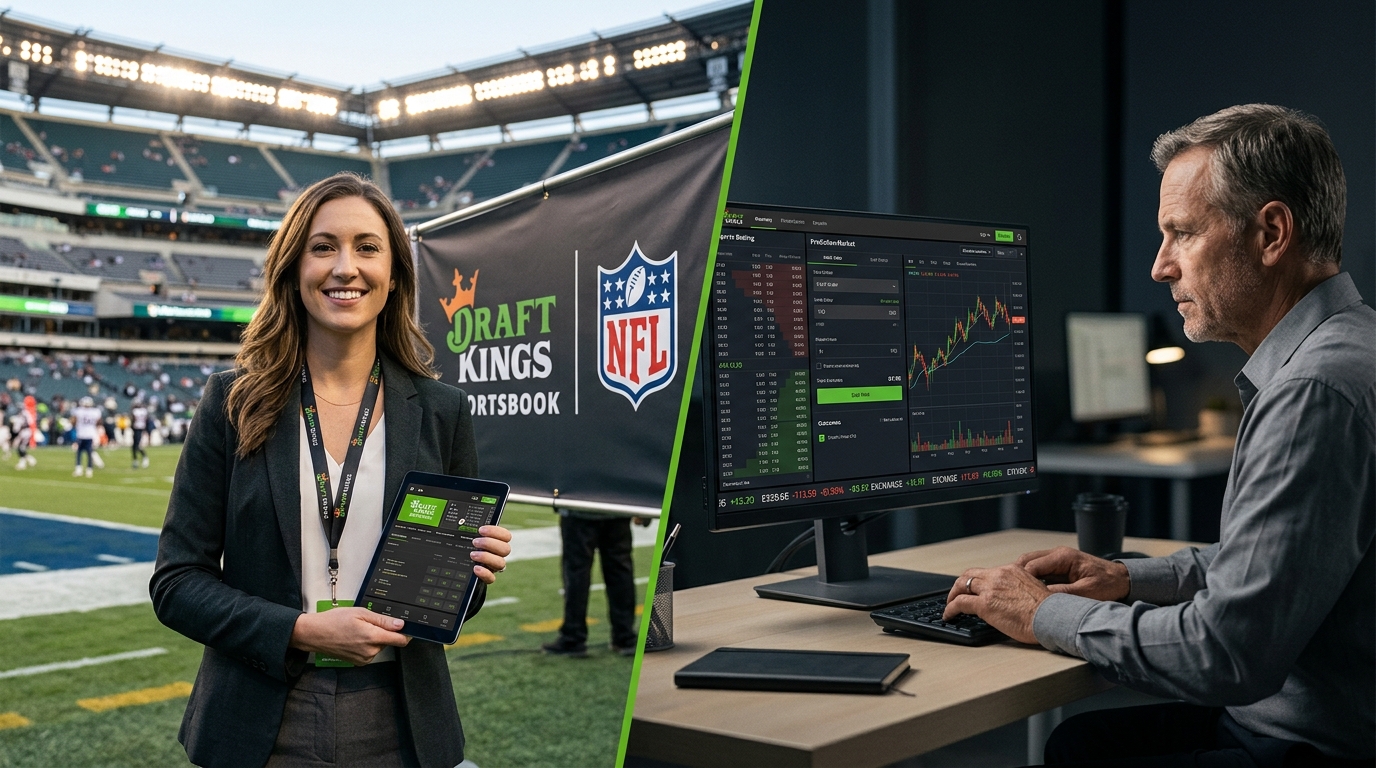
Here is the odd position DraftKings finds itself in as the NFL season opens September 9: it just renewed an official sponsorship with America’s most-watched league, securing logo rights and in-broadcast advertising. The contract pointedly does not cover DKeX, its own in-house prediction market exchange. So DraftKings paid for a billboard it cannot legally use to promote the product that may decide whether this company is worth owning.
Days before the opening kickoff, the NFL renewed sponsorship agreements with DraftKings, FanDuel, and newly added Fanatics, leaving prediction market platforms Kalshi and Polymarket out entirely. Notably, the sportsbook deals do not extend to the companies’ prediction-market operations. DraftKings holds a seat at the table. Its fastest-growing product does not.
Two Businesses, One Ticker
The sportsbook is the legacy engine. Q2 revenue came in at $1.443 billion, missing estimates of $1.51 billion, with sales and marketing costs rising to about $322.5 million as the company invested aggressively behind its Predictions launch. The company reported adjusted EBITDA of $115 million, down from $301 million a year earlier. The stock has shed about 25.8% year to date and sits around $26.
The exchange is the new bet. A number of widely circulated market-share and early-volume figures for DKeX and parlay activity were not verifiable from primary, on-the-record sources. What is verifiable is the direction of travel: DraftKings has now formally launched DKeX, bringing exchange infrastructure in-house rather than relying entirely on third-party venues.
DraftKings Predictions is registered with the CFTC as an introducing broker, while DKeX operates through Railbird Exchange, a CFTC-designated contract market DraftKings acquired in October 2025, using Railbird’s technology and federal license. The structure matters because it separates the exchange from the state-by-state sportsbook regime entirely, giving the exchange access to a wider footprint than the traditional wagering product.
The Margin Question
Exchange economics are structurally different from sportsbook economics. A regulated exchange earns fees on matched contracts regardless of which side wins. The sportsbook takes the other side of the bet. When the Knicks won the 2026 NBA title and World Cup results ran against the book, DraftKings Q2 revenue fell 5% year over year, partly explained by customer-friendly sports outcomes and increased promotional reinvestment tied to acquiring new customers on both Sportsbook and Predictions.
The exchange doesn’t carry that exposure. The thesis is that NFL prediction markets run through a vertically integrated exchange embedded in an app used by millions of existing DraftKings customers, with no third-party exchange fees and built-in distribution. If that plays out, DKeX margin should look nothing like the sportsbook. But the two businesses currently report as one.
What the NFL Divide Actually Reveals
The NHL and MLB have signed official agreements with prediction market operators, including Polymarket. And Genius Sports has announced partnerships with both Kalshi and Polymarket. The league’s own data partner works with the platforms the league refuses to sponsor. That contradiction will not hold indefinitely. It feels increasingly inevitable that the NFL will open to prediction markets once the financial math becomes impossible to ignore.
When that happens, DraftKings is one of the only sportsbook operators that already has the exchange infrastructure to compete natively. Kalshi commands significant volume today. But Kalshi is a standalone platform. DraftKings has rapidly grown Predictions inside an ecosystem that already handles billions in sportsbook volume annually.
Bull vs. Bear
The bull case: DKeX is a fee-generating exchange with near-zero outcome risk, embedded in one of the largest sports betting apps in the country, poised to expand the moment the NFL reverses course on prediction market sponsorships. Management maintained full-year 2026 revenue guidance of $6.50 billion to $6.90 billion and EBITDA guidance of $700 million to $900 million.
The bear case is equally concrete. Some of the most specific claims in the draft about analyst estimates and price-target changes could not be verified from primary, attributable research on the record. The NFL restriction compounds the uncertainty: DraftKings cannot promote its exchange product in the biggest sports advertising context of the year.
What to Watch
The Q3 report in November will be the first true read on whether DKeX can hold volume through an NFL season without the World Cup tailwind. Watch the exchange’s share of total contract volume: if parlays stay near or above that earlier 36% figure while overall volume grows, the product is working. If it fades, the exchange story reverts to a feature rather than a business. The NFL’s posture toward prediction markets at the CFTC is the longer-term variable. Until that changes, DraftKings is running two companies and getting credit for one.